On this page
The Split King adjustable bed gap problem is not only a consumer comfort complaint. For a retailer or private-label buyer, it is a system-integration risk involving two bases, two mattresses, retention hardware, bedding and the surrounding furniture. The center gap can widen when mattresses move sideways, when the bases are not held in the approved relationship, or when the selected mattress edges do not remain stable during articulation. A credible OEM specification must define how the complete system controls those variables.
This guide converts a visible retail complaint into engineering checks that can be used during RFQ, sample approval and installation planning. It does not promise that one accessory can eliminate every gap.
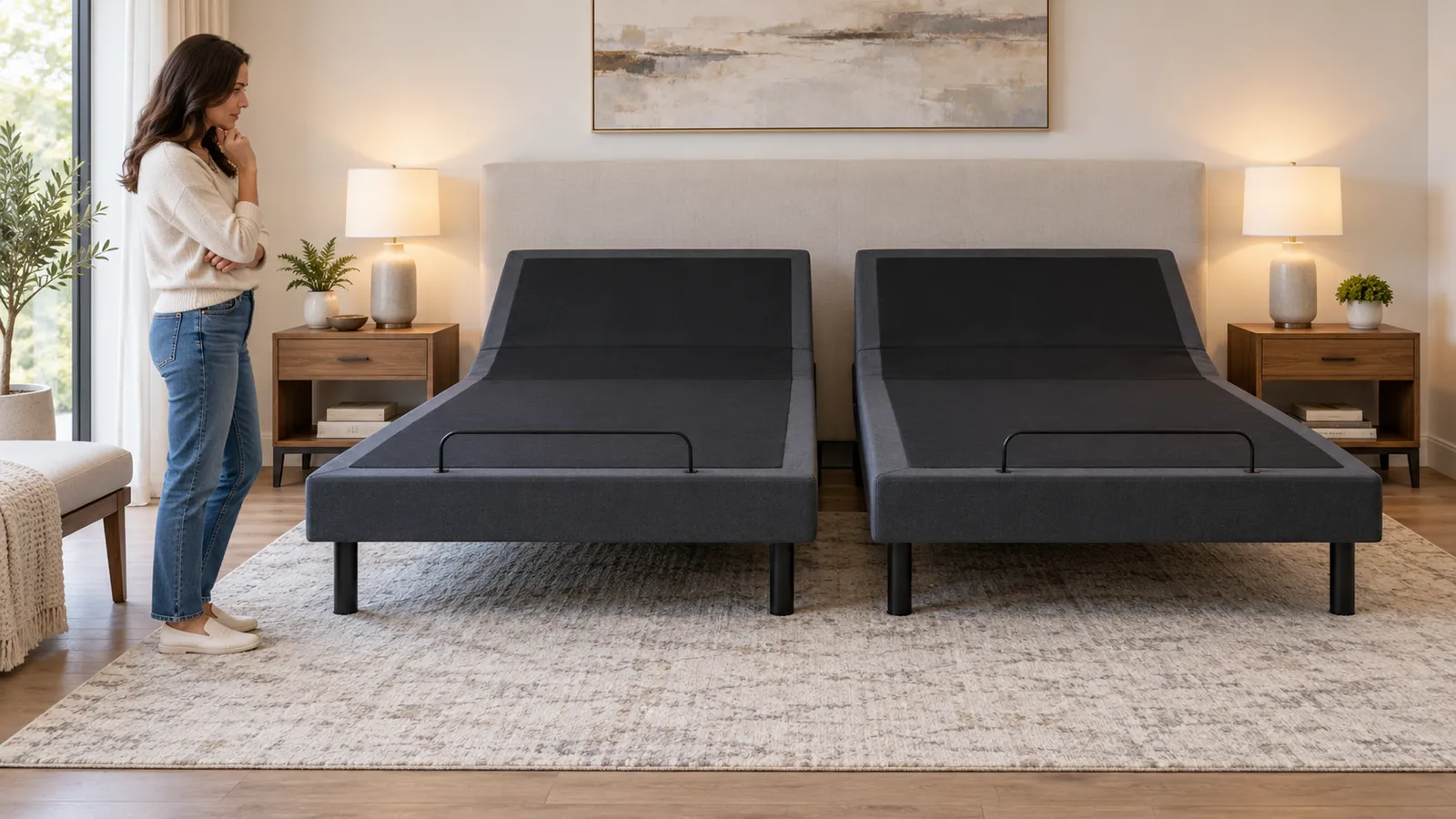
AI-generated editorial concept. It is not a KCAI product photograph, test result or customer project.
Quick answer for retail buyers
A Split King program should not be approved from a flat showroom photograph. Assemble the exact two-base and two-mattress combination, verify the center line and outside clearances, operate both sides independently, and measure how the system changes after repeated repositioning. Specify the approved retention method, base-joining method, bedding package and setup instructions in the order documents.
| Configuration | Main buyer benefit | Main center-line risk | What to verify |
|---|---|---|---|
| Full-split King | Independent movement and mattress choice on both sides | Full-length center divide and lateral migration | Retention, side alignment, bedding and user expectations |
| Split-head or flex-top | Independent upper-body positioning with a connected lower area | Upper sections may still drift or form a V-shaped opening | Flex geometry, sheets, head retention and mattress durability |
| Two bases with one King mattress | Unified sleep surface when both bases move together | Independent movement is generally not the intended use | Synchronization, mattress approval and complete motion range |
| One-piece adjustable system | No two-mattress center seam | Both sleepers normally share one position | Control logic, weight distribution and target use case |
Why the center gap grows
The gap is usually the visible result of several small interface decisions rather than one defective part. A foot retainer can limit downward travel while doing little to prevent sideways migration. Smooth deck fabric can provide less resistance than a textured interface. Rounded mattress borders may make the visual opening appear wider. If the two bases are aligned but the surrounding frame leaves excess side clearance, normal entry and exit can gradually push the mattresses outward.
Tempur-Pedic guidance on mattress separation acknowledges shifting and recommends a non-slip mat as one possible friction aid for its beds. Treat that as a testable option, not a universal specification for a KCAI system.
Translate the complaint into an OEM specification
Define the system at five interfaces.
- Base-to-base interface: Record how the two foundations are aligned or joined and whether that hardware is included.
- Mattress-to-deck interface: Identify the approved mattress bottom material, deck surface and any non-slip layer.
- Mattress-to-retainer interface: Show the location, height and contact area of each approved retainer without assuming a foot bar controls lateral motion.
- Bed-to-furniture interface: State the inside dimensions and side clearance of the intended upholstered surround or bed frame.
- User-to-bedding interface: Define the fitted-sheet arrangement and whether a shared top layer restricts independent movement.
The existing split adjustable bed OEM specification guide covers controls, accessories and side identification. Add the gap-control requirements to the same revision-controlled package instead of treating them as an informal showroom adjustment.
Compare full-split and split-head formats honestly
Full-split construction maximizes independent adjustment because each Twin XL side can move separately. It also creates a seam along the complete mattress length. A split-head design connects more of the mattress while preserving separate upper sections, which may reduce the full-length divide but introduces a different flex pattern and a smaller bedding ecosystem.
Neither format is automatically superior. The correct choice depends on the retailer's target customer, mattress partners, stock plan and service capability. A brand serving couples who prioritize independent positioning may accept a visible seam. A hospitality or residential program prioritizing a more continuous appearance may choose another architecture.
Tempur-Pedic states that a Split King sheet package normally includes two fitted sheets, while two Twin XL sheet sets can also cover the two mattresses. This demonstrates why bedding belongs in the product definition rather than being left to the customer after delivery. See the manufacturer's Split King sheet guidance.
Do not approve a bridge or strap without motion testing
A mattress bridge, encircling strap, shared topper or elastic sheet may reduce the perceived seam when the bed is flat. The same component can pull, fold or migrate when one side articulates. It may also make mattress removal and service more difficult.
Test proposed accessories in four states: both sides flat, both sides raised equally, one side raised while the other stays flat, and each side returning to flat. Observe the center surface, outside edges, fitted sheets, retainers and cables. Stop if an accessory crosses a hinge, creates concentrated pressure or conflicts with the supplier's instructions.
This is also why a generic online gap filler should not be added to the bill of materials after the golden sample. If it becomes part of the retail promise, it must be part of the controlled sample and packaging review.
Use a repeatable sample test
Record the initial center gap and outside clearance at the head, middle and foot. Mark the mattress positions with removable reference tape. Operate the complete intended motion sequence, allow the mattresses to settle, and record the same points again. Repeat after normal entry, exit and bedding changes.
The acceptance record should answer:
- Were both bases level and held in the approved relationship?
- Did either mattress move sideways or toward the foot?
- Did the retainers remain in safe contact?
- Did bedding pull one mattress toward the center or outside?
- Could both sides articulate without trapping fabric?
- Did the system return to its defined flat position?
- Were setup steps understandable without factory assistance?
Use the broader mattress compatibility checklist for flex, thickness and support questions. Gap testing complements that review; it does not replace it.
Apply the findings to KCAI product discussions
The KD011-A3 upholstered adjustable frame illustrates a current finished-furniture direction. Its product page is not proof that a Split King pairing, independent side logic or a particular retention package is included. Confirm selected mattresses, controls, retainers, surrounding furniture and accessories for the quoted project.
For OEM/ODM development, send the target mattress arrangement, finished-bed dimensions, required independent movement, bedding plan and retail installation method. That gives engineering and sourcing teams one system to evaluate.
Record the center-gap observation consistently
For a split system, document both bases and both mattresses before comparing a center gap. Mark whether the units are meant to move independently or together and use the same starting position for every observation. Take a front and overhead photograph from fixed locations, then record the center relationship at the agreed positions and after returning flat.
| Sample field | Buyer entry |
|---|---|
| Left and right base identities | Pending |
| Left and right mattress identities | Pending |
| Furniture surround and bedding | Pending |
| Starting and observed positions | Pending |
| Fixed reference points and unit | Pending |
| Photo ID, reviewer and open issue | Pending |
A gap can change with mattress placement, bedding or independent movement. Do not convert a single photograph into a statement that all split beds behave the same way. Review mattress retention separately from the split-format decision.
Request a Split King system review
The purchasing question is not whether a center seam exists; it is whether the approved system controls movement predictably and sets honest customer expectations. Managing the Split King adjustable bed gap problem begins with a controlled mattress, base, retention and bedding specification. KCAI can discuss two routes: an OEM/ODM configuration based on your product brief, or wholesale sourcing of a current model with its available options confirmed in writing. Request a quote and include the intended market, mattress format and furniture interface.