
An adjustable bed golden sample is the agreed reference for a product program before production planning—not a casual sample that someone approved in a chat message. It should connect the physical unit, the current specification, the packaging concept and the list of approved exceptions. When those records match, a buyer can evaluate later changes against a known baseline. When they do not, the word “approved” becomes too vague to protect either side.
This checklist gives furniture brands, distributors and sourcing teams a practical way to review an adjustable bed sample without inventing product claims or treating a prototype as final proof. Use it after you have issued an RFQ and compared the supplier’s assumptions, but before you authorize a production plan.
The short answer: approve a controlled reference, not just a product look
Before signing off a sample, identify the exact configuration and revision it represents. Record what is approved, what differs from the request, what remains open, and which document controls each decision. Then agree where the reference is kept and how a future revision will be authorized.
The point is not to add paperwork for its own sake. It is to make the difference between “looks right” and “is the agreed production scope” visible. A written record is especially valuable when several people own different parts of the project: product, sourcing, packaging, branding, compliance and operations.
1. Match the sample to the current product scope
Start with a one-page sample-identification sheet. It should contain the project name, sample date, current revision, buyer contact, supplier contact and a simple list of what the sample is intended to represent. If the unit is a functional prototype, label it that way. If it represents a proposed production configuration, say so clearly.
Compare the sample with the same product brief used in your adjustable bed OEM RFQ. Review the size standard, motion functions, visible frame or upholstery format, control approach, legs, retention method, accessories and any customer-facing parts. Do not assume a feature is included because it appears in a previous image or a different model.
Create three clear outcomes for each line item:
- Approved as shown: no change required for the stated revision.
- Approved with exception: acceptable for now, but the deviation is listed.
- Not approved: needs an updated sample, document or decision before release.
That distinction stops a verbal “yes” from becoming an unintended approval of every detail.
2. Inspect visible components and assembly details
The product review should be specific enough that two reviewers can reach the same conclusion. Break the inspection into visible finish, included parts, assembly interfaces and operation. Use the customer-facing standard you intend to sell, not an idealized rendering.
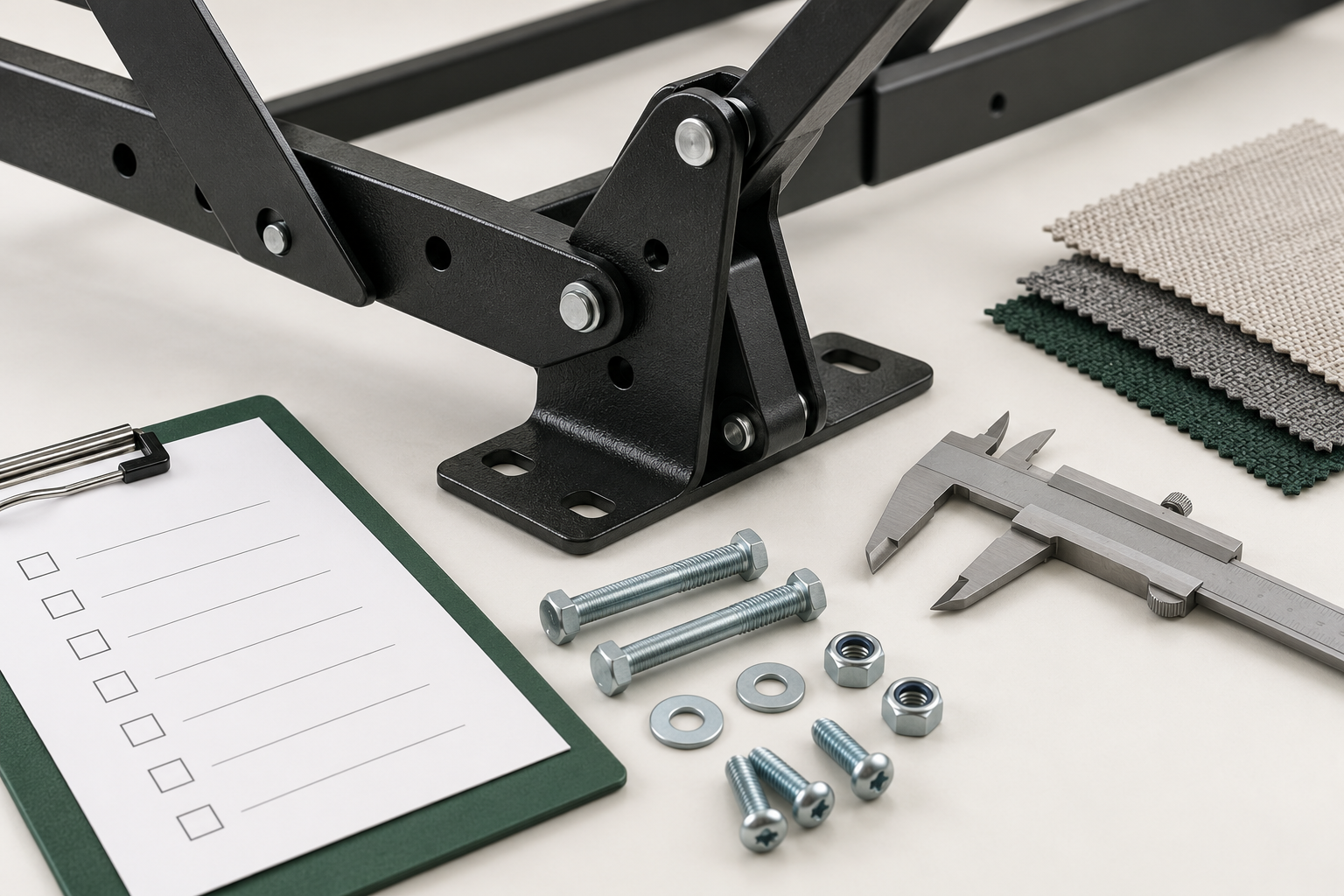
AI-generated editorial illustration of component review. It is not a KCAI product photograph, inspection record or test result.
For a generic adjustable bed sample, useful checks include:
| Review area | What to confirm | Evidence to retain |
|---|---|---|
| Visible finish | Colour, texture, seams, edges and exposed surfaces match the approved brief | Dated photos linked to the sample revision |
| Components | Legs, controls, retainers, brackets, power items and accessories match the agreed scope | Component list with included and excluded items |
| Assembly interfaces | Fasteners, joints and attachment points are present and accessible as intended | Notes on any change or unresolved fit issue |
| Operation | The requested functions can be demonstrated on the sample configuration | Demonstration notes; no performance claim beyond the observation |
| User-facing materials | Manuals, warnings, labels and branding placeholders are at the correct review stage | Artwork revision list and pending items |
Keep observations factual. “The requested control was present on the sample” is useful. “The control is superior” is not a controlled acceptance criterion.
3. Separate sample approval from production approval
One approved sample does not automatically settle every production decision. Some items can only be confirmed after packaging development, final artwork, selected components or destination-market documentation are complete. Treat those items as open decisions—not hidden assumptions.
Your sign-off record should therefore include an exception register. For every open item, state the responsible owner, the next evidence required, the target decision date and whether it affects price, packaging, documents or the production schedule. If a change requires another sample, name that sample and its revision.
This is also the moment to confirm commercial boundaries. A sample may include development materials or provisional parts that do not belong to the recurring production scope. Refer back to the OEM quote comparison guide so that new sample decisions do not quietly change the price comparison you already completed.
4. Review packaging as part of the sample—not after it
Packaging affects what buyers receive, how a product is handled and which data is available for freight planning. Even if the final carton is not ready, the golden-sample review should record the expected packaging route: carton count, basic protection approach, required labels, manual placement and any branding inputs.

AI-generated editorial illustration of revision and packaging-document control. It is not a KCAI packing plan, certification document or confirmed product specification.
Ask the supplier to distinguish confirmed details from proposals. Do not calculate container loading from product dimensions or approve a printed carton from a low-resolution mockup. The production-pack confirmation should eventually include the exact carton data needed for the selected model. The adjustable bed CBM guide explains how to use confirmed packing inputs once they exist.
5. Control artwork, documents and revisions
A physical sample can be approved while its instructions, carton artwork or document list are still in revision. That is normal. What is risky is losing track of which file goes with which sample.
Use one revision register with the columns below:
| Record | Minimum control information |
|---|---|
| Sample unit | Project name, revision, date, location and identifying photos |
| Product brief | Version, issue date, owner and approved scope |
| Artwork | File name, revision, language status and approval owner |
| Packaging brief | Carton concept, required inserts, label status and pending data |
| Document request | Requested document, product or component scope, market context and open point |
| Exception register | Description, owner, due date, consequence and closure evidence |
Avoid calling a file “final” unless it is also identifiable by a revision and date. A short revision name is easier to audit than a long email thread.
6. Keep the reference sample accessible
Agree where the approved reference will be stored and who can compare it with later units. Depending on the project, the buyer may keep one unit, the supplier may retain a reference, or both sides may hold a controlled sample. The important part is the agreement: location, photos, revision, access and replacement procedure.
If a change is approved after the original sign-off, do not silently overwrite the record. Issue a new revision, describe the change, confirm its effect on packaging and documents, and decide whether another physical sample is required. This makes the golden sample a living control point rather than a forgotten milestone.
A practical golden-sample sign-off flow
Use this seven-step sequence to keep the review manageable:
- Freeze the current product brief and label its revision.
- Identify the sample and the scope it is intended to represent.
- Inspect visible configuration, components and user-facing elements.
- Record approvals, exceptions and non-approvals line by line.
- Review packaging, artwork and document status separately.
- Assign an owner and due date to every remaining open decision.
- Issue the signed revision record and define how changes will be approved.
This approach is useful whether you are adapting an existing platform or exploring a new OEM/ODM development brief. It keeps sample review focused on evidence, scope and decisions rather than promises that cannot be verified from a single unit.
Request a sample-review discussion
Bring your product brief, reference images, packaging requirements and target-market context to the first discussion. KCAI can use that information to clarify the proposed scope and the next sample-review step. Request a quote to start the conversation.