A split adjustable bed OEM specification must define the complete two-sided system, not just two bed-base dimensions. The buyer should state which movements are independent, whether any paired operation is required, how controls and power components map to each side, how the sides are identified during setup, and which mattress, furniture, accessories, packaging and instructions belong to the approved configuration. If these decisions remain implicit, the same product can be assembled, demonstrated and serviced in different ways by different teams.
This guide gives brands, importers and distributors a practical structure for an RFQ and sample review. It does not assume that every split bed has the same control logic or features.

AI-generated editorial concept. It is not a photograph of a KCAI model, confirmed control package or customer project.
Start with the intended user behavior
“Split” describes a physical arrangement, but it does not fully describe how the product should operate. A buyer may want two sides that remain independent, a configuration with selected paired functions, or another project-specific control plan. Decide the intended customer experience before discussing remotes, control boxes or packaging.
Write a short operating statement that answers:
- Which side movements must operate independently?
- Is any simultaneous or paired operation required?
- How does the user select or leave a paired state?
- What happens after power is disconnected and restored?
- Which control belongs to which side?
- Which instructions must appear in setup and troubleshooting materials?
Do not copy these answers from a visually similar product. They depend on the selected architecture and approved component package. Add the operating statement to the adjustable bed OEM RFQ so every supplier quotes the same intended behavior.
Build a split-system decision table
The specification should separate requirements, supplier proposals and open decisions. That prevents a proposed option from being mistaken for an included feature.
| Review area | Buyer decision to record | Approval evidence |
|---|---|---|
| Physical configuration | Side format, overall arrangement and furniture interface | Current drawings and identified sample |
| Movement logic | Independent and any paired operating states | Written function matrix and sample observation |
| Control mapping | Which control operates each side and how it is identified | Control list, pairing record and labeled sample photos |
| Power architecture | Approved power components and connections | Component list and project-specific diagram |
| Mattress interface | Mattress arrangement, retention and clearance | Joint sample review for the selected combination |
| Included accessories | Cables, retainers, legs, joining parts and optional items | Included-parts list by revision |
| Packaging and setup | Carton allocation, side labels and assembly sequence | Packing map, manual and unpacking review |
| After-sales | Replacement identification and troubleshooting boundaries | Service parts map and controlled instructions |
A concise table like this is more useful than a long feature list. It tells sourcing, engineering, packaging and after-sales teams which evidence controls each decision.
1. Map controls, power and sides consistently
Every physical item needs a stable identity. If the buyer uses “left” and “right,” define the viewing direction. If another naming convention is used, apply it consistently to the product, controls, cartons, manual and spare-parts record.
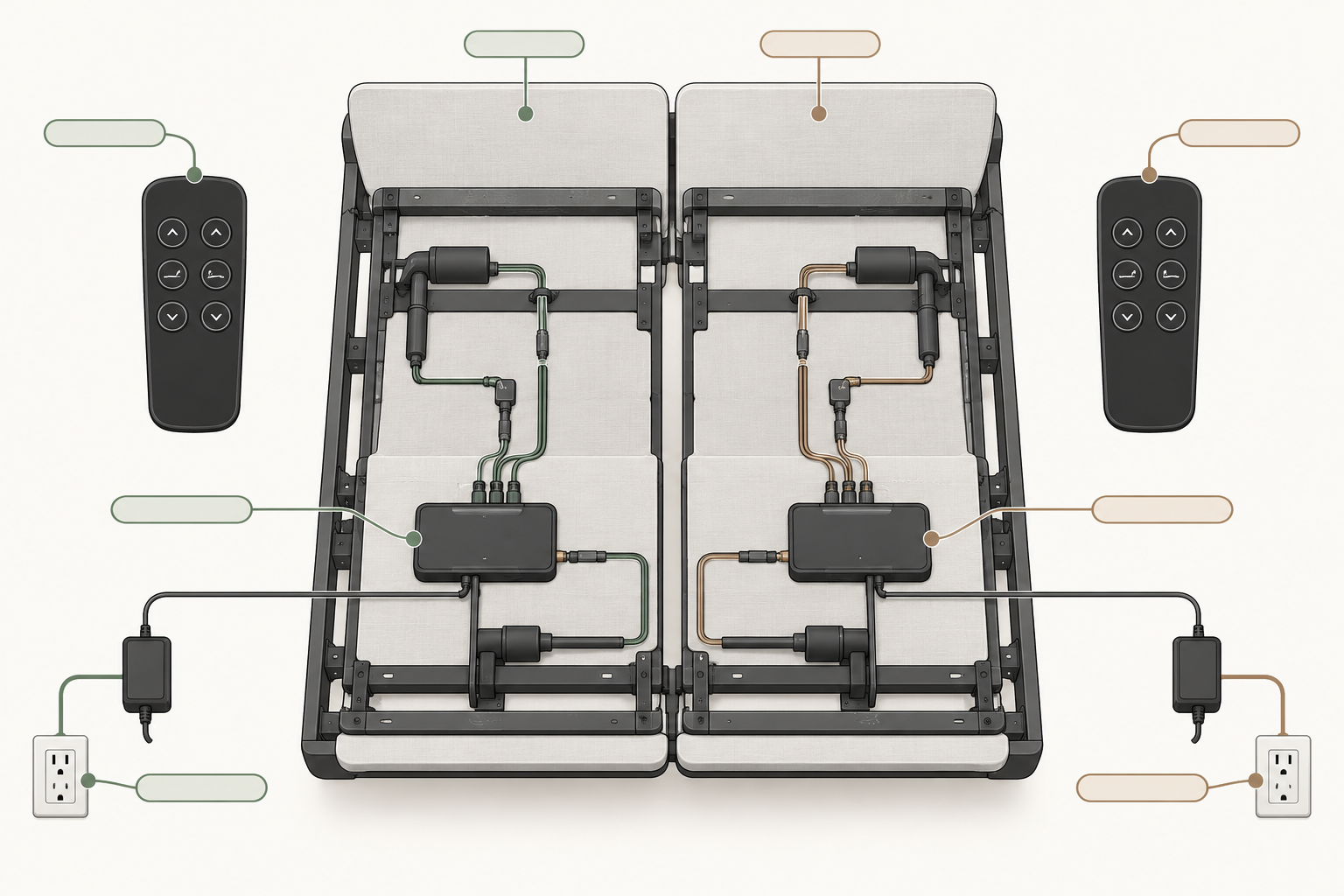
AI-generated system-planning illustration. It is not a KCAI wiring diagram, component specification or installation instruction.
The buyer's control map should identify the approved remote or handset reference, control module, power component and relevant cable set for each side. If a wireless control is proposed, the project record should also define the approved pairing and reset procedure. If a wired control is proposed, confirm connection routing and access on the finished sample.
Keep the customer-facing labels simple, but keep the internal component record precise. A replacement order should not depend on a support agent interpreting an unlabeled photo. The model, product revision and component reference should lead to one unambiguous replacement path.
The public controls and accessories overview can support an initial discussion. Exact compatibility and availability still need confirmation for the selected bed program.
2. Define independent and paired states
Do not approve a split system based only on a demonstration that each side can move. List every state the final product is intended to support and review transitions between them.
For each approved function, record:
- whether it applies to one side, both sides independently or a paired state;
- which control input activates it;
- how the system behaves when the two sides begin in different positions;
- how the user returns to the normal independent state;
- what the manual should tell the customer; and
- any open condition requiring further evidence.
This is a functional acceptance matrix, not a performance claim. If the buyer requires cycle testing, electrical evidence or another formal validation, define the applicable method, configuration and acceptance criteria separately. A sample demonstration cannot substitute for a test report, and a report for another configuration cannot automatically cover the ordered system.
3. Review mattresses, retainers and furniture clearances
Two moving sides create more interfaces than a single platform. The buyer should review the selected mattress arrangement, center gap, retention method, surrounding furniture and access to controls or cables as one finished system.
Use the adjustable bed mattress compatibility checklist to record fit and movement. For a split program, apply the checklist to each side and then observe both sides in the intended combined states. Look for unresolved contact, mattress shifting, center interference, trapped bedding, restricted clearance or access problems.
If a mattress, upholstered surround or joining method changes after sample approval, repeat the affected interface checks. A control system may still operate while the complete bed no longer behaves as the buyer intended.
4. Make the accessory list carton-specific
A generic “accessories included” line is not enough for a two-sided product. State which carton contains each remote, power item, cable, retainer, leg, joining part, manual and optional accessory. The packing map should also show how the customer identifies the corresponding side during setup.

AI-generated editorial approval scene. It is not a KCAI accessory kit, packing plan or customer order.
During packing approval, check three views of the same scope:
- the commercial quotation says what is included;
- the product and accessory list identifies the exact references; and
- the cartons, manual and setup sequence show where the parts are found.
These records should agree. Otherwise a missing item can become a supplier dispute, warehouse problem or avoidable customer-service case.
5. Design the setup and troubleshooting path
The manual should help a customer or installer reach the approved operating state without knowing the engineering history of the product. Review the setup sequence using the packed sample, not only a digital draft.
Confirm that the instructions cover side identification, power connection, control identification, pairing where applicable, intended joined or separate arrangement, normal reset steps and the point at which the customer should stop and contact support. The language must match the delivered component package.
Avoid troubleshooting instructions that invite customers to open protected components or improvise wiring. The supplier and buyer should agree what can be checked safely by the user, what can be replaced as a service part and what requires qualified support under the destination-market plan.
6. Approve service records before launch
Split systems need a clear after-sales identity map because similar-looking parts may belong to different revisions or sides. Before production release, ask how the support team will identify:
- the finished-product model and revision;
- the affected side using the agreed viewing convention;
- the control and power package supplied with that unit;
- the replacement part that matches the approved configuration;
- the current pairing or reset instruction; and
- any change introduced after the golden sample.
Do not promise a warranty period or spare-parts duration until the commercial agreement states it. Instead, require the quotation and order documents to define responsibilities, evidence requirements and replacement process. This makes after-sales scope comparable across supplier proposals.
A practical sample-approval sequence
Use this eight-step flow:
- Freeze the intended user behavior and side-naming convention.
- Identify the product, control, power and accessory revisions.
- Review each side independently through the intended functions.
- Review every approved paired or combined state.
- Check mattresses, retainers, furniture clearance and cable access.
- Unpack the sample using the proposed cartons and instructions.
- Record exceptions, owners and required closure evidence.
- Link the signed approval to the golden sample record.
If any part changes later, repeat the affected checks and issue a new revision. “Same appearance” is not evidence that the control or service mapping remains the same.
Apply the checklist to a KCAI discussion
KCAI's public range includes the KR003 split smart adjustable bed, presented as an upholstered smart-bed combination built around a split-motion mattress layout. Its side configuration, controls and compatibility are confirmed per project. That makes the model page a starting point for a requirements discussion, not authorization to assume a specific control package.
For an efficient review, send the target market, size arrangement, mattress plan, desired independent or paired behavior, control preference, furniture interface, packaging route and after-sales expectations. KCAI can then discuss an existing direction or an OEM/ODM development path against one controlled brief.
Request a split-system specification review
Bring a function matrix and carton plan to the first supplier discussion, not only a product image. Clear side, control and accessory mapping reduces ambiguity before samples and quotations diverge. Request a quote to discuss a split adjustable-bed program with the KCAI team.