On this page
A mattress brand can receive a frustrating report: the mattress bends with the adjustable base, yet ends up out of position after customers raise and lower it. The useful purchasing question is not simply whether the base has a retainer bar. It is which part moved, in which direction, under which setup and motion conditions. That observation determines what to inspect on the sample.
This guide focuses on mattress position during articulation. For the wider decision about flexibility, size and clearance, use our adjustable bed mattress compatibility checklist. For a complete mattress-brand launch covering controls, packaging and service, see the mattress-brand OEM integration guide.
Quick Answer
A mattress may move because the mattress bottom and base deck interact differently during articulation, the mattress edge does not stay engaged with the selected retention method, the mattress size or construction changes contact, or the base itself shifts inside its furniture. Footward drift, side shift, rotation and split-gap change call for different checks. These are possible causes across adjustable-bed systems, not diagnosed faults or performance claims for a KCAI model.
Name the movement before choosing a fix
Use the base frame or deck as the measurement reference, not the wall or the bed surround. A mattress can appear to move when the entire base has shifted inside the furniture. Photograph the flat starting position and the same reference points after the agreed motion sequence.
| Movement seen | What the buyer should measure | Interfaces to inspect first | Why the distinction matters |
|---|---|---|---|
| Footward or headward drift | Change at head and foot reference marks | Mattress bottom against deck; foot-end contact; base position | A foot-end restraint may address one direction but says little about sideways movement. |
| Side shift | Left and right edge distance from the deck | Deck surface; mattress bottom; centered setup; side contact | A lengthwise retainer may be present while the mattress still moves laterally. |
| Rotation | Position of all four corners, not one edge | Uneven contact, off-center loading, furniture contact | One corner can move while the opposite corner stays nearly fixed. |
| Split gap change | Center gap at marked head, middle and foot points | Each mattress/base pair; relative base position; bedding | A widening gap can reflect movement of either mattress or either base. |
| Corner overhang or local bunching | Corner location and visible cover/deck contact | Border construction; articulation break; retention contact | This may be a fit or flex issue as well as a position issue. |
These are diagnostic categories, not claims that a particular KCAI model exhibits any of them. A single photo after testing cannot show when movement began; a short, fixed-view video can help product and supplier teams see the sequence.
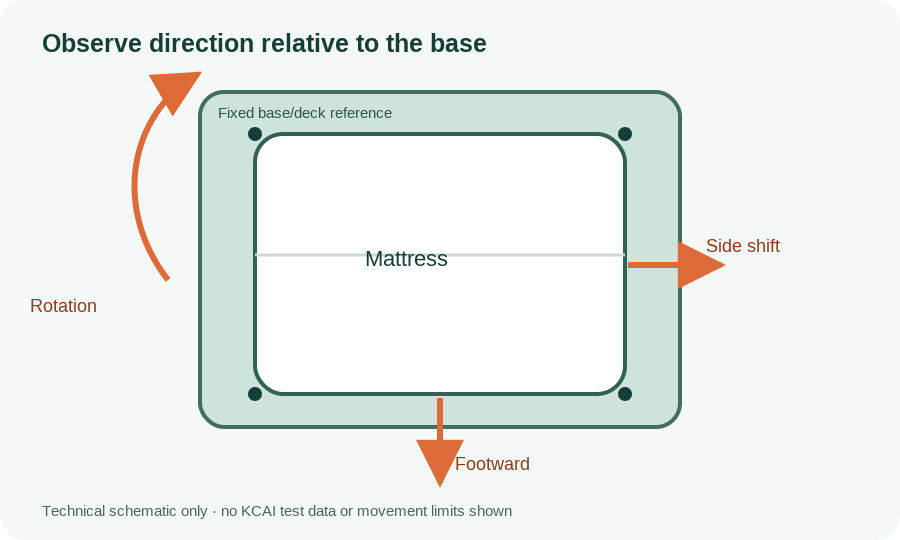
Technical schematic; directional concepts only. No KCAI test result or allowable movement is shown.
Trace the contact interfaces
The mattress rests on a moving deck. Its bottom fabric and any interface layer touch the deck surface; its border may meet a foot retainer, corner restraint or surrounding furniture. Bedding can change what touches the moving parts. Each interface can change when a mattress construction or base revision changes.
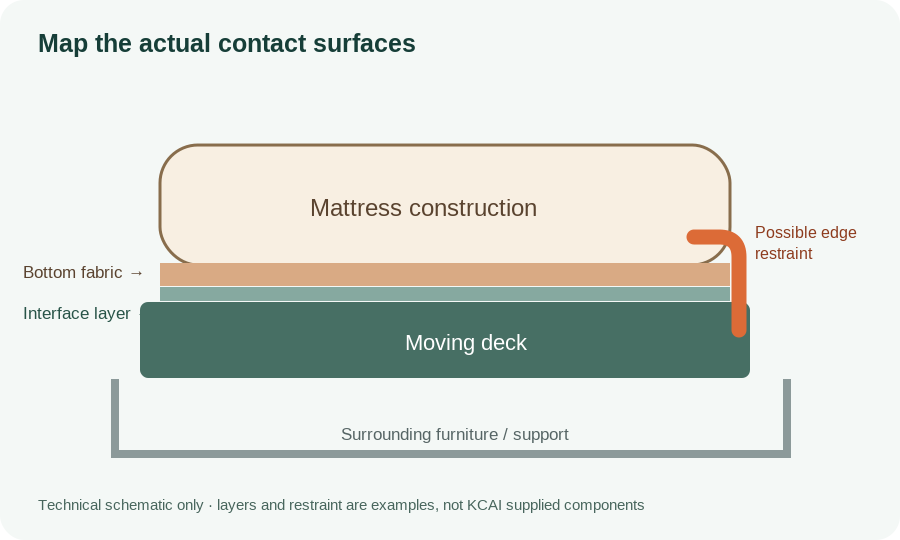
Technical schematic; contact categories only. The layer and restraint shown are not confirmed KCAI supplied components.
For a sourcing review, map four contacts:
- Mattress bottom to deck: identify the actual fabrics, coatings or interface layers on the sample. Do not assume that a grippy-looking surface will behave the same after a cover change.
- Mattress edge to restraint: note where a component contacts the border throughout movement. The contact should be reviewed for fit, cover wear and ease of mattress removal.
- Base to furniture or floor: check whether the base itself moves, rocks or touches the surround. A mattress-only correction cannot solve an unstable installation.
- Two halves of a split setup: measure each half separately and then their relationship; do not use a single-bed observation to approve a split system.
This contact map does not replace the full installation-error review. It narrows the investigation to the surfaces and components that could explain the recorded direction of movement.
Compare retention approaches by the problem they address
Suppliers may propose a foot-end bar, corner or side restraints, a deck/interface material, a mattress attachment system, or a combination. These are general design categories, not a list of components supplied with KD001-A3 or KD010-A2. The exact parts and permitted installation method must be checked on the quoted revision.
| Approach to evaluate | Potential role | Sample question | Decision risk |
|---|---|---|---|
| Foot-end bar or stop | Limits movement toward the foot at its contact zone | Does the approved mattress edge stay engaged through the chosen motion sequence? | It may not control side shift or rotation. |
| Corner or side restraint | Addresses movement at selected edges | Does it contact the intended mattress border without interfering with articulation or removal? | Location and edge shape can make one mattress behave differently from another. |
| Deck or interface material | Changes contact between mattress bottom and deck | Does the production-intent fabric combination behave consistently in the recorded setup? | Friction alone may change with materials, bedding or use. |
| Dedicated attachment | Connects compatible parts of a defined system | Are the mating components, instructions and replacement parts included in the approved scope? | A proprietary attachment may limit replacement mattress choices. |
| Furniture or setup correction | Stabilizes the base or removes unwanted interference | Did the base move relative to the surround or floor? | Treating base movement as mattress slip can lead to the wrong design change. |
There is no universal retainer size, acceptable displacement or number of articulation cycles for all mattress and base combinations. The brand and supplier should agree on the test conditions and acceptance criteria for the intended product before calling a result a pass.
Run a paired sample inspection
Use the mattress construction and adjustable-base configuration intended for sale or recommendation. If the program has several mattress builds, choose a documented sample matrix rather than extending one result to every SKU. Identify the mattress SKU/revision, base model/revision, deck surface, restraint part, bedding and furniture setup on each record.
Assign a test record ID before moving the sample. Mark fixed reference points on the deck or base at the head, foot and both side edges; identify each point in the record. Compare the mattress in the same posture before and after a defined sequence—normally flat-to-flat for overall drift—and document any position-specific readings at the same head-up or foot-up angle. State the measurement unit (for example, millimeters) and use it consistently. Record the number of repetitions, whether the test was unloaded or used an agreed mattress/occupant load condition, and the source of that condition. Take before-and-after photographs from the same marked camera position and angle, with the reference points visible. Measure foot/head change, left/right change, corner rotation and split gap where relevant. If the base moves inside furniture, record that separately.
The buyer should define a criterion and its source for each measured outcome. A blank criterion means open, not pass. If a sample changes after a new cover, bottom fabric, retainer, deck finish or furniture installation, repeat the affected checks and document the revision change.
Mattress Retention Sample Inspection Checklist
The free Mattress Retention Sample Inspection Checklist is an editable 24-item CSV for identity, setup, motion, movement, interfaces and release decisions. Download it before sampling and keep one copy per paired configuration and test record ID. Record the result in a “Measured change and direction” field, link a photograph or video, name the owner and close each deviation before approving the paired sample. No factory result should be prefilled.
| Minimum record | Buyer entry |
|---|---|
| Mattress SKU and revision / base model and revision | ______ / ______ |
| Bottom fabric, deck and retention part reference | ______ |
| Tested motion and installed bedding/furniture | ______ |
| Starting and ending position at marked points | ______ |
| Measured movement, direction and acceptance criterion | ______ |
| Photo or video, deviation owner and release decision | ______ |
Decide what needs changing before approving the SKU
Use the measured pattern to select the next engineering review. A mattress construction change, a different deck interface, an approved restraint, an installation correction or clearer customer instructions can each be relevant in different projects. Change one controlled element at a time when possible, then repeat the same measurement method so the results are comparable. Do not approve a new claim or hardware substitution from a showroom demonstration alone.
For a US mattress brand, the release record should name the mattress and base SKUs, revisions, approved restraint and included parts, sample conditions, acceptance criteria, deviations, owner and customer-facing compatibility scope. The broader mattress-brand OEM integration guide covers how that record connects to packaging, service and change control.
Start with a real model reference
KCAI's current product catalogue lists KD001-A3 as an upholstered adjustable bed frame and KD010-A2 as a disassemblable electric bed frame. Their catalogue images can help identify the product direction; they do not show which retention components are included in a current configuration or establish sliding performance. Request the current revision, parts list and sample plan for either model before designing a mattress pairing.
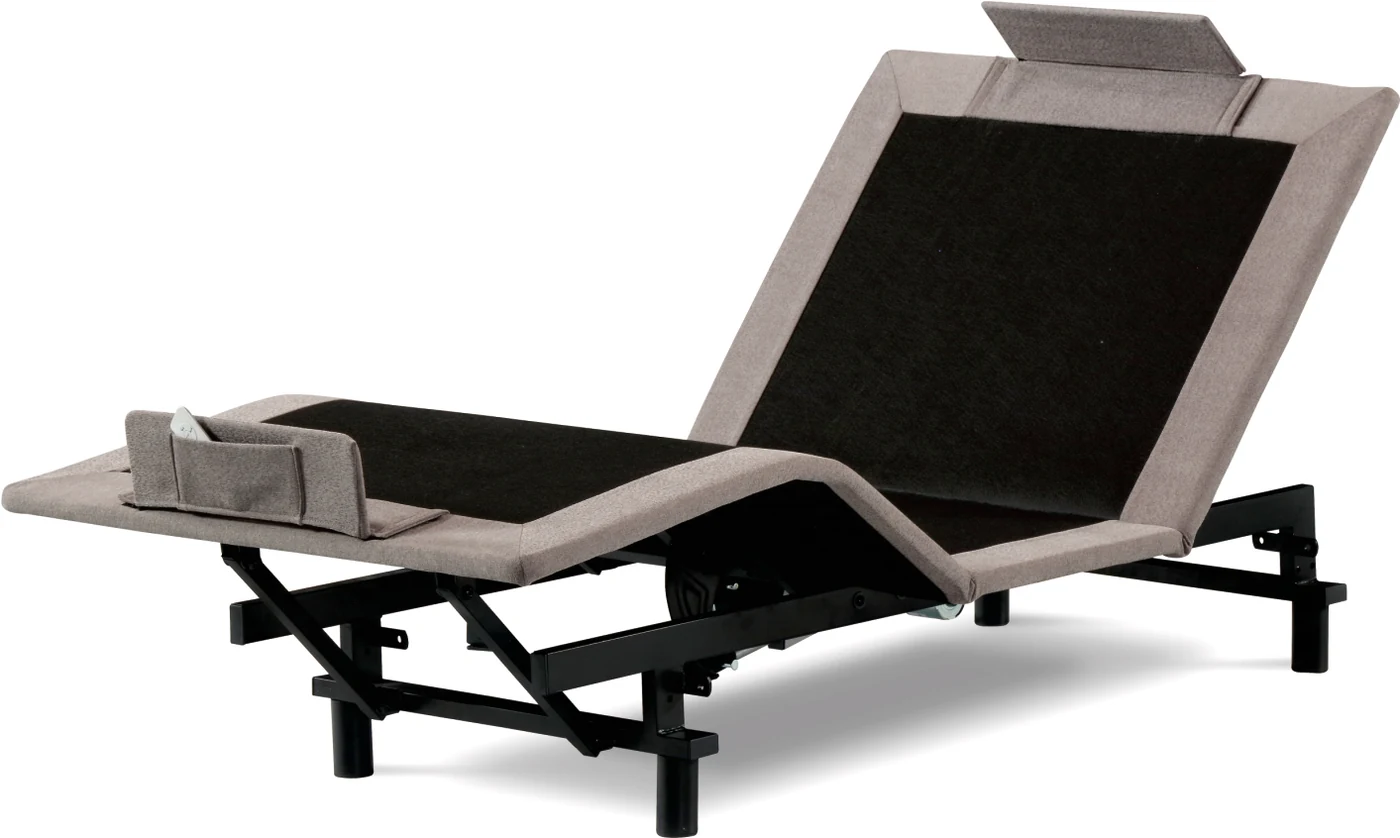
KD001-A3 catalogue reference image. Appearance only; retention hardware and performance require model-specific confirmation.
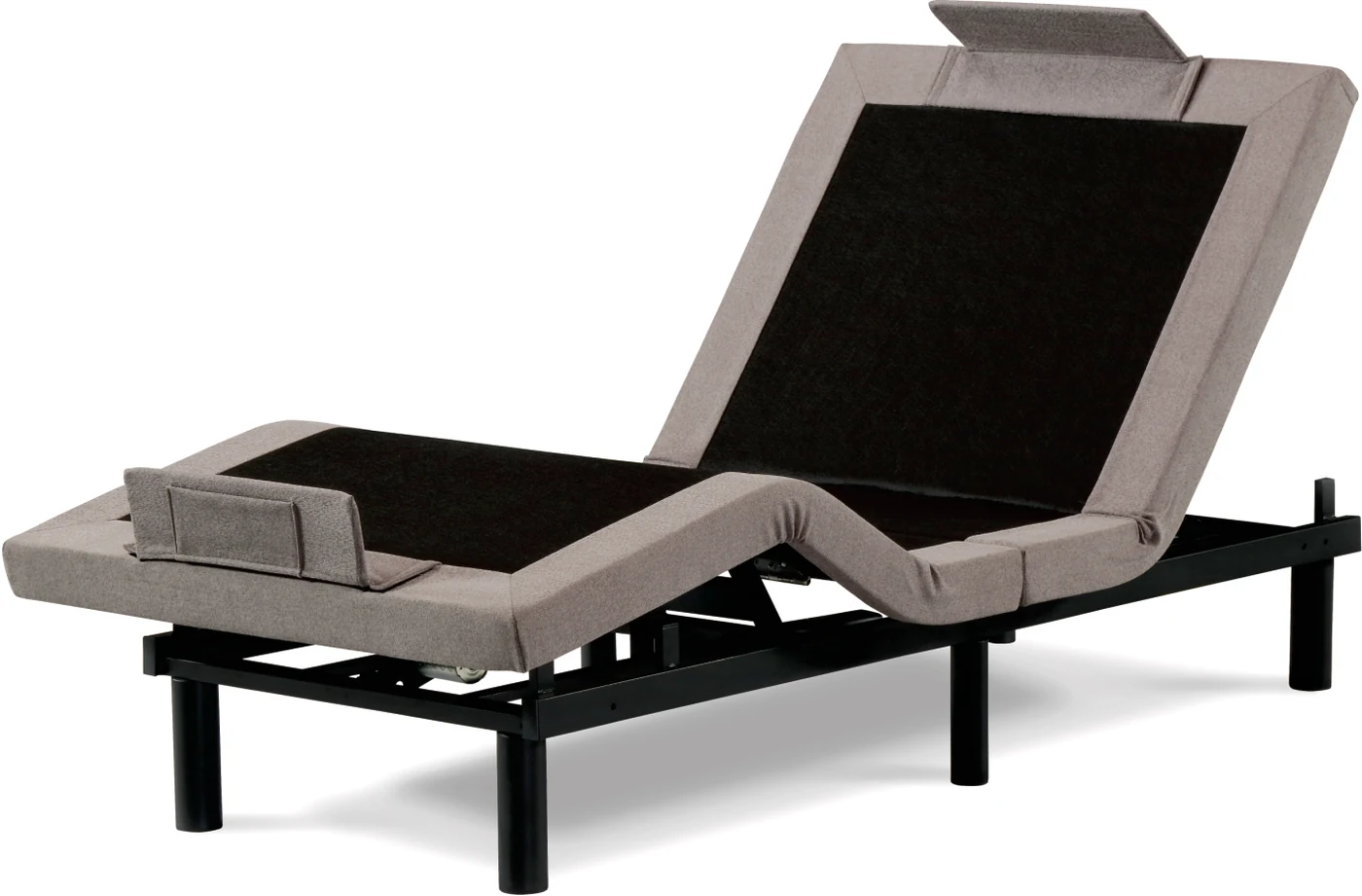
KD010-A2 catalogue reference image. Appearance only; it does not demonstrate the supplied retainer or a validated mattress pairing.
Have a mattress build in mind? Send its construction and bottom-fabric details, size, intended base or furniture format, and any photos showing the movement pattern through the RFQ form. Include your proposed acceptance criterion and sample quantity if available. That gives the product team a concrete pairing to review rather than a generic request for a “non-slip bed.”