On this page
A care facility adjustable bed maintenance checklist should connect each bed to its model, revision, room, inspection history and approved service route. The facility can then identify what was checked, what needs attention, which parts fit that configuration and who may return the bed to use. A generic checklist without product identity can lead to the wrong part being fitted or an issue being marked complete without a documented repair.
This article focuses on residential adjustable furniture programs in assisted living and senior living. If the equipment is a hospital bed, a regulated medical device, or is used with rails or care functions governed by a facility bed-safety policy, follow the applicable instructions and rules for that equipment. The residential process below is not a substitute for a clinical maintenance program.
Quick answer: identify, inspect, record and escalate
Create an asset record for each bed and link it to the approved model, revision, mattress and accessories. Set inspection intervals from the product instructions, applicable regulation, facility policy and service agreement. Train staff to report visible damage or unusual behavior, and define who can perform each check or repair. Record findings and parts against the asset. Remove an item from use when the responsible facility procedure requires it, and return it only after an authorized person documents the required action.
For U.S. nursing facilities, CMS guidance discusses routine preventive maintenance of beds and bed rails and the need for a process to determine whether beds, mattresses and rails are appropriate for residents. The scope depends on the applicable rule and equipment; buyers should verify the current CMS requirements and facility policy for their setting (CMS long-term care guidance). Do not apply those requirements automatically to a residential furniture program outside that scope.
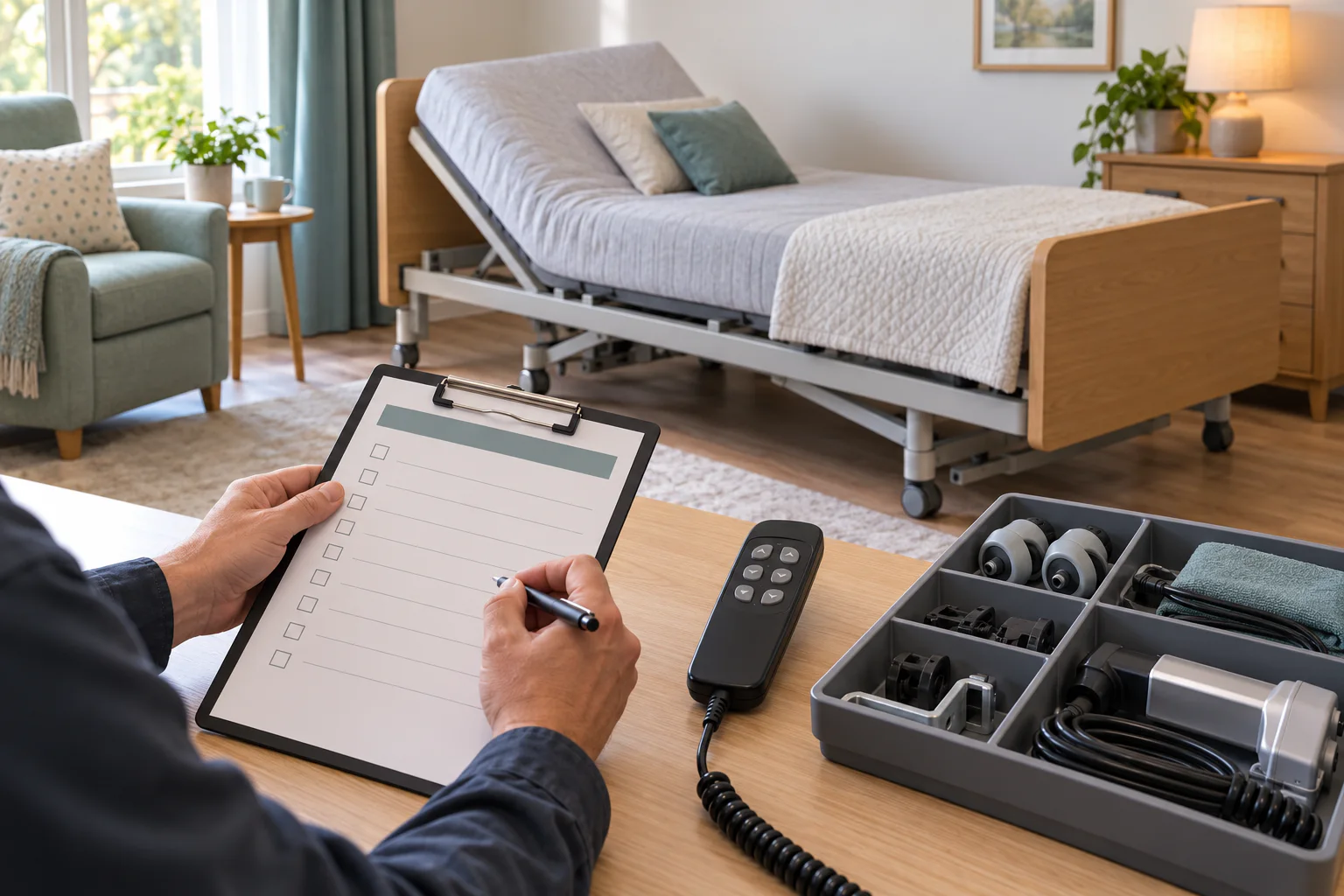
AI-generated editorial concept. It is not a real maintenance procedure, facility record, medical bed or depiction of a specific KCAI model.
Create one record for every bed
Use an asset identifier visible to the facility team and connect it to the room record. Capture manufacturer, model, serial or lot identity where available, product revision, installation date, approved mattress and accessories, control and power components, instruction revision and supplier service contact. If the equipment changes rooms, preserve the asset history while updating its location.
An operating record can include:
| Record field | Why it matters |
|---|---|
| Asset and room ID | Ties an observation to the correct bed and location |
| Model and revision | Helps confirm instructions and compatible replacement parts |
| Inspection date and owner | Shows when the check occurred and who recorded it |
| Condition or function finding | Describes what was observed without guessing at cause |
| Action and service reference | Connects the issue to repair, escalation or follow-up |
| Part reference and revision | Prevents similar-looking but incompatible substitutions |
| Return-to-use approval | Records who confirmed the facility's required release step |
Limit records to operational equipment information. Avoid adding resident health details unless the facility's authorized system and privacy rules require them.
Define a risk-based inspection routine
Start from the manufacturer's current instructions. Translate only the checks authorized for facility staff into a short visual and functional checklist. Typical observations may include visible frame damage, loose or missing hardware, unusual sound, damaged handset housing, cable cuts, unstable connectors, control response and movement that differs from the expected behavior. The exact scope depends on the model. Do not instruct staff to open powered enclosures, modify wiring, lubricate components or adjust mechanisms unless the documentation explicitly authorizes the task and the person is qualified.
The facility should define event-driven inspections after a reported malfunction, relocation, impact, accessory change or repair. It should also decide how to handle beds with overdue checks or unclear identities. An inspection is a way to discover and route issues; it does not certify a product or guarantee that no failure can occur.
Set clear stop-use and escalation rules
Write down observable reasons for staff to stop routine use and alert the designated supervisor. Examples can include exposed wiring, a damaged power lead, instability, a jammed movement, an unexpected movement, broken structural parts or a control that behaves inconsistently. The responsible technical lead should define the final list for the specific equipment and facility. Staff should not diagnose a fault from a symptom or attempt an unapproved repair.
Escalation should identify who makes the bed unavailable, how the room is reassigned, which service provider is contacted, what photos and asset information are needed, and how the repair is documented. When equipment is used in patient care or with bed rails, route the incident through the facility's applicable clinical engineering and bed-safety process.
Connect service work to compatible parts
Build a parts cross-reference by model and revision. Identify the approved actuator, control box, handset, power supply, cables and hardware where those are replaceable components. Mark whether a replacement is direct, requires a paired component or needs an approved conversion kit. Record superseded references and effective dates so purchasing does not reorder a part that service cannot use.
Ask the supplier for ordering identifiers, installation instructions, troubleshooting boundaries and notification steps for engineering changes. The spare parts traceability guide explains how to connect component references and revisions. The after-sales parts guide and warranty/RMA guide cover broader service and issue tracking decisions.
Review service history and recurring issues
At a regular cadence set by the facility, review open work orders, repeated fault reports, unavailable beds, parts consumption and unresolved compatibility questions. Separate confirmed causes from initial descriptions. A report that says “remote failed” should retain the actual observed behavior, asset ID and control revision until the service process confirms the cause.
Use the review to adjust the approved staff checklist, training, reorder points or supplier escalation package. Do not change a product component or cleaning method informally: update the configuration record, assess compatibility and release a revised instruction. For a multi-site program, compare like-for-like revisions and operating contexts rather than combining all beds into a single undifferentiated failure count.
Pilot the workflow before applying it across rooms
- Select one representative asset and confirm its identity and current instructions.
- Ask facilities, operations and service teams to review the proposed staff checks.
- Verify the escalation route, authorized repair roles and return-to-use step.
- Trial the record fields using an actual inspection or service event.
- Confirm the part cross-reference with purchasing and the service provider.
- Train the responsible teams and set a review date for open issues.
- Expand the process by product revision and room type.
If the program covers clinical devices or beds with rails, include clinical engineering and the responsible care professionals in the pilot. The senior living procurement guide can help connect the maintenance plan to the original specification and service ownership.
What to request from an OEM supplier
Request the approved model and revision list, user and service instructions, component identification, compatible replacement parts, change-notification method, warranty or escalation route, and the documents available for the destination market. Ask the supplier to distinguish staff checks from technician-only service. Put the final responsibility matrix and response assumptions into the project documents rather than inferring them from a general guide.
For an OEM or home-care furniture project, provide the room types, product configurations, service roles, markets and record fields needed for the program. Request a quote to discuss model-specific documentation and the parts information required for planning.