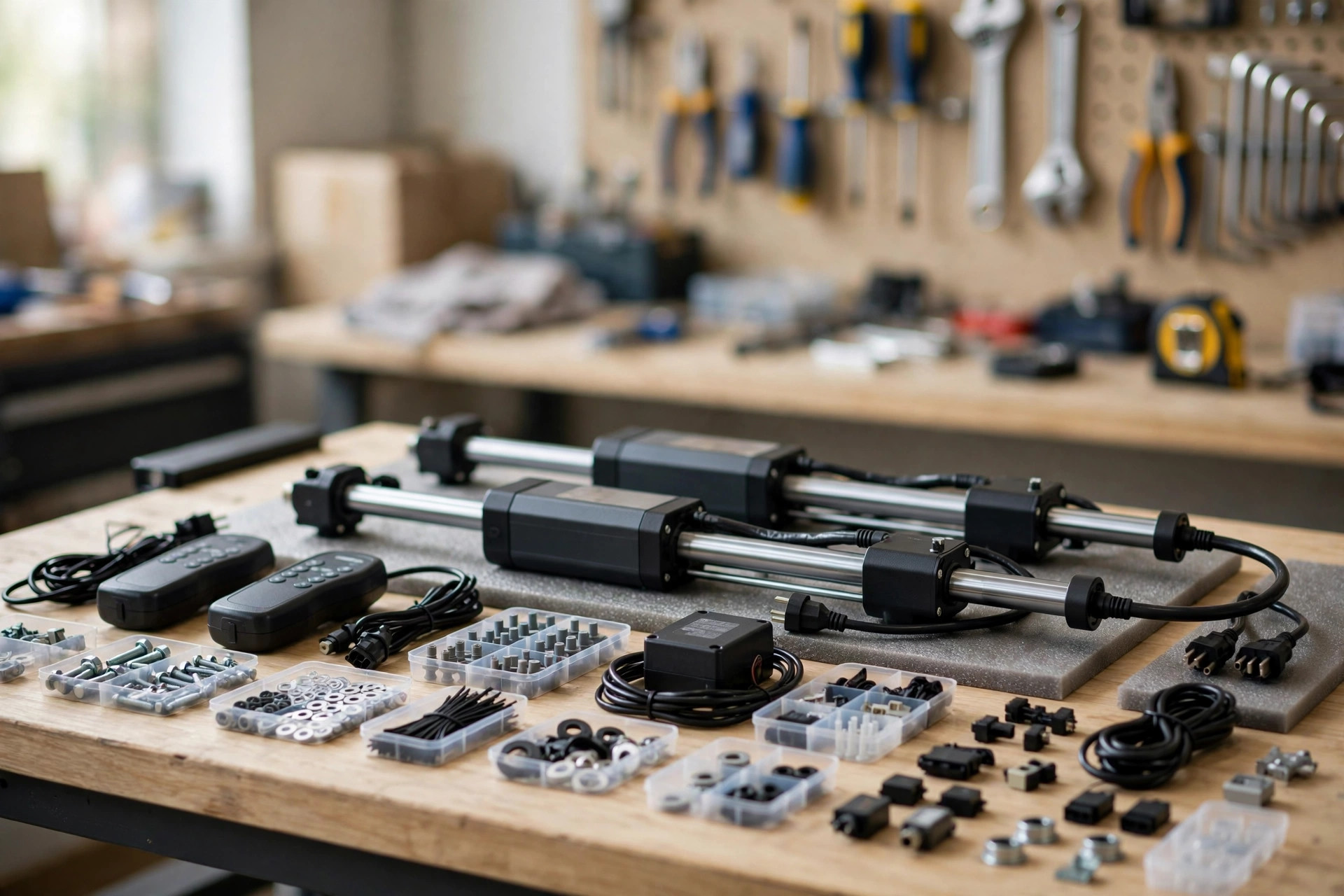
Cover image: an AI-generated illustration of an after-sales service scene with a technician and organized spare parts (shown for reference, not an actual product photo).
After-sales parts are the line item missing from almost every adjustable bed sourcing spreadsheet — and the one that destroys margins when it appears. The direct answer: before signing any purchase order, get the factory's spare-parts and service commitment in writing — which parts are covered, how long they remain available, at what pricing mechanism, and with what technical support — because a motorized bed without a parts program is a disposable product with your brand on it. Buyers negotiate hard on unit price and container loading, then discover that a single failed actuator in year two costs more in customer-service time, replacement shipping, and reputation than the margin on a hundred units. This guide maps which parts actually fail, why remote model codes determine long-term compatibility, and what to lock into your contract before you commit. For the broader supplier-evaluation framework, see our complete guide to sourcing adjustable beds from a China factory.
The Direct Answer: Parts Availability Is a Contract Term
Here is the uncomfortable truth about motorized furniture: the bed is the easy part. Frames, upholstery, and hardware either work on arrival or they don't — inspection catches them. Electronics and mechanisms fail over time, in customers' homes, months after the sale. When that happens, your customer calls you, not the factory in Dongguan. If the factory cannot supply a matching actuator, remote, or control box, your options are: buy back the bed, ship an incompatible part and hope, or tell the customer the bed is unrepairable. Every one of those options costs more than the margin you saved negotiating the unit price.
This is why parts availability must be a written contract term, not a verbal assurance. "We can provide spare parts" means nothing. A written commitment covering which parts, for how long, at what price mechanism, and with what lead time means everything. Negotiate it when you have leverage — before the purchase order — because afterward you are a supplicant, not a customer.
Which Parts Actually Fail — and Why It Matters
Adjustable beds concentrate failure risk in a small set of components. Understanding the failure map focuses your service negotiation where it counts:
| Component | Failure exposure | Service implication |
|---|---|---|
| Actuators / lifting mechanism | Highest — moving parts under cyclic load | Must match motor brand and model exactly; not interchangeable across platforms |
| Handset remote | High — handled daily, dropped, lost | Replacement must match the control protocol of the installed base |
| Control box | Medium — electronics, surge exposure | Firmware and wiring compatibility with the specific model |
| Power supply | Medium — wear and surge exposure | Voltage and connector compatibility per model |
| Frame structure | Low when properly engineered | Weld and steel specifications locked at golden sample |
| Upholstery and foam | Low-medium — wear, not failure | Fabric dye lots vary; lock material codes |
The pattern is clear: electronics and mechanisms carry the exposure, and they are precisely the parts where cross-model compatibility cannot be assumed. A service program that stocks "adjustable bed parts" generically is not a service program — it is a warehouse of maybe.
Remote Codes and Compatibility: The SK-Series Lesson
Remotes look interchangeable. They are not. A handset is paired to a specific control protocol, and ordering "a remote for our adjustable bed" without a model code is how buyers end up with drawers of useless handsets. Serious programs document remote model codes the way they document motor brands — as engineering identifiers, not marketing names.
As a concrete example, KCAI's program uses documented remote model codes including SK.29.11, SK.34.09, SK.50.17, SK.27.11, SK.27.19, SK.51.11, SK.51.19, and SK.67.09. These are real model codes in the program — which is exactly why they are useful as an example and dangerous as an assumption: the correct code for your model is whichever one ships with it and is recorded on the specification, not whichever code you remember from a catalog. Lock the remote model code for your specific model in the bill of materials and the golden sample record. Years later, when a customer needs a replacement, the service order references a code, not a description — and codes don't get lost in translation.
Motor and Control Matching: The Silent Compatibility Rule
The same discipline applies to the drive system. Actuators from different motor brands are generally not interchangeable within a model: mounting geometry, control signaling, and performance characteristics differ. A factory that ships OKIN motors on the golden sample and Haojiang motors in mass production — or vice versa — has created two incompatible installed bases, and your service program must now stock and track both.
This is a golden-sample discipline issue as much as a service issue. The motor brand belongs on the approval form, on the bill of materials, and in the QC checklist that compares production units against the sample. When evaluating suppliers, ask directly: which motor platform ships on my model, and is that brand locked across the production run? A factory with genuine engineering control answers immediately and in writing. One that hedges is telling you substitution is already in its playbook. For context on how the reference sample anchors these decisions, see our guide to the golden sample process.
What to Get in Writing Before You Sign
Translate the service discussion into contract language before the purchase order. Request the factory to state its spare-parts and service commitment in writing, covering at minimum:
- Covered parts. Which components the program stocks: actuators, remotes, control boxes, power supplies — named by model code, not described generically.
- Availability period. How long after the last shipment the factory commits to supplying parts. There is no industry-standard number — that is precisely why it must be written down for your program.
- Pricing mechanism. How spare-part pricing is set: fixed price list, cost-plus formula, or renegotiated annually. Unpriced commitments become expensive surprises.
- Lead time. Standard fulfillment time for parts orders, and expedited options for urgent field failures.
- Technical support. Who answers pairing and troubleshooting questions, in what language, through what channel, with what response-time commitment. Include remote pairing support explicitly — a replacement remote the customer cannot pair is a second failure.
- Compatibility documentation. A cross-reference of which parts fit which models in your installed base, updated when specifications change.
If a supplier will not put these six items in writing, you do not have a service program — you have a hope. Price that risk into the unit cost honestly, or find a supplier who will commit.
The Service-Response Test
There is a simple way to measure service quality before you commit: test it. During supplier evaluation, submit a realistic technical question — a remote pairing failure scenario, an actuator troubleshooting question, a request for the wiring diagram of a specific model — and measure two things: response time and technical depth. A factory with a real service function answers with specifics: the pairing procedure for the exact remote code, the diagnostic steps for the exact motor platform. A factory without one answers with pleasantries and a promise to "check with the engineer" that never resolves.
The support quality you observe during courtship is the ceiling, not the floor. If pre-sales technical support is slow and shallow, post-sales support for your angry customers will be worse. Weight this test as heavily as the unit price — it predicts the cost side of your P&L more accurately than any quotation.
How a Real Factory Approaches Parts and Service
A capable OEM partner treats after-sales as part of the product, not an afterthought. KCAI Intelligent Sleep (Dongguan Kangcai Intelligent Sleep Technology Co., Ltd.) has operated as a furniture manufacturer since 2004, with a 25,000-square-meter facility, more than 100 staff, and over 100 global customers served. Its OEM/ODM programs cover smart adjustable beds, slat frames, leisure chairs, mattresses, and upholstered beds for home, elderly care, institutional, hospitality, and project applications — supported by roughly 30 years of furniture R&D experience and multiple invention and utility model patents.
In practice, that engineering depth shows up in service-relevant specifics: documented remote model codes across the program, OKIN and Haojiang drive platforms with brand consistency between sample and production, lifting systems validated through 10,000+ aging cycles (15,000+ on KD001-B2), and confirmed adjustment geometry of 0–60° head and 0–40° foot on bed frames — parameters that make parts matching deterministic rather than guesswork. When comparing suppliers, ask each one for the six written commitments above and the documented model codes for your program. The factory that answers precisely is the factory whose service program will still be answering in year three. Explore the program structure through our OEM/ODM services and the electric adjustable bed base line.
Frequently Asked Questions
Which adjustable bed parts fail most often? The moving and electronic components carry the most after-sales exposure: actuators and lifting mechanisms, handset remotes, control boxes, and power supplies. Structural frames rarely fail when properly engineered. Ask your factory which parts its service program stocks and how compatibility is tracked by model.
Why do remote model codes matter for after-sales service? Remotes are not interchangeable across platforms. A program that documents specific remote model codes — for example SK.29.11 or SK.50.17 — lets you order exact replacements years later. Lock the remote code for your model in the specification so service orders match the installed base.
What spare-parts commitments should I get in writing before signing? Get the factory to state its spare-parts commitment in writing: which parts are covered, the availability period, pricing mechanism, order lead time, and technical support for pairing and troubleshooting. Verbal assurances about parts support are not a service program.
How do I test a factory's service responsiveness before committing? Submit a technical question during evaluation — for example, a remote pairing issue or an actuator troubleshooting scenario — and measure response time and technical depth. The support quality you see during courtship is the best you will ever get.
Should motor brand consistency matter for after-sales? Yes. Actuators from different motor brands are generally not interchangeable within a model. Lock the motor brand — for example OKIN or Haojiang — in the bill of materials and the golden sample record so replacement parts match the installed base.
Price the service program, not just the unit
The cheapest adjustable bed is the one whose parts program still answers in year three. Get the six commitments in writing before the purchase order — or price the risk honestly.
Path 1 — OEM/ODM custom development: Define your service requirements alongside your design brief: covered parts, availability period, and support channels. Our engineering team structures these commitments into the program through our OEM/ODM services. Send your specifications and service expectations via request-a-quote to start the discussion.
Path 2 — Wholesale purchase of existing models: Source from our existing adjustable bed lineup — including the electric adjustable bed base series — with documented model codes that make long-term parts matching deterministic. Share your target volumes and service requirements through request-a-quote, and we will confirm availability with a project-specific production schedule.