On this page
Quick answer
Warranty data becomes useful only when each case connects a customer symptom to a specific SKU, revision, production lot, component, failure age, diagnosis, remedy, cost, and root-cause decision. Standardize those fields before launch, calculate rates with consistent denominators, and review trends by model and component. Then connect confirmed causes to containment, supplier corrective action, spare-parts planning, instructions, packaging, or controlled design changes.
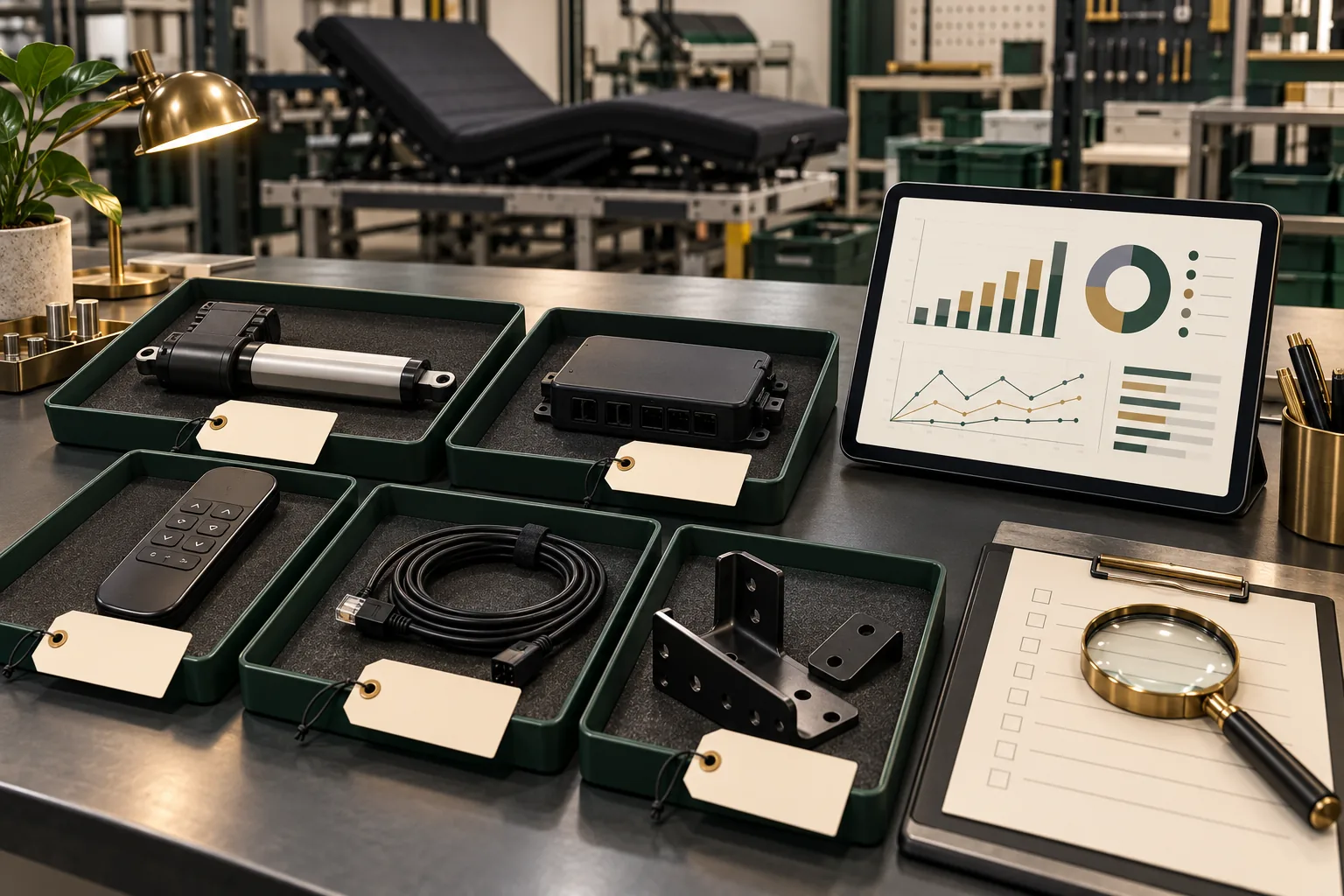
AI-generated concept illustration. It does not show KCAI customer returns, actual failure data, warranty performance, or a factory investigation.
This guide does not state a KCAI warranty duration, claim rate or product failure rate. Obtain current written terms for the exact model and contract.
Define one case language across sales, service, and factory teams
“Bed does not work” is not a root cause. It may describe lost power, a disconnected cable, remote pairing, control-box behavior, actuator failure, mechanical obstruction, assembly error, shipping damage, or an unresolved condition. If distributors, call centers, service technicians, and factories use different terms, the same issue will appear as several unrelated problems.
Create a two-level taxonomy: customer-observed symptom first, verified cause second. Keep “not reproduced” and “cause undetermined” as valid outcomes. That prevents teams from forcing weak evidence into a convenient supplier-fault category.
| Data layer | Example categories | Why it matters |
|---|---|---|
| Customer symptom | no movement, one section inactive, noise, remote issue, unstable frame | Enables consistent intake before diagnosis |
| Operating context | installation, first use, normal use, move/reassembly, power event | Helps separate setup from in-service patterns |
| Suspected subsystem | power, remote, control box, actuator, cable, frame, upholstery, packaging | Routes troubleshooting and parts |
| Verified cause | component, assembly, transit, instructions, misuse, software, unknown | Supports fair responsibility and action |
| Resolution | guidance, reset, spare part, repair, replacement, credit, no fault found | Connects case outcome to cost and inventory |
The taxonomy should match the actual product architecture. Do not copy component names from another model without checking the bill of materials.
Capture the minimum viable RMA record
Each case should include a case ID, customer or channel, commercial SKU, factory model, revision, serial or lot identifier where used, shipment date, installation date if known, failure date, reported symptom, photos or video where appropriate, diagnostic steps, component replaced, returned-part status, resolution date, direct cost, and final cause classification.
Also record who made the diagnosis and the evidence level. A phone-based hypothesis is different from a returned component examined by an engineer. Maintain privacy controls and collect only the customer information needed for service and legal obligations.
Use controlled lookup values where possible. Free text is still useful for context, but it should not be the only source for trend analysis. Require completion of core fields before closing a case, or report data quality alongside warranty metrics.
Calculate rates that buyers can compare
Raw claim counts reward low sales volume and punish high volume. Use a denominator that matches the decision:
- claims per units sold for commercial exposure;
- claims per installed units when installation data is reliable;
- component replacements per units containing that component;
- cost per shipped unit for financial planning;
- claims by months in service for early-life versus later patterns;
- repeat claims per serviced unit for repair effectiveness.
State the time window and maturity of the cohort. A model sold for three months should not be compared directly with one observed for two years. Segment by SKU, revision, lot, component supplier, channel, installer, geography, and production period only when sample sizes support a responsible conclusion.
Do not publish an industry benchmark without a reliable source and comparable definition. Your own stable baseline is usually more useful: watch for a change after a component, process, packaging, or instruction revision.
Use a closed-loop investigation workflow
When a signal crosses the buyer's agreed threshold, use a documented path:
- Triage: check for safety implications, repeated symptoms, affected lots, and customer containment needs.
- Preserve evidence: retain photos, logs where applicable, returned parts, packaging, labels, and chain-of-custody details.
- Contain: identify inventory, shipments, or service parts potentially affected and decide temporary controls.
- Investigate: reproduce the symptom, inspect the returned item, compare it with approved specifications, and test plausible causes.
- Correct: define action, owner, deadline, validation method, and affected documents or stock.
- Verify: monitor later production and field data to determine whether recurrence actually declined.
The ISO 10002 complaints-handling guideline provides a process-oriented reference for receiving, analyzing, and improving from complaints. It is guidance, not proof that a supplier's process is certified or effective. For design and configuration changes, ISO 10007 offers configuration-management guidance; buyers still need project-specific controls.
Connect root causes to the right corrective lever
Not every case requires a redesign. Confirmed installation errors may call for clearer instructions, labeled connectors, installer training, or packaging sequence changes. Transit damage may require pack-out or distribution testing review. A component trend may require supplier containment, incoming inspection, specification change, or a qualified alternative. Unresolved cases may require better diagnostic tools rather than an assumed cause.
Every approved change should reference the affected SKU and revision. Update drawings, bill-of-materials records, work instructions, inspection criteria, spare-parts compatibility, manuals, and service scripts as applicable. Avoid substituting a new component into production while support teams still stock incompatible parts.
The broader after-sales parts guide explains why compatibility and availability should be planned before shipment. The total-cost-of-ownership guide shows where service labor, replacements, and downtime enter the sourcing decision.
Align supplier and customer-facing warranty terms
The supplier agreement should define covered products and components, exclusions, evidence requirements, remedy options, response targets, returned-material authorization, freight responsibility, spare-parts pricing and availability, analysis ownership, recurring-defect escalation, and treatment of design or supplier changes.
Those commercial terms are not automatically the same as the warranty offered to US customers. The FTC's Businessperson's Guide to Federal Warranty Law explains federal warranty concepts for consumer products. Have qualified counsel review the exact written warranty, sales channel, disclosures, and state-law implications before sale.
Do not advertise a warranty duration merely because it appears in a supplier conversation. Use current, approved, model-specific written terms. Ensure service teams, product pages, manuals, and contracts all use the same released version.
Compare warranty scope before comparing warranty years
A long warranty headline can hide different responsibilities. Ask for the written terms for the exact base, motor, controls and upholstery. Then record who pays for the replacement part, diagnosis, labour, freight and return transport. These are commercial questions for the actual agreement, not assumptions about what KCAI offers.
| Customer reports | Record needed | Responsibility to agree |
|---|---|---|
| Control does not respond | Model, revision, handset identity and symptom | Diagnosis and compatible replacement |
| Motorized section stops | Safe video, position and batch record | Authorized inspection and remedy |
| Visible delivery damage | Carton and product photos | Carrier claim and handoff |
| Mattress-and-base bundle complaint | Both product identifiers | Which party investigates the interface |
Example: a disputed replacement request
A hypothetical retailer receives a report about a remote. The product label and handset code are photographed safely, and the customer describes what does not respond. The supplier checks the exact control revision before a part is selected. The case then follows the agreed written terms for diagnosis, shipment and labour. This scenario is a process example, not a KCAI claim or customer case.
Connect the service agreement to the spare-parts planning guide and retail returns triage process. Ask for the actual warranty document before retail copy is approved.
When the offer combines a mattress and base from different suppliers, use the bundle warranty responsibility matrix to define the customer intake and the handoff between the two product teams.
Build the supplier scorecard before the first shipment
Agree on the monthly or quarterly scorecard fields during sourcing. Useful measures include case data completeness, claim rate by mature cohort, response time, diagnostic closure time, repeat issue rate, spare-parts fill rate, corrective-action timeliness, and recurrence after closure. Define each measure so both parties calculate it the same way.
For a new program, send the planned SKU architecture, target market, channel, service model, warranty expectations, diagnostic flow, and desired spare-parts kit with the RFQ. Ask what component identification and investigation support can be provided for that exact model.
Review available controls and accessories and the OEM/ODM process, then request model-specific documentation rather than assuming compatibility or coverage.
Request a quote and include “warranty/RMA planning” so spare parts, case data, and investigation responsibilities can be discussed before order approval.