On this page
Adjustable bed spare-parts traceability is the ability to identify a finished bed's production configuration and select a compatible replacement part using controlled model, revision, serial or lot, component and change records. A product name alone may be insufficient when motors, control boxes, remotes, harnesses or connectors have changed during the program.
For distributors and private-label brands, traceability turns after-sales service from visual guesswork into a repeatable decision. The goal is not to place a barcode on every item for appearance. It is to connect the customer's bed to the exact compatible part and the instruction needed to replace it safely.
Build the traceability chain
The chain begins with the finished product and ends with the service action.
| Record | What it should answer |
|---|---|
| Finished-product identity | What model, size and revision did the customer receive? |
| Production reference | Which lot, order or date range produced this unit? |
| Component mapping | Which actuator, control box, remote, harness and power parts were approved for it? |
| Change history | When did a part change, and which finished units are affected? |
| Compatibility rule | Is the replacement direct, paired with another part or part of a conversion kit? |
| Service record | What symptom was reported, what was sent and what was the outcome? |
Define the level of identification that the program can maintain consistently. A serial number is useful only when production and service systems can retrieve meaningful data from it.
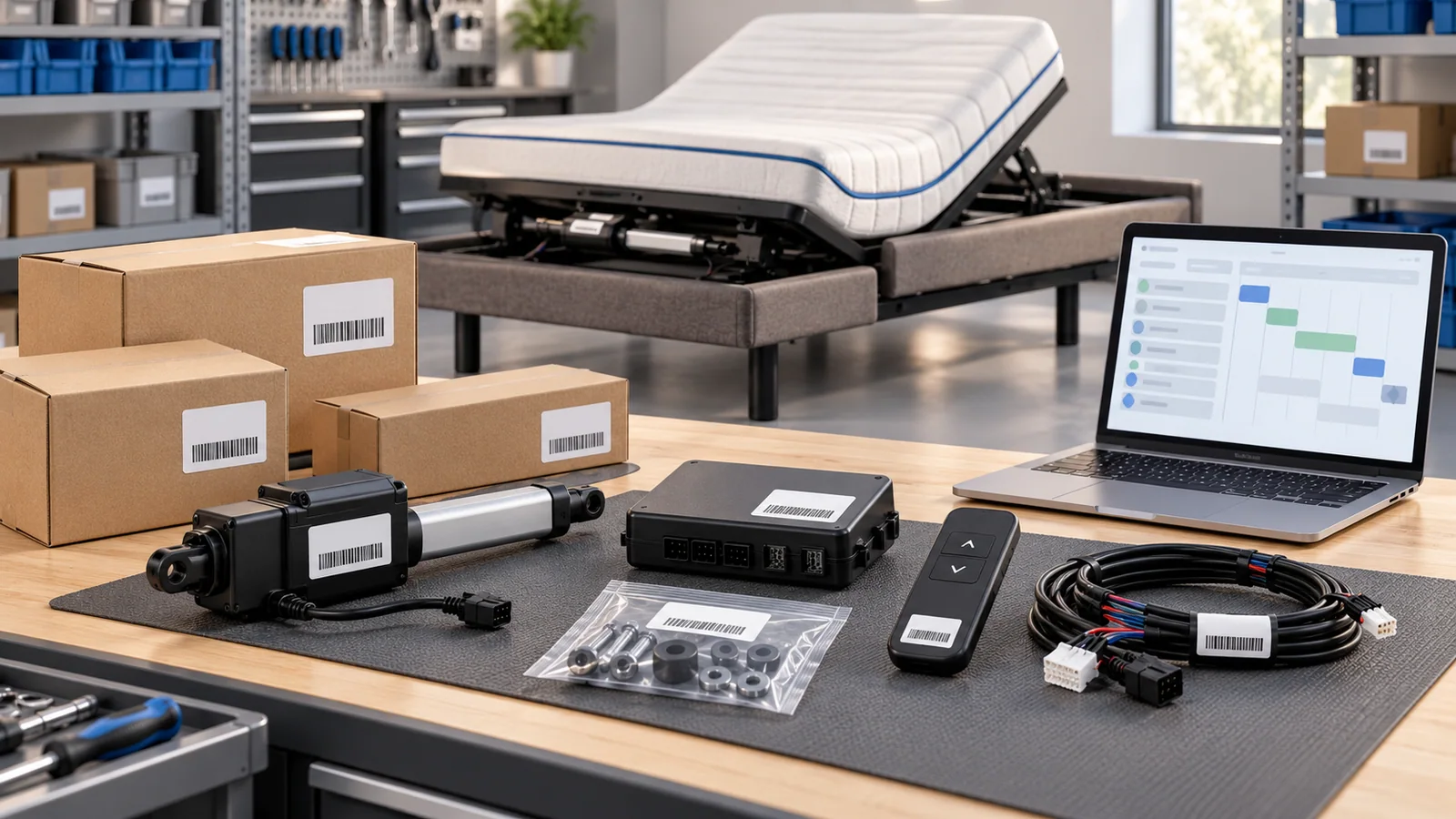
AI-generated editorial illustration. It is not a photograph of KCAI parts inventory, serial labels or service software.
Start with the information customer service can collect
Design the process for a real support conversation. Before selecting a part, ask for:
- finished-product model and size;
- serial or lot identifier if available;
- purchase channel or order reference;
- clear photographs of the product label, affected component label and connectors;
- a description or video of the observed symptom; and
- any previous parts or repairs.
Do not ask an unqualified user to perform unsafe electrical or mechanical diagnosis. The information-gathering script should stay within the service procedure approved for the product and market.
The KD010-A2 disassemblable electric bed frame can be discussed as a serviceable OEM concept, but the exact spare-parts list and compatibility rules must be confirmed for the ordered configuration.
Create a compatibility table, not a picture library
Two control boxes can look identical yet use different software, connector arrangements or permitted functions. Two actuators can share a housing but differ in stroke, mounting or system compatibility. Visual matching should be used to support identification, not replace controlled data.
A service compatibility table can include:
- finished model and revision range;
- component category and approved part number;
- supplier model where disclosure is permitted;
- connector and paired-component identity;
- direct replacement, paired replacement or conversion-kit status;
- required instructions and validation record; and
- effective production range and obsolescence status.
Keep the customer-facing name simple, but preserve exact technical identity behind it.
Handle component changes before stock is mixed
When a part changes, decide whether old and new revisions are interchangeable. The answer may be:
- direct replacement: approved without changing another component;
- paired replacement: must be replaced with a matching control, remote or harness;
- conversion kit: requires multiple parts and specific instructions; or
- not compatible: must remain separated and clearly identified.
Do not label a substitute as equivalent until the responsible technical team has reviewed fit, function, interfaces and required evidence. Connect every approved substitution to the design-freeze and change-control process.
Define service kits around the repair task
A spare part may require mounting hardware, an adapter harness, instructions or packaging protection. Build the kit around the approved service action, not just the largest component.
For each kit, define:
- compatible finished-product range;
- included parts and quantities;
- tools or skills required;
- replacement and post-repair check instructions;
- return or disposal instructions where applicable; and
- kit label and revision.
If a repair is not intended for consumers, state the required service channel clearly. Avoid publishing a universal installation video when multiple revisions need different steps.
Plan service stock with evidence, not promises
Buyers should discuss spare-parts scope, commercial terms, replenishment and obsolescence before launch. However, do not publish an unsupported stock percentage, response time or years-of-availability promise. Base the plan on the order volume, installed configurations, failure and return data, lead time and the brand's service policy.
The broader adjustable bed after-sales spare-parts guide explains how to structure the commercial service plan. The traceability system described here is what makes that inventory usable.
Use RMA data to improve the product record
Record the part dispatched, reported symptom, production identity and confirmed outcome. Over time, this helps distinguish a recurring component issue from assembly, shipping, setup or diagnosis problems. Follow the warranty and RMA data guide to define useful reason codes without overstating conclusions from a small sample.
Buyer audit questions
- Can the supplier map a finished-product revision to its approved electrical and mechanical parts?
- Are old and new connectors or controls distinguishable?
- Does every approved substitute have a documented compatibility decision?
- Can customer service identify the right kit without relying only on appearance?
- Are service instructions revision-controlled?
- Can an RMA record be connected back to production identity?
- Is obsolescence communicated before incompatible parts are mixed?
Buyer takeaway
Spare-parts availability has little value if the correct revision cannot be selected. A scalable service program links product identity, component compatibility, change control and service outcome in one traceable chain.
For a private-label program, send KCAI your target product and after-sales requirements. We can identify the configuration and service-part records that should be agreed before sample approval and launch.