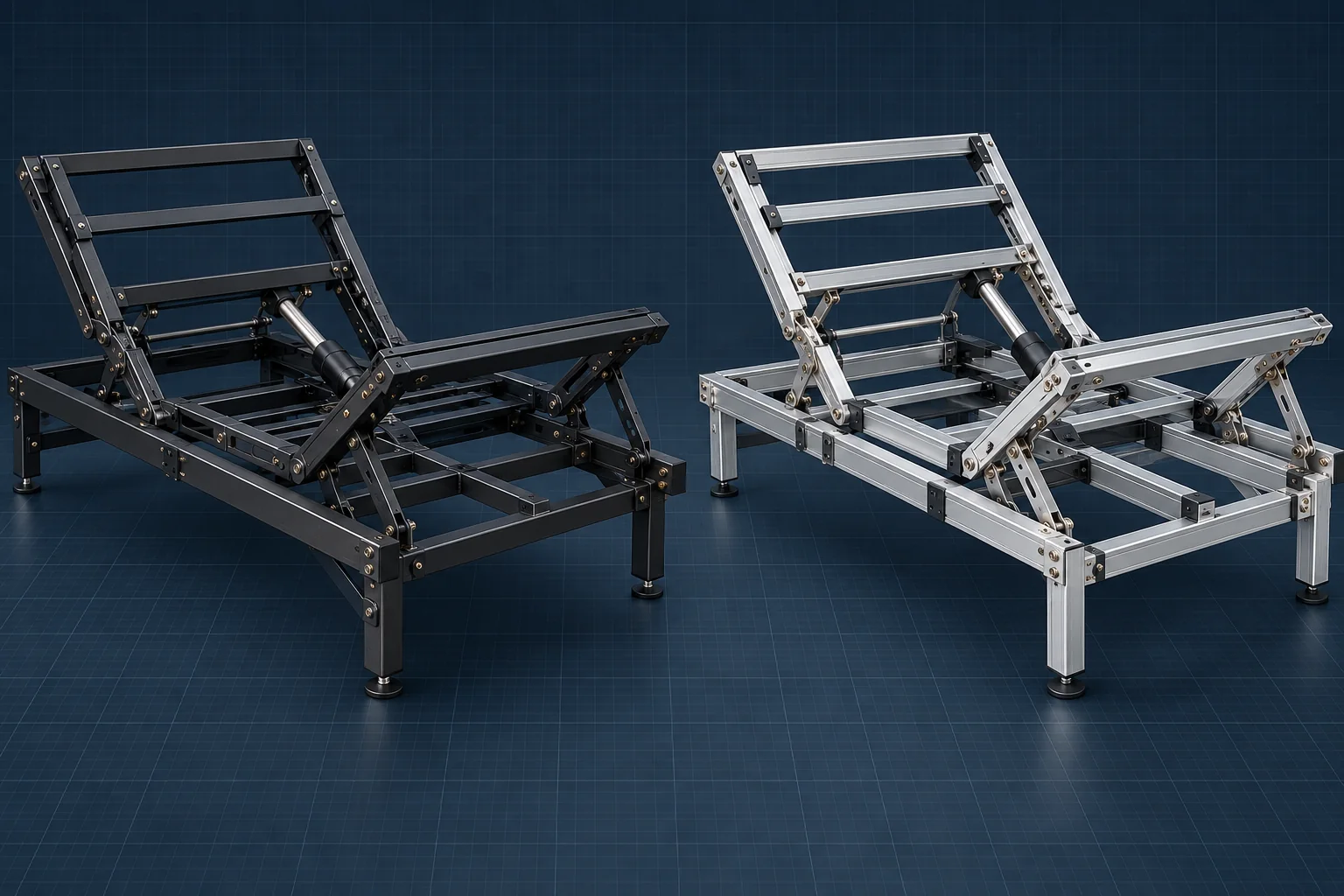
On this page
The right adjustable bed frame material is not selected by asking whether steel or aluminum is “stronger.” An OEM buyer must compare the complete structure: material grade, section geometry, wall thickness, joints, moving linkages, actuator mounts, surface treatment, finished weight, packaging and verified performance. A poorly designed frame does not become reliable because its material name sounds premium.
Carbon steel can offer a practical path to stiffness, weldability and cost control in a suitable geometry. Aluminum may reduce finished mass and avoid red rust, but often requires different section sizes, joints and corrosion controls. Hybrid construction may be appropriate when each material has a defined role in the load path. Compare completed designs against the same load cases and acceptance criteria.
Quick comparison for OEM buyers
| Decision factor | Carbon-steel structure | Aluminum structure | Evidence to request |
|---|---|---|---|
| Structural efficiency | Can achieve high stiffness in compact formed or tubular sections | Can reduce mass but may need larger profiles for equivalent system stiffness | Section drawing, grade, wall thickness and complete-frame test record |
| Joining | Commonly welded, bolted or riveted | Commonly bolted, riveted, mechanically locked or welded using a controlled process | Joint drawings, process controls and inspection criteria |
| Corrosion strategy | Usually depends on coating quality and coverage | Does not form red rust, but surface finish and galvanic contact still need review | Finish specification, pretreatment and environmental test scope |
| Shipping and handling | Higher mass may affect carton weight and installation | Lower mass may support handling goals | Packed gross weight, carton plan and assembly method |
| Cost model | Often favorable for high-volume fabricated frames | Material and joining costs may be higher depending on design | Revision-controlled quotation with included processes |
| Field repair | Familiar fabrication methods, but repairs can invalidate finish or warranty | Repairs may require alloy-specific methods and parts replacement | Approved service policy and replacement-part plan |
This table is a decision map, not a universal ranking. Supplier quotations should state the actual design rather than substituting generic “steel frame” or “aluminum frame” labels.
Material name is not a structural specification
“Carbon steel” covers multiple grades, forming conditions and coating systems. “Aluminum” covers multiple alloy families and tempers. Without grade, section and process information, the material field in a quotation cannot support an engineering decision.
Ask the supplier to identify:
- material family and applicable grade;
- tube, sheet or extrusion dimensions;
- nominal wall or sheet thickness and permitted tolerance;
- joint type at each critical load path;
- surface preparation and finish;
- critical fastener specification and locking method; and
- drawing revision that matches the tested sample.
The purpose is not to collect confidential factory know-how. It is to prevent a commercial sample, drawing and production order from referring to three different constructions.
Compare stiffness, not only tensile strength
An adjustable base must hold shape while its deck changes angle and the linkage transfers force through pivots. Buyers therefore need to consider bending stiffness, unsupported span, local buckling, hole deformation and joint movement. A material strength value by itself does not describe those behaviors.
A deeper rail may be stiffer than a shallow rail made from a nominally stronger material. A reinforced actuator bracket may perform better than a thicker but poorly supported plate. A light frame may be entirely suitable if geometry and joints are designed for the declared use; a heavy frame may still flex if the load path is weak.
BSI describes BS EN 1725:2023 as covering safety, strength and durability for fully assembled adult beds in domestic and non-domestic environments. Its scope is an important reminder: buyers evaluate an assembled bed system, not an isolated metal coupon. The applicable standard and test edition must still be confirmed for the destination, product type and intended use.
Review joints as closely as the metal
Many frame problems begin at interfaces: a weld toe, elongated bolt hole, loose pivot, distorted bracket or fastener without a defined locking method. The two material routes create different manufacturing questions.
For welded carbon steel, review weld location, access, distortion control, finish coverage around the weld and the inspection method. For aluminum, review the alloy-specific joining process, heat-affected design considerations where welding is used, and whether bolted interfaces distribute load without crushing or fretting the profile.
For both materials, the golden sample should control:
- pivot hardware and bushing stack;
- actuator bracket location;
- fastener grade and tightening method;
- hole and slot dimensions;
- anti-loosening features;
- left-right symmetry; and
- inspection points that remain visible after upholstery or deck panels are installed.
The adjustable bed actuator engineering guide explains why actuator performance cannot be separated from its mounting geometry.
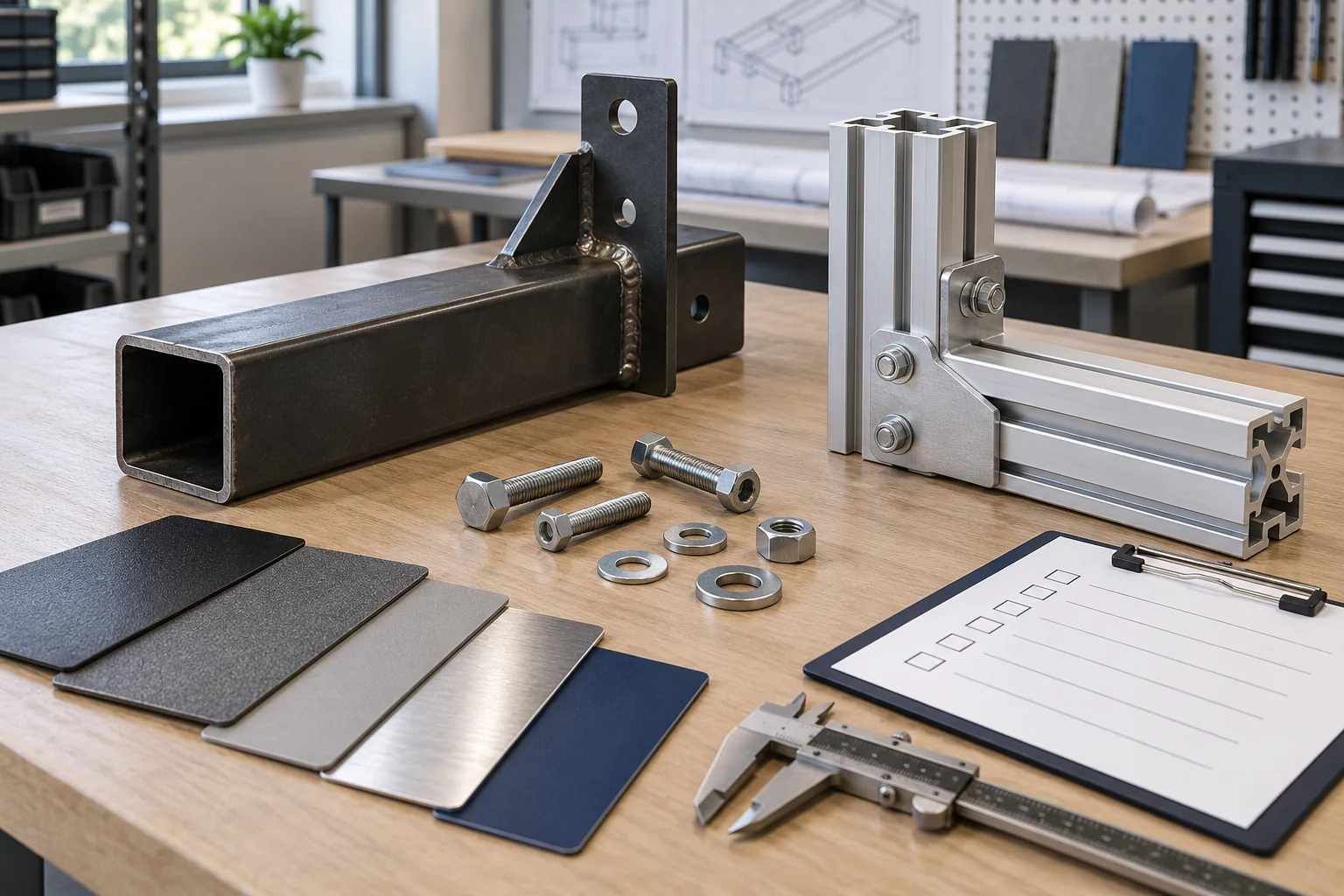
AI-generated concept image for editorial explanation. It does not depict a specific KCAI material specification, production process or approved sample.
Put corrosion control in the specification
Carbon steel normally relies on a defined protective finish. Buyers should specify pretreatment, coating type, color or appearance requirement, coverage expectations and acceptance criteria for chips, thin areas and inaccessible interfaces. Packaging should prevent finished parts from rubbing through the coating during transport.
Aluminum avoids red-rust staining, but that does not make every aluminum assembly maintenance-free. Surface appearance, cleaning chemicals, moisture traps and contact with dissimilar metals can still affect the system. A mixed-metal frame needs compatible fasteners and an interface strategy appropriate to its environment.
Do not request a generic salt-spray duration simply because it appears in another product specification. First define the expected environment and failure mode, then agree the relevant method, sample preparation and acceptance criteria with a qualified test partner.
Include logistics and installation in the material decision
Frame mass affects more than freight. It can influence manual handling, carton design, final-mile procedures, installer staffing and the customer's first setup experience. Aluminum may help a weight target, but a larger section or extra joining hardware can offset part of that benefit. Steel may support a compact folded structure, but gross carton weight still needs verification.
Evaluate a production-intent packed sample, not an unboxed prototype. Record:
- net and gross weight by carton;
- largest component dimensions;
- number of people or tools required for safe assembly;
- risk of finish damage during unpacking;
- hardware count and error-proofing; and
- whether the assembled product can be moved without using an unsuitable structural member as a handle.
The KD010-A2 disassemblable adjustable bed frame can begin a discussion about packed configuration and field assembly, while the final material, dimensions and commercial scope must be confirmed for the quoted project.
Validate the finished frame under relevant load cases
Material selection should end with a test plan for the complete approved configuration. Depending on the destination and intended use, that plan may include distributed loading, edge loading, asymmetric loading, articulated positions, repeated operation, impact, stability, entrapment review and electrical safety.
UL Solutions identifies UL 962 among its furniture safety standards and describes furniture evaluation as covering issues such as electrical shock, fire hazards, mechanical stability, strength and integrity. Certification scope cannot be inferred from a component logo or a material choice. Ask which exact finished product, construction and factory are covered by any certificate presented.
Use the adjustable-bed trade-show inspection checklist to record the first physical observations that should feed a later engineering validation plan.
Build a material approval package
Before mass production, place these items under the same revision:
- frame and critical-joint drawings;
- material and finish specification;
- bill of materials for structural parts and fasteners;
- approved production-intent sample;
- applicable test plan and report references;
- packed configuration and assembly instructions;
- inspection checklist; and
- change-notification requirement.
If a factory proposes changing a tube, profile, bracket, fastener, coating or supplier, the buyer should assess whether the change affects fit, load path, test coverage, appearance, packaging or service parts. “Equivalent material” is not an adequate change description.
Ask KCAI for a project-specific frame review
KCAI's adjustable bed products include different architectures for upholstery integration, disassembly, motion and retail positioning. The public catalogue should be used to identify a direction, not to assume an unlisted material grade or load rating.
Request a quote with the destination market, sizes, intended use, target packed weight, installation model, finish expectations and required evidence. KCAI can then confirm available options for the selected model or discuss an OEM/ODM configuration against a controlled technical brief.