The Short Answer
Choose an adjustable bed whose drive system comes from an established actuator manufacturer — such as German OKIN or Haojiang motors — backed by in-house lab testing of 10,000+ lift cycles, and match the architecture to your market: a separated lifting system (like the KD010-A2, 2000x900mm) when buyers want mattress freedom, or a one-piece integrated design (like the KD001-B1, 2000x1800x500mm) for a single-box retail product. Verify the mechanism type (wall-hugger vs fixed pivot), the structural stack the actuator pushes against, and the documentation your factory can actually produce. Everything below shows you how to check each of these before committing tooling or volume.
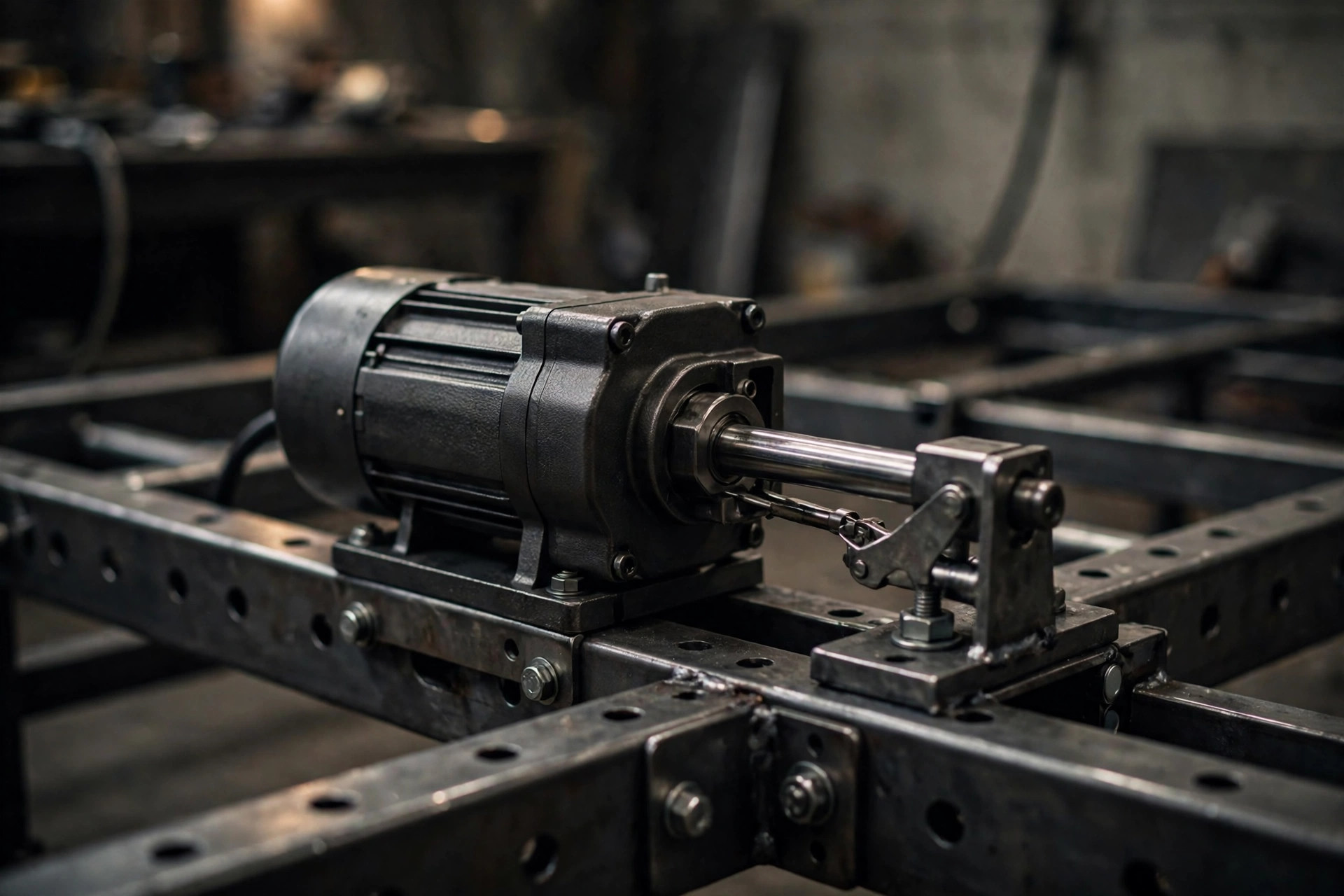
Conceptual illustration of an adjustable bed actuator mechanism (AI-generated for illustrative purposes; not a photograph of a specific KCAI component).
OKIN, Haojiang, and Generic Actuators: What the Categories Mean for Buyers
Every adjustable bed is built around a motion system. The linear actuators that raise the backrest and leg sections decide almost everything a buyer will judge: smooth motion, noise, left-right synchronization, and long-term reliability. For B2B buyers they also decide the economics — a documented, traceable drive system keeps warranty and service costs predictable, while an undocumented drive transfers the risk downstream to you and your distributors.
Drive systems fall into three sourcing categories, and what each implies for documentation, consistency, and service matters more than any single brand name.
German OKIN actuators. OKIN is a long-established German manufacturer of linear drive systems for furniture applications. Units in this category typically arrive with full datasheets and defined parameters, and every unit is traceable to a production batch, with replacement parts available through established channels. For markets with high service expectations, that traceability is the main value.
Haojiang actuators. Haojiang is a Chinese actuator manufacturer widely used in China-made adjustable beds, including the KCAI range. This category balances performance and cost: modern drive units with soft start/stop motion, low-noise design, and energy-efficient operation — actuators only draw power while moving.
Generic or unbranded drive systems. Typically selected on unit price. They can perform acceptably, but documentation is thinner, performance can vary between batches, and spare-part availability depends entirely on the factory's willingness to stock them. The risk is not that every generic actuator fails — it is that tracing a failure and sourcing an identical replacement is harder.
Actuator categories at a glance
| Factor | Branded actuators (OKIN / Haojiang) | Generic drives |
|---|---|---|
| Manufacturer documentation | Datasheets and defined parameters available | Often limited |
| Batch traceability | Traceable to production batch | Varies by supplier |
| Spare-part supply | Established channels | Depends on factory stocking |
| Batch-to-batch consistency | Controlled specifications | May vary |
| Typical use case | Markets with service expectations | Price-driven entry lines |
KCAI specifies German OKIN and Haojiang motors across its electric bed and mattress ranges, paired with the in-house cycle testing described below. The point is not that one category is "good" and another "bad" — each carries different documentation, consistency, and service implications. Match your choice to your market's expectations and warranty-cost tolerance.
What 10,000+ Cycle Durability Testing Actually Measures
Cycle testing is the most quoted — and most misunderstood — durability metric in the adjustable bed industry. Here is what the number actually means.
One cycle is one complete travel of the lifting system: the actuator drives the mechanism from flat to its full raised position and back to flat, under load, in a test fixture. A "10,000+ cycle" rating means the lifting system completed more than ten thousand such round trips in the lab.
How a lab runs the test. The lifting section is mounted in a fixture that applies a representative load, then cycled thousands of times while technicians inspect it at intervals for structural failure (cracked welds, deformed brackets, loose fasteners), abnormal noise, loss of synchronization between sides, and any loss of function. A unit passes when it completes the full count with none of these failure modes.
What KCAI actually tests. KCAI runs the lifting systems of its electric bed frames through 10,000+ aging cycles in its in-house lab. Its KD001-B2 electric mattress (2000x1800x530mm, 3D breathable material) is tested to 15,000+ cycles. These are real in-house endurance runs, not theoretical calculations.
What the number does not mean. A cycle count is laboratory endurance, not a promise of years of service — real-world life depends on user weight, usage frequency, environment, and maintenance. When comparing suppliers, ask what load the test used and whether the report comes from the factory's own lab or a third party.
Separated vs Integrated Lifting Architecture
Beyond the actuator itself, buyers must choose the architecture: how the lifting system relates to the sleeping surface. KCAI's catalog contains clear examples of both.
Separated architecture — KD010-A2. The KD010-A2 is a split-design AI bed frame (2000x900mm; Twin, Full, Double, Queen, and King customizable) whose lifting system is separated from the mattress. The base provides the motion; the end user places their own mattress on top. This suits markets where consumers already own a preferred mattress, or where retailers sell base and mattress as separate SKUs.
Integrated architecture — KD001-B1. The KD001-B1 (2000x1800x500mm, side height 300mm) builds the lifting system and mattress as one unit. This suits a single-box retail story: one product, one delivery, one setup. The trade-off is that mattress and mechanism must be designed as one system — the actuator's load path runs through a structure that includes the mattress support.
Separated vs integrated at a glance
| KD010-A2 (separated) | KD001-B1 (integrated) | |
|---|---|---|
| Dimensions | 2000x900mm (Twin–King customizable) | 2000x1800x500mm, side height 300mm |
| Lifting system | Separated from mattress | One-piece integrated with mattress |
| Backrest / leg angles | 0–60° / 0–40° (bed frame range) | 0–55° / 0–35° (mattress range) |
| Cycle-test level | 10,000+ (lifting system, in-house lab) | 10,000+ (lifting system, in-house lab) |
| Best fit | Mattress freedom, separate SKUs | Single-box product, simple retail story |
The engineering note buyers often miss: the same actuator behaves differently in each architecture because the load path differs. In a separated design, the actuator pushes a rigid frame; in an integrated design, it works through a structure that includes mattress support layers. Read cycle-test results per architecture — do not assume they transfer.
Wall-Hugger vs Slide-Back vs Fixed Mechanisms
The mechanism is the linkage geometry between the actuator and the moving sections. Three types dominate the market.
Fixed-pivot mechanisms. The head section rotates around a fixed pivot point. As the backrest rises, the top of the mattress moves away from the headboard — and away from the nightstand. This is the simplest, most cost-effective geometry, and it works well for price-driven product lines where the gap is acceptable to the market.
Wall-hugger (slide-back) mechanisms. As the backrest rises, the head section also translates backward toward the wall, so the sleeper stays close to the nightstand in any position — important for buyers who read, work, or eat in bed. KCAI's KD001-A7 is a wall-hugger-class model (framed slide-back design) in 2000x1800, 2000x1500, and 2000x900mm; the KD004-A3 is a slide-back model in the same size range.
Staying near the nightstand may help users find a more comfortable reading or resting position — but adjustable beds are furniture, not medical devices, and anyone with a medical condition should consult a physician.
For B2B buyers, the mechanism choice is a market-fit decision. Premium lines usually justify the wall-hugger; entry lines usually do not. Note that a wall-hugger linkage under load is a more demanding application for the actuator than a simple fixed pivot — one more reason to check the cycle-test documentation behind it.
The Structural Stack Behind the Actuator
An actuator is only as good as the structure it pushes against. If the frame flexes, the mechanism binds; if the support panel deforms, the motion goes uneven. KCAI builds its electric bed frames on a defined structural stack:
- High-quality steel for the load-bearing frame and mechanism brackets
- High-strength honeycomb aluminum panel for rigid, lightweight support surfaces (also used in models like the KD002-B1 with its split left/right backrest lift)
- Eco multi-layer board (15/18mm) for the deck surfaces
- High-density foam and selectable upholstery fabrics for the comfort layers
The motion envelope this structure supports is defined: bed frames adjust the backrest 0–60° and the leg section 0–40°; electric mattresses adjust the backrest 0–55° and the leg section 0–35°. What a buyer is actually purchasing is a verified range of motion held by a verified structure — not just a motor.
When evaluating any factory, ask for the structural specification in the same detail you ask for the actuator brand. A supplier that can name its steel, panel, and board specifications — and show how they are tested together — is engineering a system. One that can only name the motor is selling you a component.
Buyer's Engineering Checklist for OEM/ODM Partners
Use this checklist when qualifying an adjustable bed factory. Every item should have a document behind it, not just a verbal answer.
- Actuator brand and model. Which drive units are specified — OKIN, Haojiang, or other — and can the factory show the datasheet?
- Cycle-test reports. Does the factory run its own lab testing (KCAI: 10,000+ cycles for lifting systems, 15,000+ for the KD001-B2 mattress), and can you see the load and pass criteria?
- Architecture documentation. For separated designs like the KD010-A2 and integrated designs like the KD001-B1, are the load paths and test results documented per architecture?
- Mechanism geometry. Fixed, wall-hugger, or slide-back — which linkage is in your model, and was the cycle test run on that exact geometry?
- Structural materials. Steel, honeycomb aluminum panel, eco multi-layer board specifications — named, not generic.
- Control ecosystem. Remote models (KCAI uses units such as SK.29.11, SK.34.09, SK.50.17, SK.27.11, SK.27.19, SK.51.11, SK.51.19, SK.67.09), plus wireless, app, and voice options where offered.
- Certifications. Third-party references such as CNAS, SGS, TUV, or UL where applicable to your target market.
- Spare parts and service. Which wearing parts are stocked, for how long, and through which channel.
A factory that answers all eight with documents is a manufacturing partner. One that answers with adjectives is a trading risk.
Frequently Asked Questions
Should I choose OKIN, Haojiang, or a generic actuator for my adjustable bed line?
All three categories can work depending on your positioning. German OKIN brings established documentation and global traceability; Haojiang, widely used in China-made adjustable beds, offers strong cost-performance with soft start/stop motion, low-noise design, and energy-efficient operation; generic drives compete on price but vary more between batches. Match the category to your market's service expectations, and verify documentation, batch traceability, and spare-part supply rather than deciding on unit price alone.
What does 10,000+ cycle durability testing actually mean?
One cycle is one complete lift-and-lower travel of the lifting system under load in a test fixture. KCAI's bed-frame lifting systems complete 10,000+ such cycles in its in-house lab (the KD001-B2 mattress: 15,000+), with inspections for structural failure, abnormal noise, and loss of function. Treat the figure as laboratory endurance evidence — not a guaranteed number of years of use — and ask for the test load and pass criteria behind it.
Separated or integrated lifting architecture — which should I buy?
Choose a separated architecture like the KD010-A2 split-design bed frame (2000x900mm, Twin–King customizable) when your market wants to pair the base with different mattresses or sell base and mattress as separate SKUs. Choose an integrated one-piece design like the KD001-B1 (2000x1800x500mm) for a single-box product with a simpler retail story. Verify cycle testing per architecture, since the actuator's load path differs between the two.
Do I need a wall-hugger mechanism?
If your buyers read or work in bed and want the head section to stay near the nightstand as it rises, specify a wall-hugger (slide-back) mechanism such as KCAI's KD001-A7. For price-driven lines where the nightstand gap is acceptable, a fixed-pivot mechanism is the economical choice. Confirm the cycle test was run on the exact linkage geometry you are buying.
What engineering documentation should my OEM/ODM partner provide?
At minimum: the actuator brand and model with datasheet, in-house cycle-test reports with load and pass criteria, structural material specifications, remote control model numbers, applicable certification references (CNAS, SGS, TUV, UL), and written spare-part availability terms. Documentation you can file is worth more than claims you can only repeat.
Two ways to work with KCAI. If this guide matches how you evaluate product, there are two ways to move forward. For OEM/ODM custom manufacturing — your dimensions, mechanism geometry, upholstery and control options, engineered and tested in our in-house lab — start with our OEM/ODM program and send your specification to our engineering team. For wholesale purchase of existing models — including the KD010-A2 separated-lift adjustable electric bed base and the current electric mattress range — request a quote with your target models, sizes, and volumes, and we will respond with specifications, testing documentation, and terms.