On this page
An adjustable base mattress brand OEM program succeeds when the mattress and powered foundation are developed as one customer experience, even if they come from different bills of materials or suppliers. Compatibility is not proven by placing a flexible mattress on a moving base for a showroom photograph. The approved system must maintain support, fit, retention, appearance and usable controls through its intended motion and service life.
For a mattress brand, the adjustable base introduces new engineering, packaging, compliance and after-sales responsibilities. This guide turns those responsibilities into a launch sequence that sourcing, product, quality and customer-service teams can share.

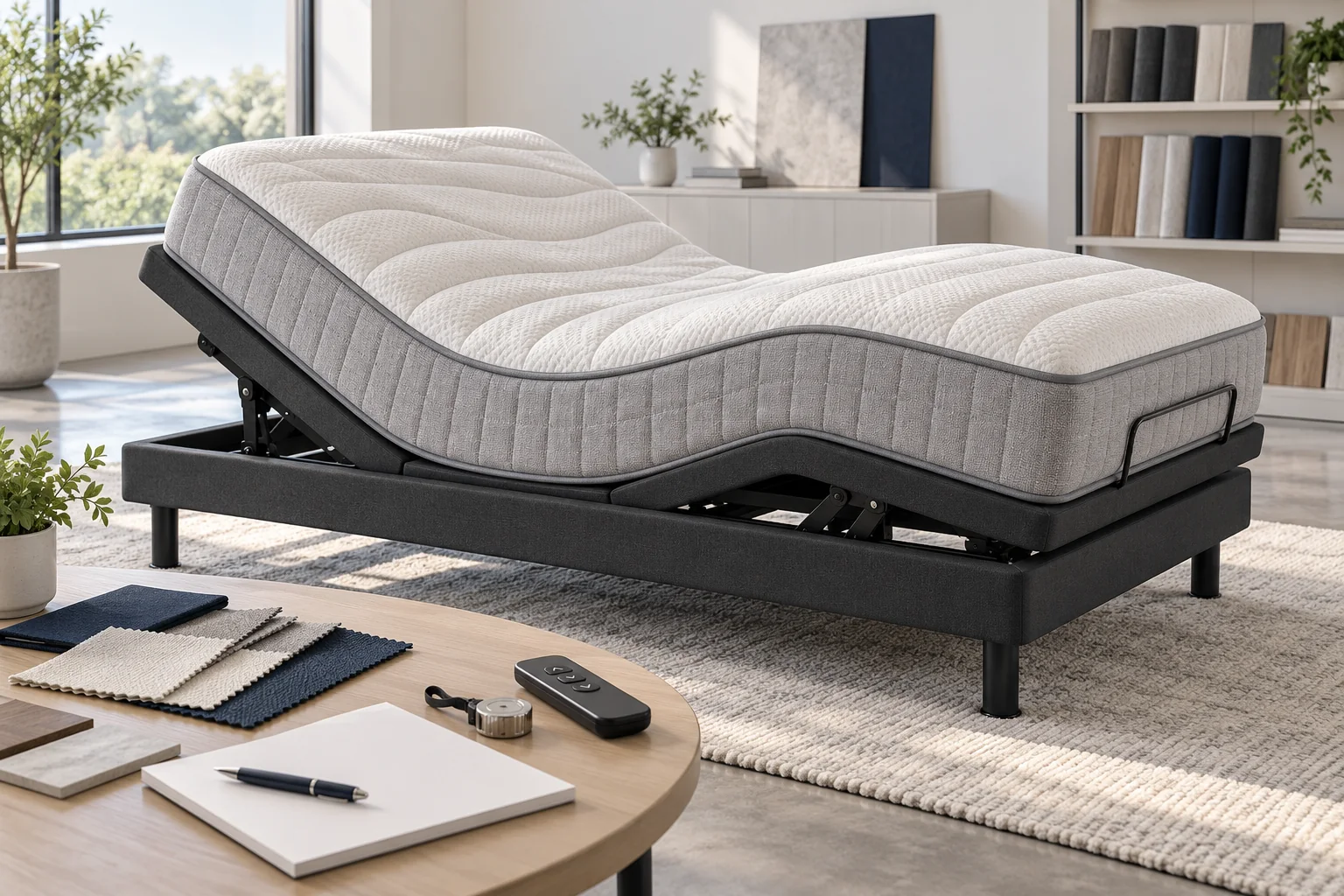
AI-generated editorial concept. It is not a KCAI product photograph, test result or customer project.
Quick answer: approve the system at seven interfaces
Before launch, create one approval record for the exact mattress and base revisions. Close each interface with a sample observation or controlled document; an open item remains an open launch decision.
| Interface | Minimum approval evidence |
|---|---|
| Mattress and moving deck | Paired-sample motion, recovery and layer/cover observations |
| Contact and retention | Starting marks, migration result and retainer contact check |
| Size and furniture | Shared drawing and measured clearance in intended surround |
| Controls and user | Approved handset, pairing, preset and instruction check |
| Power and installation | Cable keep-out and assembled-system inspection |
| Packaging and delivery | Packed-sample trial with component and handover record |
| Claims and market scope | Claim-to-document map for the sold configuration |
Use this matrix to decide whether to approve, revise or hold the proposed pairing. The mattress compatibility checklist covers the technical sample work; the golden-sample guide covers the controlled release record.
Define the commercial offer before selecting a base
Start with the promise the brand wants to make. Will the adjustable base be an optional accessory, a recommended companion, a bundled sleep system or an integrated adjustable mattress? Each route changes merchandising, inventory and service.
| Offer structure | Advantage and approval focus |
|---|---|
| Base sold separately | Flexible mattress choice; define the approved mattress range, dimensions and exclusions. |
| Mattress and base bundle | A controlled pairing; match the paired SKU, labels, packaging and revisions. |
| Upholstered complete bed | A furniture presentation; review the surrounding dimensions, motion envelope and installation. |
| Integrated motion mattress | A single-system offer; evaluate the complete system, service access and logistics. |
The private-label adjustable bed service page explains the wider brand-development route. This article focuses on the technical handoff between the mattress brand and base program.
Map mattress flexibility to deck geometry
“Works on an adjustable base” is not a complete mattress specification. The layer stack, quilting, border construction, adhesives, zoning and cover tension influence how the product bends. The base contributes deck breaks, hinge radii, surface friction, retainer location and motion sequence.
Test the exact production-intent combination in flat, head-up, knee-up and combined positions. Observe:
- whether the mattress follows the deck or bridges across a hinge;
- whether layers shift or the cover develops persistent wrinkles;
- whether the foot end remains engaged with the retainer;
- whether side edges migrate beyond agreed limits;
- whether compressed areas recover after returning flat; and
- whether motion creates interference with a surround or headboard.
The adjustable bed mattress compatibility checklist provides a deeper material and sample review. Do not extend approval from one mattress height or construction to an entire collection without evidence.
Control mattress migration and retention
Mattress movement can be caused by a smooth deck surface, a low-friction mattress bottom, insufficient retainer coverage, unsuitable dimensions or repeated asymmetric use. A larger retainer is not automatically the answer: its height, edge finish and contact with the mattress must remain safe through articulation.
Define the approved interface layer and mattress bottom fabric. Mark starting positions during sample tests and measure movement after repeated sequences. Check the retainer with bedding installed, because a fitted sheet or protector can change the interface.
For split systems, also review the center relationship between the two mattresses and bases. The Split King gap OEM guide explains how lateral migration, bedding and furniture clearances contribute to customer complaints.
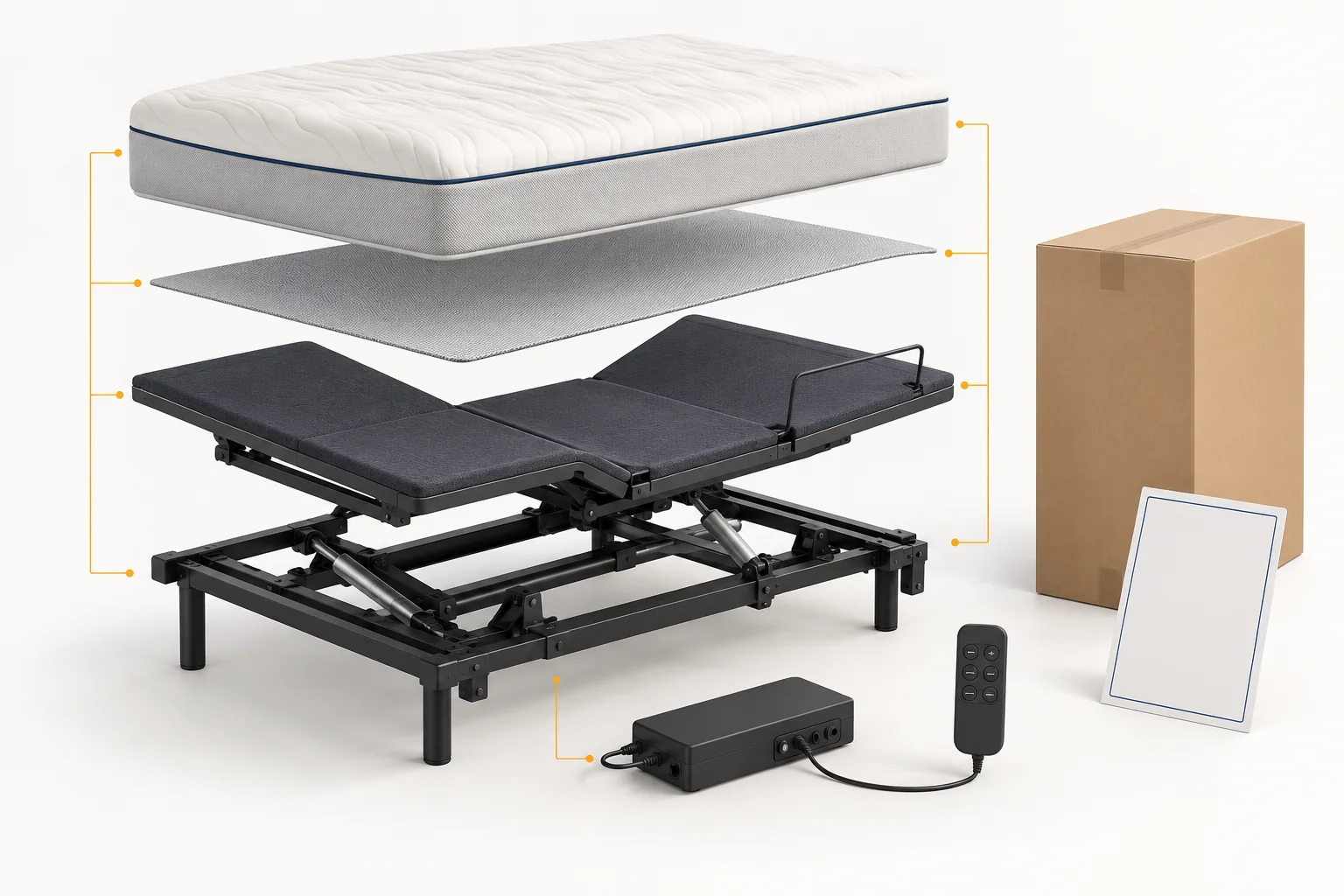
AI-generated editorial concept. It does not represent a specific KCAI product construction, customer program or approved packaging configuration.
Build a shared dimensional drawing
The mattress team and base supplier should work from one dimensional interface document. At minimum, it should show:
- nominal mattress length, width and height range;
- base deck dimensions and segment break locations;
- retainer position and allowed contact zone;
- maximum motion envelope;
- corner radius and upholstery build where relevant;
- cable and power-supply keep-out zones;
- inside dimensions of any surrounding bed; and
- tolerance ownership for each interface.
A shared drawing prevents both parties from meeting their individual dimensions while the assembled system still rubs, gaps or appears misaligned. Photographing a successful sample is useful, but the controlled drawing is what makes the result repeatable.
Specify controls as part of the brand experience
An adjustable base adds a user interface that may be unfamiliar to a mattress customer's support team. Decide which functions belong in the launch SKU, which are optional, and which should not be advertised until confirmed.
Review button order, icons, labels, pairing, memory behavior, synchronization for split systems, child-lock or safety behavior where applicable, power-loss instructions and troubleshooting. Confirm the handset shown online matches the one packed with the approved revision.
The remote-control specification guide provides a structured approval checklist. Customer-service scripts should use the same button names and reset sequence as the manual.
Keep mattress and powered-furniture compliance scopes separate
The mattress and powered base may be subject to different rules and evidence. In the United States, the CPSC identifies two federal mattress flammability standards: 16 CFR Part 1632 and Part 1633. The CPSC explains that Part 1632 addresses smoldering ignition, while Part 1633 addresses open-flame performance of mattress sets.
Those mattress requirements do not establish electrical or mechanical compliance for a powered base. UL Solutions describes UL 962 as a standard relevant to household and commercial furniture. The exact route, certification need and covered construction must be confirmed for the destination and intended use.
ASTM's scope for ASTM F1566-14(2021) includes test methods for mattresses, foundations and mattress sets and states that the resulting data are for comparative analysis rather than universal pass/fail criteria. This is another reason to define the brand's own approved construction and acceptance criteria rather than treating a test-method name as a complete product claim.
Obtain qualified market-specific advice. Do not assume that a mattress report covers the base, that a component mark covers the finished product, or that evidence for one construction covers a later material change.
Validate packaging as a coordinated system
A bundle can fail operationally even when both products perform correctly. The base may arrive on a different day, the handset may be packed where installers do not find it, or labels may not show which side belongs to a split configuration.
Run a packed-sample trial that covers:
- receiving and carton identification;
- delivery sequence and handling limits;
- component and hardware verification;
- base assembly and cable routing;
- mattress placement and retention;
- control pairing and complete functional check;
- packaging removal; and
- customer handover and troubleshooting materials.
Record total labor and exceptions without turning one ideal demonstration into a guaranteed installation time. If the brand uses a white-glove partner, include that partner in the trial.
Create one system golden sample
Separate mattress and base samples are useful during development, but the launch should have an approved system sample. Freeze the mattress build, cover, base revision, deck surface, retainer, controls, legs, cables, labels, cartons and instructions.
Then create a compatibility record containing:
- paired SKU and revision table;
- dimensional inspection results;
- motion and recovery observations;
- migration and retainer checks;
- control and synchronization checks;
- applicable compliance evidence map;
- packing and installation record;
- approved photography references; and
- change-notification responsibilities.
Use the golden sample approval checklist to keep sign-off traceable. A change to mattress foam, cover, base deck fabric, retainer, control or dimensions should trigger an interface review before shipment.
Protect the approved pairing through later changes
The sample decision can lose its value if subsequent orders are identified only by a marketing name. Keep the approved mattress and base revisions linked to their instructions, control details, relevant photographs and packaging record. When one item changes, document the change and decide which interfaces need review.
For example, a mattress cover change may raise a question about the contact interface; a control revision may require the manual and customer-service script to be checked. These are review triggers, not a claim that every change will cause a failure. The brand and supplier should agree who initiates the review and records the decision.
Before ordering again, compare the proposed specification with the last approved record. If a feature, document or component cannot be matched to the approved configuration, resolve that question before publishing the associated claim. The same discipline applies when adding a new mattress size or a different sales channel.
Prepare after-sales ownership before launch
The customer sees one branded sleep system, not two supplier organizations. Define who diagnoses mattress feel, mechanism noise, remote pairing, migration, transport damage and installation errors. Give support teams a decision tree that separates symptoms without asking customers to dismantle unsafe areas.
List replaceable parts, identity labels, evidence needed for a claim, shipping route and authorization owner. Do not publish a warranty duration or remedy until the signed commercial agreement confirms it for the complete offer.
Discuss a mattress-brand program with KCAI
KCAI's catalogue includes adjustable bases and integrated motion-mattress directions. The KD004-B1 adjustable motion mattress can support discussion of an integrated format, while the KD010-A2 disassemblable adjustable bed frame can start a separate base-and-mattress integration review. Available features, materials, dimensions, evidence and commercial terms require project confirmation.
Request a quote with the mattress construction, target sizes, destination, offer structure, furniture context, control requirements, packaging channel and validation expectations. KCAI can then review an existing direction or an OEM/ODM brief without assuming unverified compatibility.