On this page
A private-label smart bed specification brief is the controlled document that tells potential suppliers what product must be quoted, sampled and eventually approved. It should define more than appearance. A useful brief connects the commercial concept to motion architecture, controls, interfaces, packaging, documentation and after-sales support.
Without this brief, two suppliers can return similar-looking quotations for materially different products. One may include a complete motion base and control package; another may assume a different mattress interface, accessory set or packaging method. The quoted prices are then not directly comparable.
Start with the buying decision, not a feature list
Write a one-paragraph project definition before selecting functions:
- target market and sales channel;
- intended user and use environment;
- product format, such as an adjustable base, upholstered smart bed or integrated motion mattress;
- required bed sizes and whether split configurations are needed;
- brand position and target retail architecture; and
- planned service model after delivery.
This paragraph becomes the test for every later choice. If a feature does not serve the target customer, channel or service model, treat it as optional rather than quietly adding complexity.
The private-label adjustable bed customization checklist provides a broader launch checklist. The specification brief in this guide is the document a buyer can attach to an RFQ.
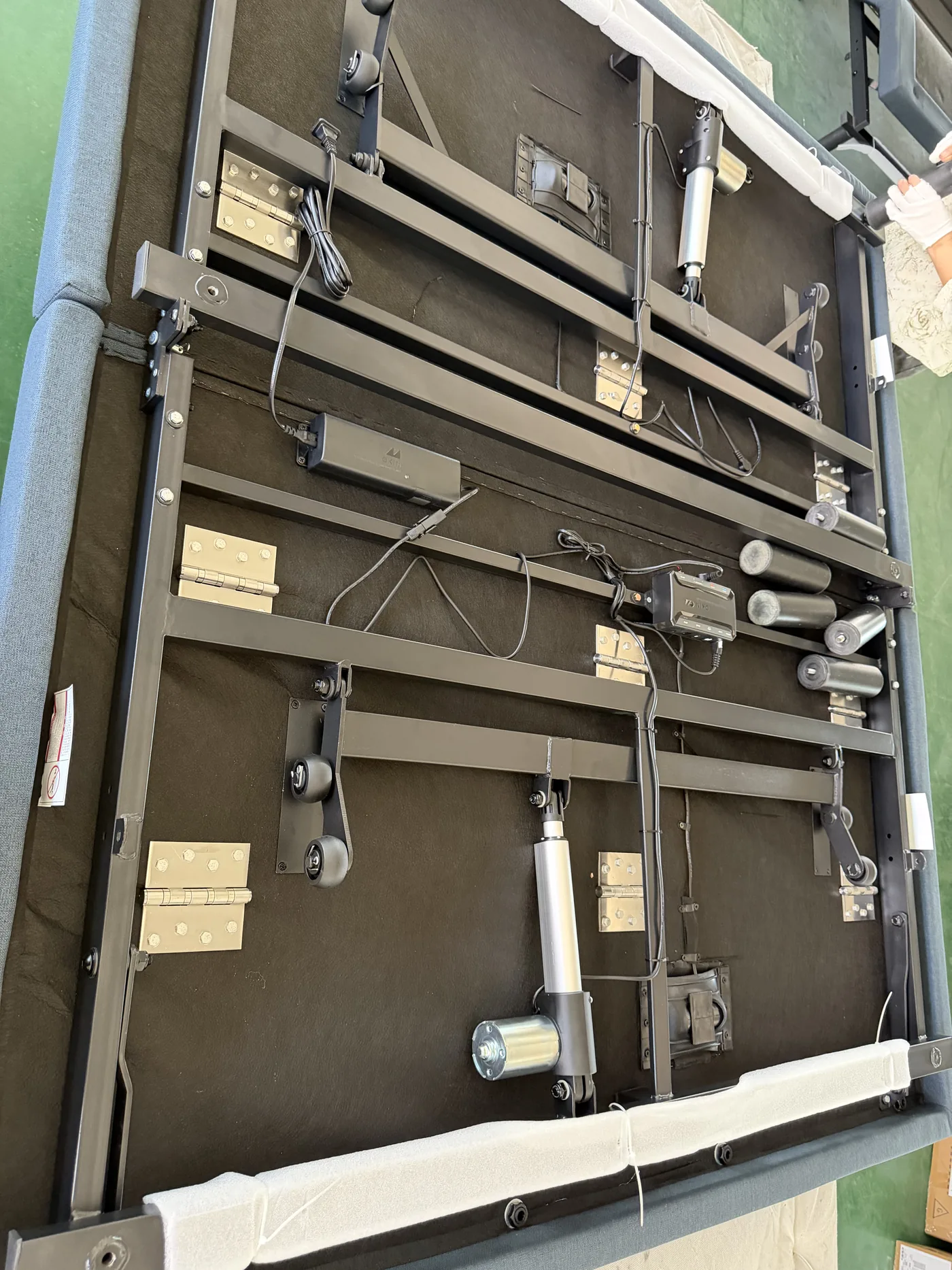
Company-supplied workshop photograph. It shows a real production environment, not a model-specific performance or capacity claim.
Define the product architecture first
The words “smart bed” can describe several different architectures. Name the required format and identify which parts belong within the supplier's scope.
| Architecture decision | Questions the brief should answer |
|---|---|
| Motion platform | Is the project an open-frame base, upholstered base, integrated mattress or complete furniture system? |
| Articulation | Which zones must move, and which positions must be independently controlled? |
| Mattress interface | What mattress type, dimensions and movement compatibility must be evaluated? |
| Furniture interface | Is the system freestanding, installed in a surround or integrated with a headboard and side rails? |
| Split configuration | Are the two sides independent, synchronized or both depending on the operating mode? |
| Accessory scope | Which remotes, retainers, legs, cables, brackets and instructions are included? |
Do not copy unverified dimensions or load ratings from a competitor listing. Mark an item “to be confirmed through supplier engineering review” when the commercial team has not approved it.
Separate required, optional and excluded functions
A professional brief makes priorities visible. Use three labels:
- Required: the quotation and sample must include the function.
- Optional: request a separate technical and commercial option.
- Excluded: do not include it in the current configuration.
Apply these labels to articulation, presets, massage or vibration, lighting, USB or power accessories, app functions, smart-home interfaces and monitoring features. For every digital feature, also define the expected user account, connectivity, privacy, update and support responsibilities. “App control” is not a complete requirement.
If the project includes an upholstered complete bed, define the frame, mattress, controls and service boundary as one proposed system. The KD004-B1 motion-mattress page is a product starting point, not proof of a complete smart-bed package. The ordered combination needs its own confirmed specification.
Control the interfaces that create launch risk
Many late-stage problems occur at the boundaries between subsystems rather than inside one component. The brief should identify at least these interfaces:
- actuator, control box, handset and power supply compatibility;
- frame movement clearance within the furniture surround;
- mattress flexibility across the intended articulation range;
- cable routing through moving and folding zones;
- paired-side synchronization where applicable;
- accessory mounting and replacement access; and
- carton division versus the customer's assembly sequence.
Ask the supplier to show how each critical interface will be confirmed during sample review. A rendering can explain intent, but physical fit and function must be evaluated on the approved configuration.
Specify evidence as deliverables
Do not write “quality must be good.” Name the evidence required at each decision point.
| Decision point | Useful evidence request |
|---|---|
| Quote review | Configuration list, exclusions, option pricing and open questions |
| Engineering review | Drawings, interface dimensions, component identities and revision status |
| Sample review | Functional checklist, fit observations and issue/action log |
| Packaging review | Carton plan, labels, included parts and assembly sequence |
| Approval | Golden-sample record and signed specification revision |
| Production release | Approved bill of materials, inspection points and controlled artwork |
Certification or test documentation must match the actual product, component, market and revision. A logo in a brochure is not a substitute for scope review.
Include packaging and service before the quotation is final
Large products can look commercially attractive until carton size, assembly work or service complexity is understood. State the intended logistics channel and ask for:
- carton count and preliminary packed dimensions;
- gross and net weights when confirmed;
- protection of moving, upholstered and electrical parts;
- hardware and accessory organization;
- assembly steps and required tools; and
- replacement-part identification approach.
Define who supports the end customer, what information customer service can collect and which components are intended to be replaceable. These decisions affect labels, manuals, spare-part records and carton design.
Use a controlled approval sequence
A concise private-label sequence is:
- issue the requirement brief with required, optional and excluded items;
- receive a supplier clarification list and configuration-based quotation;
- close interface questions before sample fabrication;
- inspect the sample against the brief, not memory;
- resolve deviations through a written issue log;
- approve packaging, instructions and controlled artwork;
- freeze the golden sample and specification revision; and
- release production only against the approved package.
The adjustable bed golden-sample approval checklist explains how to document the final approval boundary.
A practical one-page RFQ summary
The first page of the brief can contain:
- project name, revision and owner;
- destination market and channel;
- product architecture and target sizes;
- five to ten required functions;
- separately priced options;
- critical interfaces;
- required sample and documentation deliverables;
- logistics assumptions;
- service expectations; and
- a table of open questions.
Detailed drawings and checklists can follow as appendices. This keeps commercial comparison readable while preserving the technical detail needed for execution.
Buyer takeaway
A private-label smart bed program becomes easier to quote and safer to approve when the buyer defines architecture, interfaces and evidence before discussing cosmetic options. The objective is not to lock every answer on day one. It is to expose the decisions that must be closed before production.
To prepare a configuration-based discussion, send KCAI your target market, product format and required functions. Unknown values can remain open for engineering review rather than being replaced by unsupported assumptions.