On this page
Private-label smart bed cost cannot be reduced to one online number. A responsible OEM quote is the result of a defined product architecture, size mix, motion system, mattress and furniture scope, controls, upholstery, digital functions, packaging, documentation, quantity and delivery term. MOQ is also configuration-dependent: it may be driven by materials, components, branded packaging, production setup or a combination of those inputs.
The useful buyer question is therefore not “What is your cheapest smart bed?” It is: What specification can both parties price, sample, verify and repeat?
The quote equation buyers should use
A private-label quotation can be reviewed as six connected blocks:
Platform + selected options + customization + one-time work + packaging/documentation + commercial basis
If one block is missing, the visible unit price may not represent the launch cost.
| Quote block | Examples of decisions to define |
|---|---|
| Platform | Adjustable base, upholstered complete bed, motion mattress or integrated smart-bed system |
| Selected options | Motion zones, control route, accessories, mattress format and furniture interfaces |
| Customization | Upholstery, colours, trim, labels, manuals, remote appearance and packaging artwork |
| One-time work | Samples, engineering, tooling, artwork, packaging mock-ups or project-specific validation |
| Packaging and documents | Carton structure, assembly material, labels, reports and destination-market documentation |
| Commercial basis | Quantity and size mix, currency, delivery term, payment milestones and quotation validity |
Use the private-label smart bed specification brief to define these blocks before asking suppliers to price them.
Three customization levels and their cost implications
Level 1: controlled private label on an existing platform
This route starts with a supplier platform and limits changes to approved branding, finish, packaging or accessory choices. It can reduce engineering uncertainty, but it is not “no development.” The buyer still needs to approve the exact configuration, labels, instructions, carton presentation and documents.
Level 2: configured platform with project-specific options
The buyer selects a base platform, then changes upholstery, controls, accessories, dimensions or interfaces within an agreed engineering envelope. Each change must be checked for compatibility and may affect the sample, packaging and evidence plan.
Level 3: substantial ODM or new-product development
This route changes the architecture, mechanism, furniture structure, digital behavior or several interfaces at once. It normally requires more engineering decisions, prototypes, validation gates and change control. A low initial quote does not eliminate those tasks.
The private-label customization checklist helps buyers separate cosmetic, functional, packaging and documentation changes.
What shapes smart bed MOQ?
MOQ should be explained by the input that creates the constraint. Ask the supplier to identify which of the following applies.
| Potential MOQ driver | Procurement question |
|---|---|
| Base platform setup | Can the order use a current platform and standard component set? |
| Upholstery or colour | Is there a minimum material purchase, dye lot or colour commitment? |
| Branded components | Does the logo method require a setup, tool or material batch? |
| Printed packaging | Is the carton or insert printed specifically for the buyer? |
| Size mix | Can different sizes share the same material and production commitments? |
| Digital configuration | Is project-specific firmware, app work or account setup required? |
| Validation scope | Does the chosen configuration require a separate sample or project-specific evidence? |
This approach lets buyers negotiate the design of the program rather than only the headline number. For example, a neutral carton with controlled labels may create different commitments from a fully printed package. The correct choice depends on the brand and channel; the supplier must confirm what is available.
The product architecture changes the quote
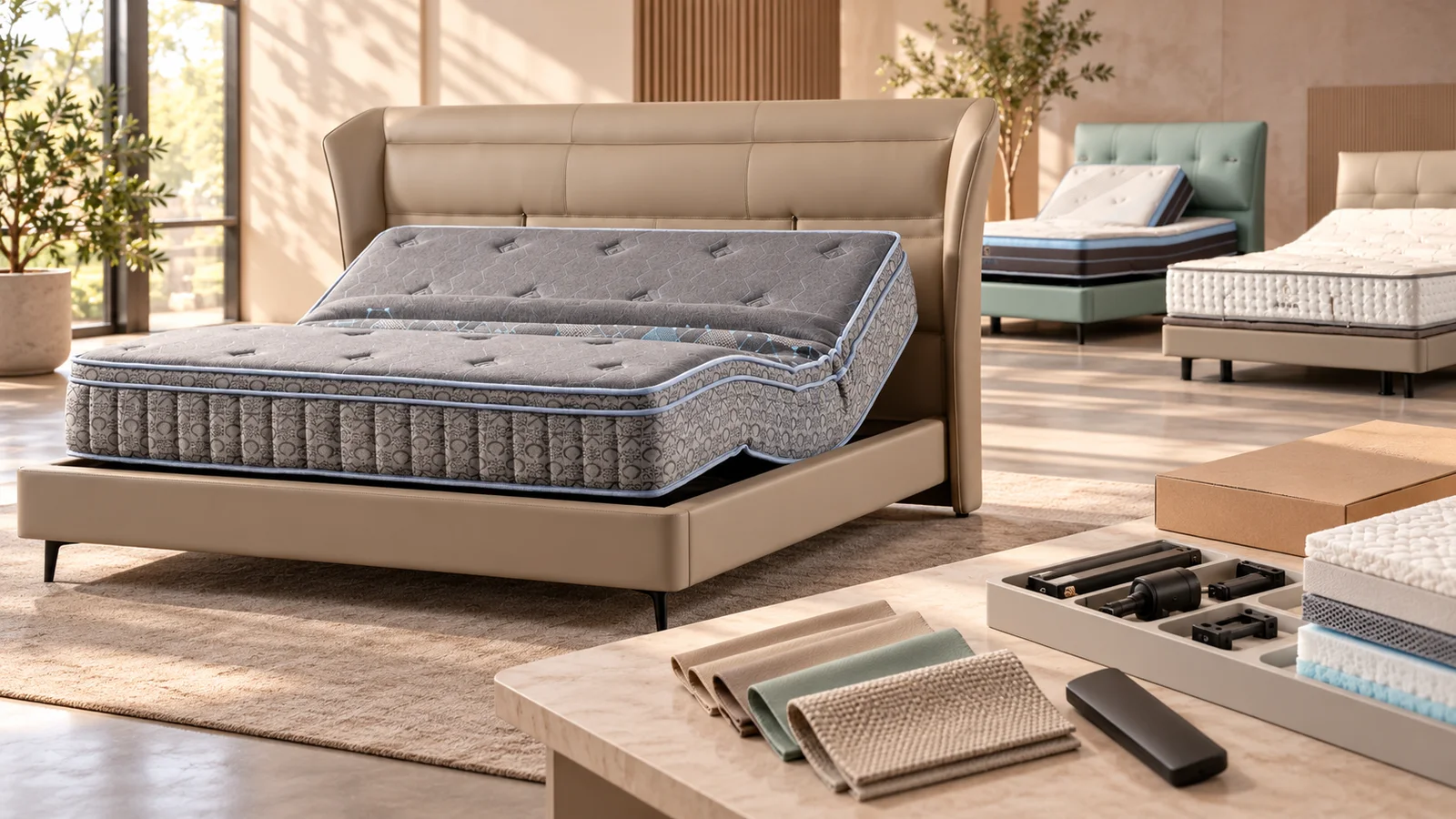
The phrase “smart bed” can refer to different systems: a moving base with separate mattress, an integrated motion mattress, or a furniture assembly with connected controls. These architectures have different mechanical, electrical, packaging and service boundaries. The KD004-B1 product page is a motion-mattress reference, but it does not establish a complete smart-bed configuration or a digital feature set. Define the architecture and included controls in the RFQ before comparing costs or minimum quantities.
Separate physical and digital scope
A smart-bed RFQ becomes unreliable when “app control” or “AI” is written as a single unchecked line. Break digital scope into acceptance questions:
- What functions are visible to the user?
- Which device, app, mini-program, remote or voice interface controls them?
- Who owns the customer account and data relationship?
- Which connectivity is required?
- What happens when connectivity is unavailable?
- Who maintains software, firmware and compatibility?
- Which privacy notice, consent and deletion process applies?
- How will the buyer approve function, language and failure behavior?
If these questions are not ready, ask the supplier to quote the physical product and digital option separately. The smart-bed cybersecurity OEM checklist covers the risk discussion in more detail.
Sample cost is not the production unit price
A sample can include costs that do not recur in the same form during production:
- low-volume material sourcing;
- engineering or setup work;
- custom logo or trim trials;
- packaging mock-ups;
- one-off component procurement; and
- express shipment.
Ask the quotation to show each item separately. Record whether any payment can be credited, who owns tooling or artwork, how long it will be retained and what change would require new work. Do not bury those decisions in the unit price.
Use quantity breaks correctly
Request quantity breaks only after the product scope is stable. Every tier should use the same:
- model and revision;
- size mix;
- functions and components;
- upholstery and finish;
- accessory and spare-parts scope;
- packaging and artwork; and
- delivery term.
If a lower tier uses neutral packaging while a higher tier uses printed cartons, the numbers describe different products. The OEM quote comparison guide provides a line-by-line normalization matrix.
Quote-ready private-label brief
Send the following information in one controlled document:
Commercial definition
- destination market and sales channel;
- expected launch range and forecast quantity;
- sizes and size mix;
- target schedule and delivery basis; and
- required sample stages.
Product definition
- architecture and reference model;
- required, optional and excluded functions;
- motion and control requirements;
- mattress and furniture interfaces;
- upholstery, colour and visible finish; and
- included accessories and spare parts.
Brand and delivery definition
- logo locations and methods;
- label, manual and language requirements;
- packaging route and artwork scope;
- document and evidence requests; and
- after-sales responsibility model.
Mark unanswered fields “open” rather than guessing. The supplier's response should close or qualify each field.
Cost-control decisions that preserve product clarity
Buyers can reduce avoidable cost without hiding requirements:
- Start with a defined supplier platform before requesting structural changes.
- Separate must-have functions from launch-later options.
- Limit colour and material proliferation until demand is proven.
- Reuse controlled components across sizes where the supplier confirms compatibility.
- Approve packaging against the actual distribution route.
- Freeze interfaces before approving artwork and documentation.
- Maintain one revision-controlled configuration list.
These steps do not guarantee a specific price or MOQ. They reduce the ambiguity that often creates quotation revisions and sample rework.
Request a current KCAI quotation
Send KCAI your private-label smart bed brief with the destination market, platform, sizes, required functions, customization level, packaging route and expected quantity. KCAI can then respond with a model-specific configuration, open questions and current commercial terms. Any MOQ, price, lead time, warranty, documentation or testing scope will be confirmed in writing for that project.