On this page
Quick answer
Cybersecurity belongs in the sourcing specification whenever an adjustable-bed project includes an app, cloud account, voice assistant, Wi-Fi, Bluetooth, or another connected control. A buyer should define the required device identity, access control, data protection, secure update, security-state reporting, support ownership, and end-of-support plan before approving the connected configuration. The objective is not to collect a supplier's “secure” claim. It is to obtain model-specific evidence, assign responsibilities, and create pass/fail launch gates.
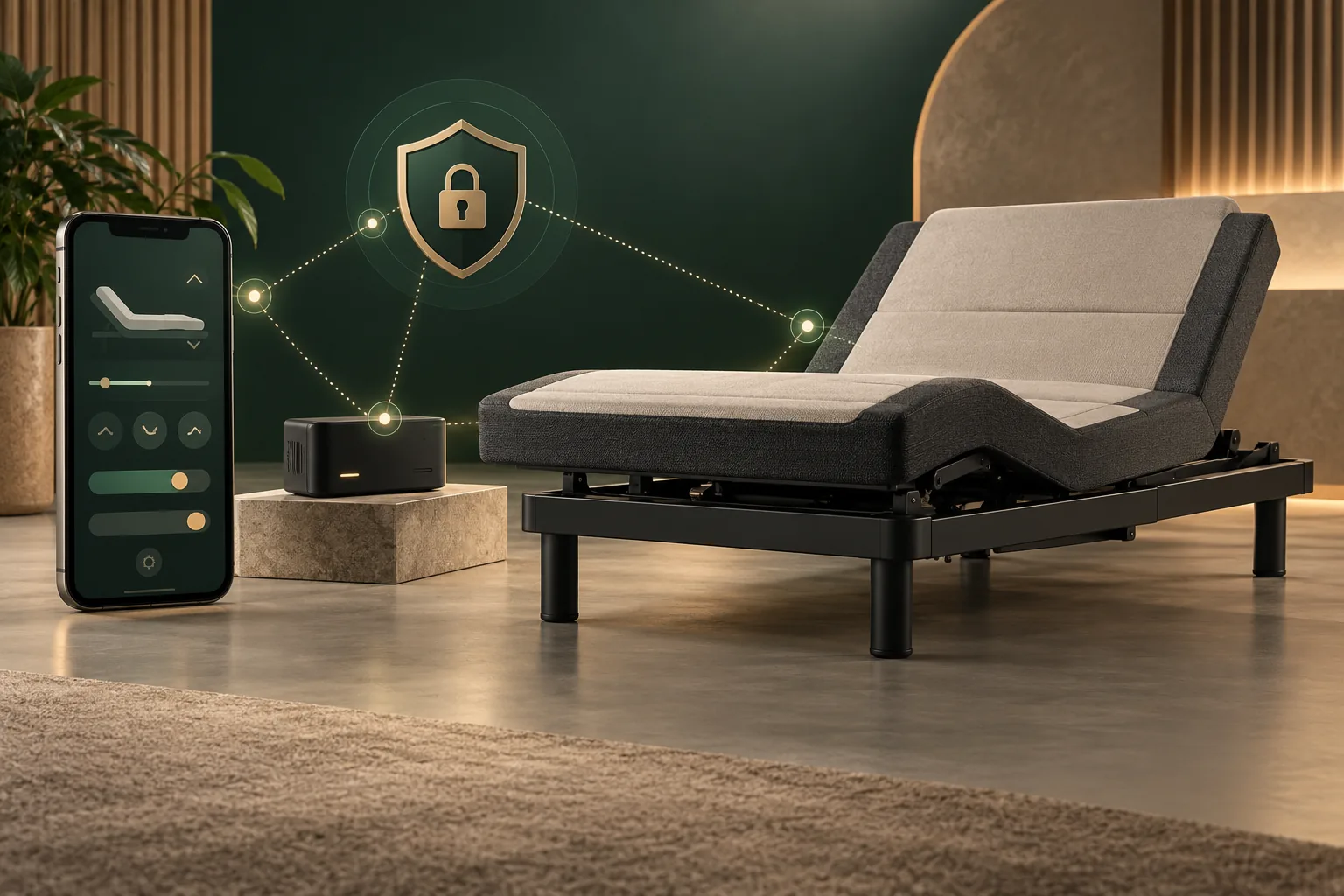
AI-generated concept illustration. It is not a KCAI product photograph, security audit, certification, or proof of a shipping configuration.
This checklist is for procurement planning. It does not establish that any KCAI model has the capabilities below, and it is not legal or cybersecurity advice.
Start with the exact connected architecture
“Smart bed” is too broad for due diligence. One SKU may use only a local wireless remote, while another project may add a mobile app, third-party voice platform, analytics service, or cloud account. Those architectures create different data paths and support obligations.
Ask the supplier to draw one page showing every component and connection: handset, control box, radio module, app, cloud service, third-party integration, update server, and administrator portal. Mark which organization operates each service. If an optional feature is not selected, remove it from the review rather than evaluating a hypothetical system.
| Procurement question | Evidence to request | Launch decision |
|---|---|---|
| What connects to what? | Model-specific architecture and data-flow diagrams | Scope is complete and matches the quoted SKU |
| Who can control the bed? | Account, pairing, reset, and authorization description | Unauthorized control paths are addressed |
| What data leaves the device? | Data inventory, purpose, retention, and sharing map | Collection matches the buyer's approved use |
| How are defects corrected? | Update method, signing approach, rollback plan, and owner | A supportable correction path exists |
| How long is software supported? | Written support period and end-of-support process | Commercial life and support life are aligned |
Convert recognized guidance into RFQ requirements
The NISTIR 8259 series gives manufacturers and customers a common way to discuss IoT device cybersecurity. NIST IR 8259A describes a device cybersecurity capability baseline, including device identification, configuration, data protection, logical access, software update and cybersecurity-state awareness. NIST IR 8259 Revision 1, published in April 2026, describes foundational activities for IoT product manufacturers. Use these publications as starting points for a risk-based project review, not as proof that a particular bed is certified or secure.
Translate those concepts into project questions:
- Device identification: Can the buyer distinguish product model, hardware revision, firmware version, app version, and cloud-service version?
- Configuration: Which security-relevant settings can an authorized user change, and how are defaults restored safely?
- Data protection: What sensitive data is stored or transmitted, and how is it protected in transit and at rest where applicable?
- Interface access: Which physical, local wireless, network, app, and cloud interfaces exist? How is access authorized and revoked?
- Software update: Who can issue an update, how is its authenticity checked, and what happens if installation fails?
- State awareness: Can support teams identify security-relevant faults or version drift without exposing customer data?
Do not prescribe a feature simply because it appears in a framework. Ask the security reviewer to map the exact product risk to the necessary capability and acceptance evidence.
Review the app and cloud, not only the bed frame
A mechanically sound base can still inherit risk from a mobile application, third-party software development kit, account system, or cloud endpoint. Your supplier questionnaire should therefore identify the legal and technical owner of every software layer.
Request a current software bill or component inventory appropriate to the project, plus a list of third-party services. Ask how vulnerability reports are received, triaged, corrected, and communicated. The FTC's IoT security guidance advises businesses to build security into devices from the outset, minimize unnecessary data collection, control access, test security measures, and plan for updates.
Procurement should also ask what happens when a customer sells or disposes of the product. A reset process should address accounts, local pairing, and stored information relevant to the selected architecture. If a cloud service is discontinued, the contract should explain which functions remain available.
Build an evidence pack before pilot approval
Security evidence should be tied to versions. A statement about an earlier app or control board may not describe the pilot configuration. Create a release record containing:
- final product and control-box model identifiers;
- hardware, firmware, app, and relevant service versions;
- architecture and data-flow diagrams;
- access, pairing, reset, and recovery procedures;
- update and rollback responsibilities;
- vulnerability intake and incident-contact details;
- approved third-party dependencies and services;
- security test scope, date, result, limitations, and remediation status;
- support period and end-of-support communication plan.
Keep this pack with the same design-freeze record used for mechanical and electrical approval. If firmware, radio hardware, the app, or a cloud dependency changes, route the change through impact review instead of silently replacing a component.
Put ownership into the commercial agreement
Cybersecurity work fails when every party assumes another party owns it. Your RFQ and quality agreement should name the owner for app publishing, certificates and credentials, cloud hosting, vulnerability monitoring, customer notices, emergency updates, technical support, and end-of-support decisions.
Separate responsibilities that belong to the brand from those that belong to the manufacturer or software provider. For example, a brand may control its privacy notice and app-store account while a technology provider maintains a software library. The contract should still define how information and fixes move between them.
Useful launch gates include:
- architecture reviewed against the exact commercial SKU;
- high-severity findings resolved or formally accepted by an authorized reviewer;
- update and recovery flow demonstrated on the pilot configuration;
- customer-facing disclosures approved for the target market;
- security contacts and response time expectations documented;
- no unreviewed component or software substitution after design freeze.
Send a precise sourcing request
For a connected-control inquiry, provide the destination market, product model or desired platform, required control method, app ownership preference, third-party integrations, expected commercial lifetime, and buyer security questionnaire. Ask for written confirmation of what is standard, optional, custom, or unavailable.
You can review available project pathways on the OEM/ODM page and the controls and accessories category. For broader pre-order verification, use the private-label adjustable bed checklist. All connected features and evidence remain subject to model-specific confirmation.
Request a quote and include “connected-control security review” in the message so the requested architecture can be scoped before quotation.