On this page
A smart bed ODM validation plan divides product development into evidence-based decision gates. At each gate, the buyer and supplier agree whether the project can proceed, must proceed with named conditions or must stop for corrective work. This is more reliable than treating a finished-looking sample as automatic production approval.
ODM does not remove the buyer's responsibility to define the target market, evaluate the proposed product and approve the final configuration. It changes where the starting design comes from. The adjustable bed OEM versus ODM guide explains that commercial distinction; this guide focuses on controlling an ODM project after the route has been selected.
Why a gate structure matters
Smart beds combine moving structures, electrical components, user controls, mattresses or furniture interfaces, packaging and customer documentation. A change in one area can affect several others. For example, a different control package may change functions, labels, instructions, spare parts and the sample test checklist.
A gate structure creates three controls:
- the required evidence is known before the review;
- unresolved items remain visible rather than becoming assumptions; and
- the next stage starts from a controlled revision.
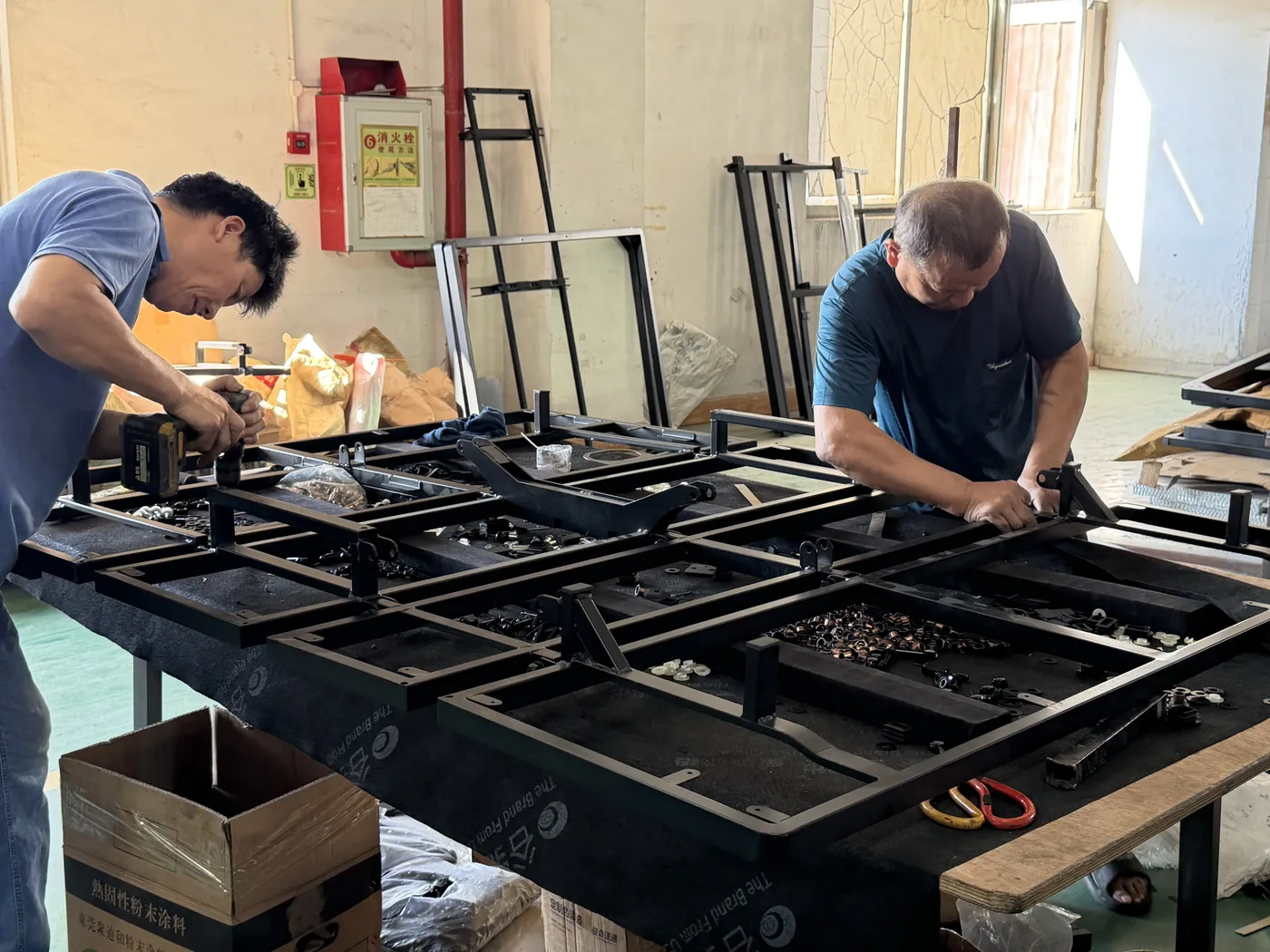
Company-supplied workshop photograph. It documents a real assembly environment but does not establish a specific model's validation status or production volume.
Gate 1: requirement and market fit
The first gate asks whether the proposed ODM platform is suitable for the intended program. Review:
- destination market and sales channel;
- intended product format and sizes;
- required, optional and excluded functions;
- target furniture and mattress interfaces;
- electrical and control expectations;
- packaging and customer-assembly constraints;
- service and replacement-part expectations; and
- required product and document evidence.
Exit evidence: an approved requirement brief, clarification log and list of unresolved feasibility questions. Do not approve a model only because its brochure contains many features.
Gate 2: architecture and configuration selection
At this gate, confirm exactly which platform and components form the proposed product.
| Review area | Decision to record |
|---|---|
| Mechanical architecture | Motion zones, frame format, key interfaces and mounting concept |
| Electrical architecture | Actuator, control box, power supply, handset and accessory combination |
| Software or connectivity | Enabled functions, account or app responsibilities and update ownership |
| Furniture integration | Clearances, headboard or surround fit and moving-part access |
| Mattress interface | Intended mattress type, dimensions and articulation compatibility |
| Commercial configuration | Included accessories, separate options and explicit exclusions |
Exit evidence: a configuration list, interface drawings where available, open-risk register and sample plan. Every quotation revision should point to this configuration.
Gate 3: engineering sample verification
The engineering sample is for finding problems, not hiding them. Evaluate the product against a written checklist that covers:
- required motion and control behavior;
- clearances throughout movement;
- cable routing and connector retention;
- stability and expected use conditions;
- noise and vibration observations under defined setup conditions;
- assembly sequence and access for service;
- surface, upholstery and visible workmanship; and
- consistency between physical sample, drawings and component list.
Record observations with photographs, configuration identity and a disposition. “Accepted verbally” is not adequate change control.
Exit evidence: a completed verification record, issue/action list and agreed sample revision. Test values and acceptance limits must be project-specific and supported, not copied from an unrelated model.
Gate 4: packaging, labels and documentation
Packaging is a product interface. It affects damage exposure, warehouse handling, assembly and the customer's first use. Review the actual approved configuration in its proposed carton system.
Confirm:
- carton division and packed orientation;
- protection of moving, upholstered and electrical parts;
- accessory and hardware control;
- product, carton and regulatory label artwork;
- assembly and operating instructions;
- carton-to-instruction sequence; and
- handling of market-specific power or language variants.
Exit evidence: approved packaging specification, artwork revision, instruction set and any agreed verification records. If transport testing is required, define the applicable product, package, method and acceptance criteria rather than writing a generic “drop tested” claim.
Gate 5: golden sample and design freeze
The golden sample is the physical reference only when it is connected to controlled documents. At this gate, reconcile:
- physical sample;
- approved specification;
- drawings and bill of materials;
- firmware or control configuration where applicable;
- colors, materials and workmanship standard;
- packaging, labels and manuals; and
- agreed inspection checkpoints.
Any remaining deviation should have a written decision. A conditional approval must list the exact action, owner and evidence required before release.
Exit evidence: signed approval record and frozen revision package. Use the design-freeze and engineering-change guide to control later changes.
Gate 6: pilot production
A pilot checks whether the production process can reproduce the approved design. It is not merely a small commercial shipment. Buyers should review:
- component and revision consistency;
- work instructions and assembly sequence;
- in-process inspection points;
- functional checks on finished units;
- packaging execution and carton identification;
- issue rate and corrective action from the pilot; and
- traceability between product, lot and approved configuration.
The appropriate pilot quantity depends on the product, changes and project risk; avoid publishing a universal number. The adjustable bed pilot-order workflow provides a detailed planning framework.
Exit evidence: pilot report, resolved issue list and release recommendation.
Gate 7: production and shipment release
Before release, confirm that purchasing, production, quality and logistics are all using the approved revision. Check that:
- open actions are closed or formally accepted;
- production parts match the approved component map;
- inspection records reference the correct criteria;
- packing and labels match destination requirements;
- shipment documents match the commercial order; and
- service data identifies the shipped configuration.
Exit evidence: authorized release record and retained production/inspection documentation appropriate to the agreement.
Use one gate register
A simple gate register prevents decisions from becoming scattered across email and chat.
| Field | Purpose |
|---|---|
| Gate and revision | Identifies the decision being reviewed |
| Required evidence | Defines what must be available |
| Result | Approved, conditionally approved or not approved |
| Open action | States the remaining gap without vague wording |
| Owner and due date | Creates accountability |
| Closure evidence | Shows how the action was resolved |
| Approver and date | Preserves decision authority |
Buyer takeaway
An existing ODM platform may shorten some development steps when it fits the brief, but that must be demonstrated in the project plan. Speed should come from clearer decisions rather than fewer controls. A seven-gate plan keeps requirements, interfaces, packaging, samples and production evidence connected to one approved configuration.
For a project-specific review, send KCAI your target market, required product format and current specification. The first discussion can identify which validation gates and deliverables are relevant without inventing unsupported parameters.