On this page
Quick answer: Repairability depends on the exact construction and approved service plan. A motion mattress may contain comfort materials, upholstery, moving structure and electrical parts within one product format, but that does not mean every layer can be opened or every component replaced in the field. Before launch, a mattress brand should identify which symptoms can be diagnosed remotely, which assemblies a qualified service partner may replace, and which failures require factory handling or complete-unit replacement.
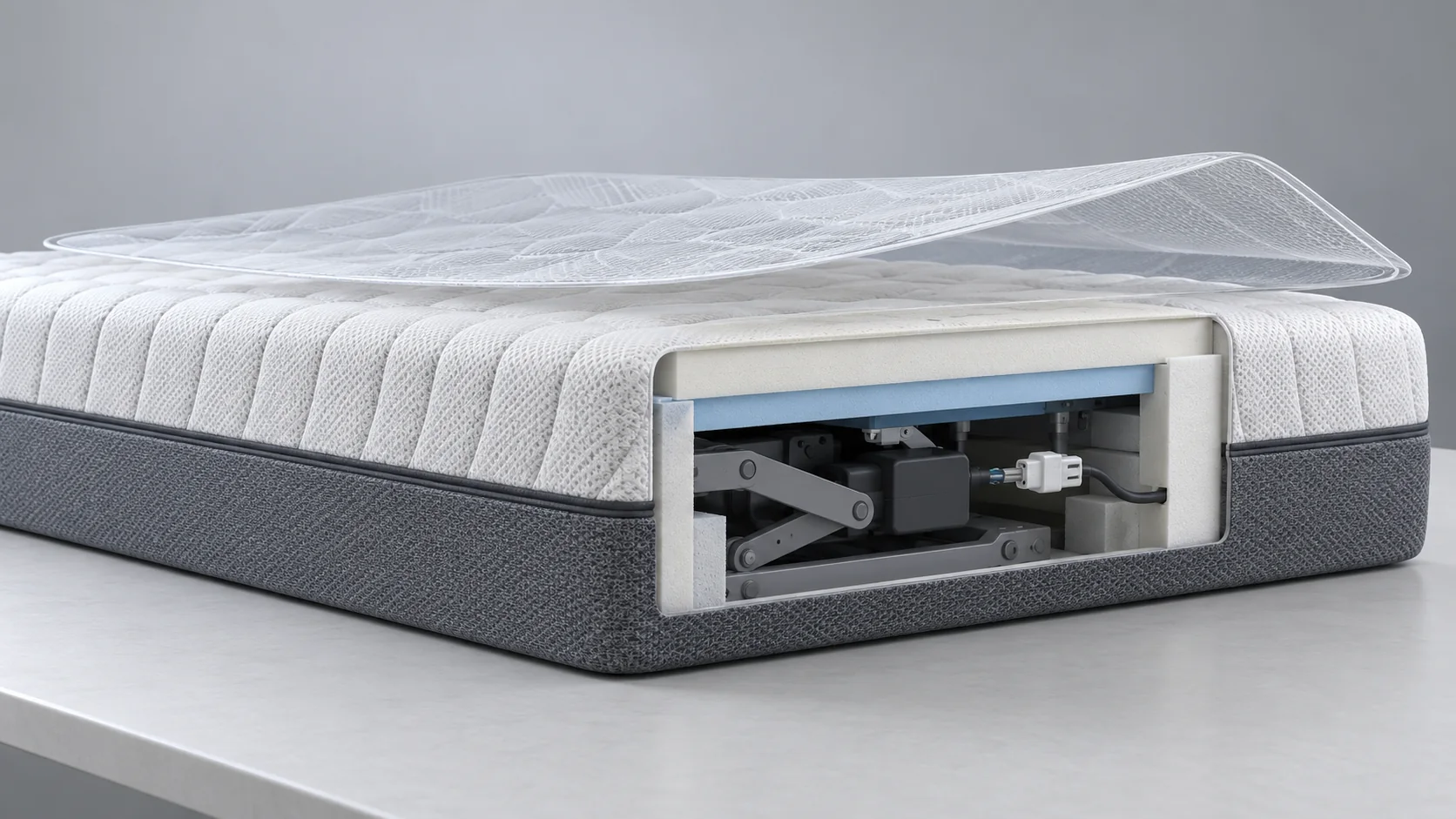
Conceptual AI illustration. The pictured opening and component locations are invented for explanation; they are not a KCAI construction, access method or repair instruction.
Start with the product boundary
A separate adjustable base and mattress can often be handled as two distinct sale and service items. An integrated motion mattress presents a different handoff: the customer sees one mattress-format product while support teams may need to distinguish a comfort complaint from a motion, control, power or installation fault. The adjustable-base versus motion-mattress guide explains the product-format choice. This article addresses what happens after sale when that integrated product needs inspection.
Draw a boundary around the exact item sold. List every included layer, moving assembly, control, power component, external accessory, support surface and document. Do not rely on a generic diagram for an actual bill of materials. A replacement policy cannot be written until the buyer knows whether an item is accessible without disturbing the upholstery or an approved safety construction.
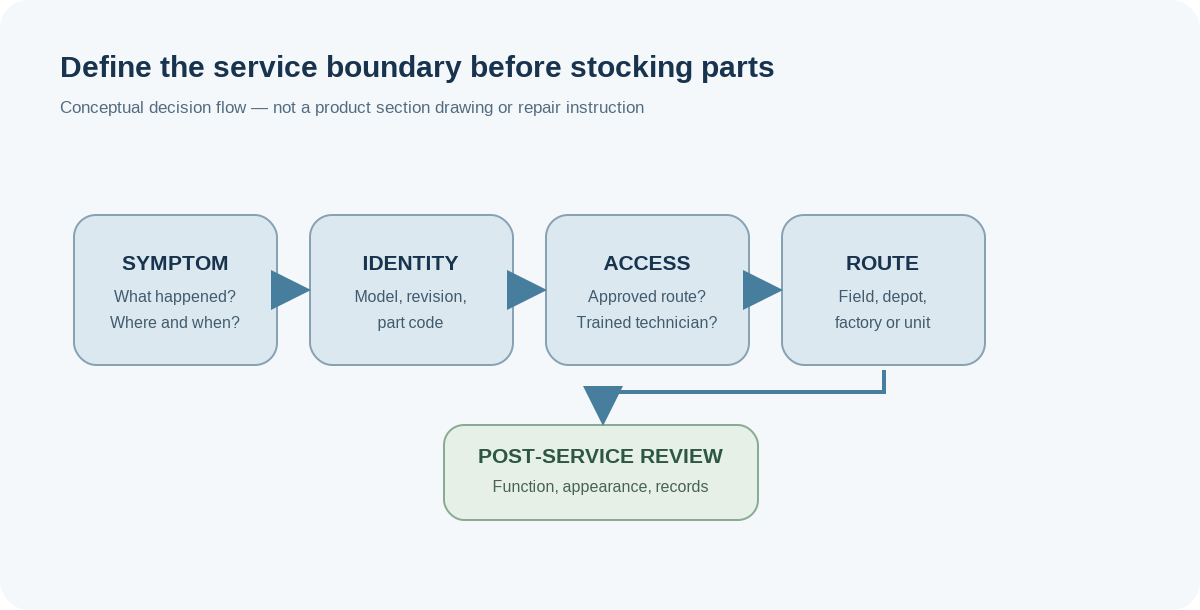
Technical schematic of questions to resolve. Boxes are not a representation of KD003-B1, KD004-B1 or any other model.
Classify parts by service route, not by appearance
“Replaceable” should have a precise meaning in the purchase agreement. A part that can be removed in a factory may still be unsuitable for replacement in a customer's home. The route depends on access, instructions, tools, identification, post-repair checks and the effect on the finished product.
| Service class | Buyer decision | Evidence to request |
|---|---|---|
| Remote triage only | Can support identify the symptom without opening the unit? | Approved symptom questions, safe user checks and escalation rule |
| External accessory replacement | Can a supplied handset or external power item be exchanged? | Exact part code, pairing/compatibility instructions and identity check |
| Authorized field assembly replacement | Can a trained technician reach and replace an assembly without damaging approved construction? | Access drawing, work instruction, reassembly checks and parts traceability |
| Depot or factory repair | Does the unit need controlled facilities or materials? | Return route, inspection standard, repair record and disposition decision |
| Complete-unit replacement | When is repair impractical or unapproved? | Commercial remedy, transport plan and disposal/return responsibility |
These are possible service classes, not claims that any KCAI product supports a particular route. The Ergomotion technical-installation library demonstrates how model-specific replacement instructions can be organized for separate adjustable bases. It does not establish that an integrated mattress has the same access or replaceable parts.
Separate the fault from its reported symptom
“The mattress will not lift” can mean several things: a control command was not received, a power connection is interrupted, a mechanism cannot move, or the customer is using the product on an unsuitable support. “The mattress feels uneven” could refer to a comfort layer, cover tension, support surface or movement that stops at a different point. The first service step is to capture the observed condition without guessing the component.
| Customer report | Initial information to collect | Decision owner |
|---|---|---|
| No motion in any direction | Product label, power arrangement, remote response, safe checks in the approved manual | Service desk; supplier if unresolved |
| One section behaves differently | Exact section, command, start/end position, video and sample revision | Qualified technical support |
| Noise only during movement | Location, conditions, mattress/support arrangement and video | Supplier engineering or approved service partner |
| Cover bunching or visible seam change | Position, use history, photographs and approved material reference | Mattress quality team |
| Damage after transport | Carton/label photos, unpacking record and first-use result | Logistics and supplier quality |
Do not ask an end user to cut a cover, bypass a control protection, inspect live wiring or dismantle moving parts. The approved product instructions define safe customer checks; further work belongs to trained service personnel.
Review access before approving a spare-parts list
A parts list is useful only if the repair route works in practice. On a controlled sample, have a qualified team follow the proposed instructions and record:
- Identity: finished-product model, revision, lot, component code and the label location a service team can see.
- Access: which surface or panel is opened, what must be moved first, and whether the cover, foam or structural support is disturbed.
- Extraction: how the component is disconnected and removed without damaging adjacent parts; identify any one-time fasteners or materials.
- Reassembly: the controlled sequence, replacement materials, visual checks and functional checks.
- Record: before/after photographs, replaced part code, technician, date and post-repair disposition.
Record time to reach the part separately from time to finish an approved repair. A short access time is not useful if the cover cannot be restored consistently or the finished unit cannot pass its required post-repair checks. The adjustable-bed spare-parts guide addresses opening-stock planning; this article defines the integrated-mattress repair boundary that must precede stocking decisions.
Fillable serviceability review card
| Field | Project entry |
|---|---|
| Finished-product model, revision, sample and lot ID | ______ |
| Reported symptom and reproduction steps | ______ |
| Approved customer checks and escalation point | ______ |
| Candidate component and exact replacement code | ______ |
| Service class: external / field / depot / unit | ______ |
| Access route and affected cover or comfort layers | ______ |
| Required tools, training and safety isolation | ______ |
| Parts or materials consumed during reassembly | ______ |
| Post-repair function and appearance checks | ______ |
| Applicable test or compliance review trigger | ______ |
| Photos, work-instruction revision and approver | ______ |
The card contains no prefilled service time or cost. Those figures require observation on the actual approved product and a defined regional service model.
Treat changes to the finished mattress as a controlled decision
An integrated product may have both moving equipment and a mattress construction. In the United States, the CPSC describes separate mattress flammability requirements under 16 CFR Parts 1632 and 1633. The applicable scope and evidence must be assessed for the specific product and how it is sold. CPSC's guidance on finished-product changes also explains why a component result may not be enough when a rule evaluates the finished product.
That matters to a service plan. Opening a cover, replacing foam or changing a tape edge may affect the approved construction and record set. The buyer should agree with qualified compliance and product teams on which repairs are permitted and what evidence must be reviewed afterward. This is a project decision; the existence of a zipper or removable-looking part does not grant approval to alter the mattress.
Compare service routes as part of the landed program cost
Two suppliers can quote similar unit prices and create very different after-sales costs. Build a decision model from observed or contract values:
expected service cost per sold unit = sum of (case-type incidence per sold unit × average approved remedy cost for that case type)
The expression is a planning framework, not a forecast. Keep each case type's observation period and sold-unit denominator aligned. Without measured incidence, regional labor arrangement and an approved repair route, do not publish a numeric estimate. Record who owns each cost and what happens when a part has been revised or discontinued. If a field repair is unavailable, the return and replacement logistics may dominate the decision.
The warranty and RMA data guide covers how to collect field evidence. For an integrated mattress, add the identity of the complete mattress construction and the service-route decision so that a case does not disappear into a generic “motor” or “mattress” category.
Apply the method to current model discussions
KD003-B1 and KD004-B1 are relevant product directions for a serviceability review, but the available public articles do not establish their exact internal service access, field-replaceable parts or repair procedure. Before either model appears in a public comparison table, obtain a current exploded or section drawing, bill of materials, approved service instructions, spare-part identifiers and product-owner approval for what may be shown. The KD003-B1 buyer guide and KD004-B1 buyer guide provide separate model discussions; neither should be interpreted as a service manual.
Developing a motion-mattress program? Describe the target market, channel, proposed service network and model interest in the RFQ form. Request a service-boundary review for KD003-B1 or KD004-B1 before committing to a warranty or parts promise.