On this page
“The bed does not work” is a customer report, not a diagnosis. It can describe transit damage, a missing part, an incomplete setup, a control question, a compatibility problem or a product fault. A retailer that sends every case straight to full-unit return may incur unnecessary freight and still fail to fix the customer's problem. A retailer that dismisses a real fault creates a worse outcome. The service desk needs a controlled way to separate the cases.
This adjustable bed returns triage workflow is for retail and distributor operations. It supports the installation-error guide and the shipping-damage checklist. It is not a repair manual; the current manufacturer instructions and applicable customer terms govern each case.
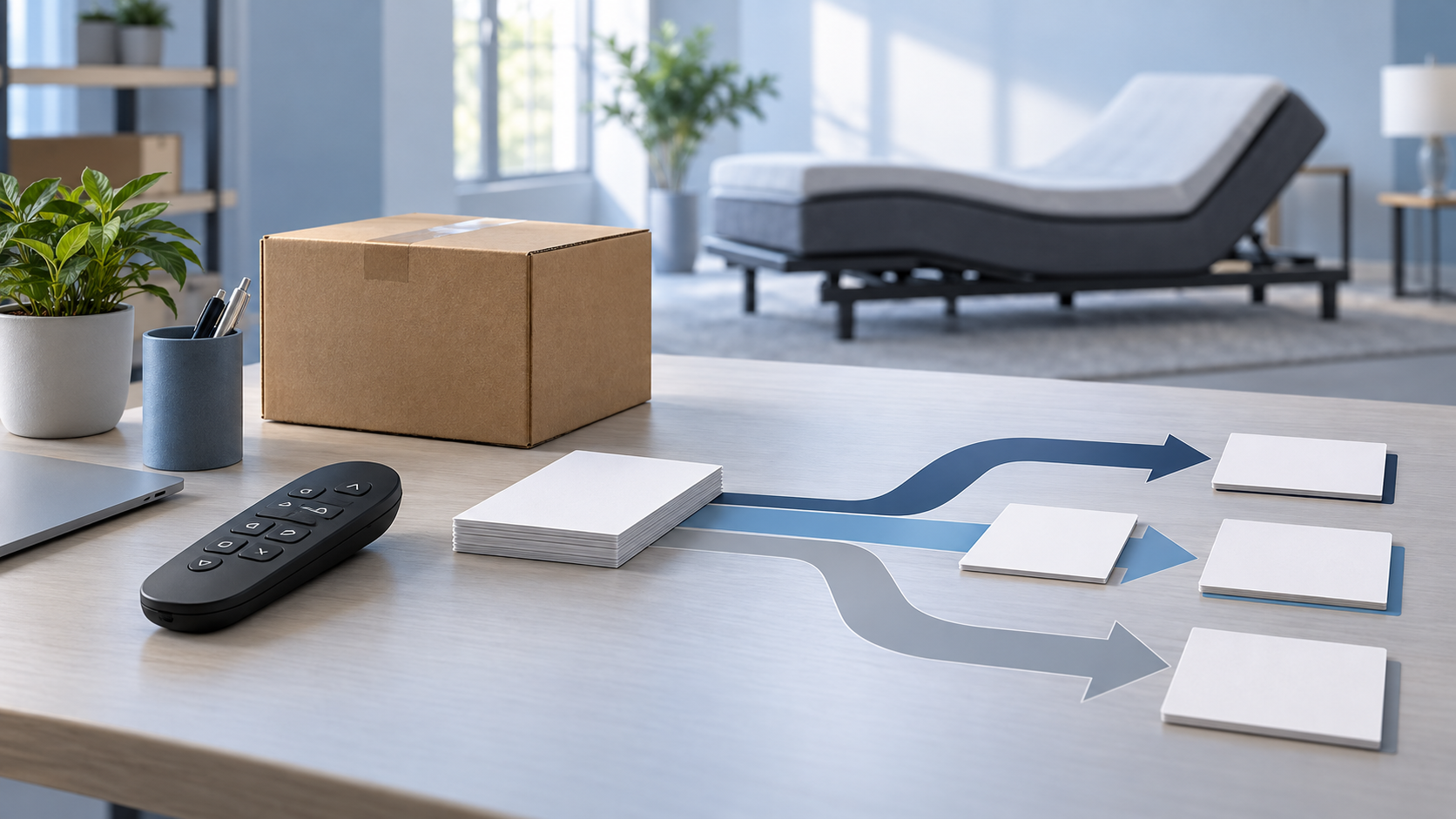
AI-generated editorial concept. The bed, service desk and case cards are not a KCAI facility or real customer case.
Capture one complete case record at intake
The first contact should collect enough information for the next team to act without asking the customer to repeat the story. Start with the order number, delivered SKU, model and revision if available, delivery date, installation method, reported behavior and whether the issue happened at arrival or after use. Ask for photos of the exterior carton, visible damage or missing items where relevant and appropriate.
Do not ask a customer to open an electrical housing, bypass a safety feature or attempt an unapproved repair. If there is an apparent electrical hazard, damaged cord, smoke, unusual heat or another immediate safety concern, stop normal troubleshooting and follow the manufacturer's safety instructions and the retailer's escalation process.
| Intake field | Why it matters | Typical source |
|---|---|---|
| Order and bundle identity | Connects the case to what was sold | Retail order record |
| Model, size and revision | Selects the correct manual and parts | Product label or controlled SKU record |
| Delivery condition | Separates transit issues from later operation | Delivery record and carton photos |
| Installation status | Reveals whether setup was completed | Installer handover or customer report |
| Exact symptom | Allows the authorized team to reproduce the issue | Customer description or video if appropriate |
| Safety concern | Determines whether routine triage should stop | Customer report and current instructions |
If a base and mattress were sold together, record both components and the agreed service responsibility for each. The warranty and RMA data guide explains how to keep the resulting case data useful for purchasing decisions.
Route the case by evidence, not by a generic return code
Use a small set of provisional categories at intake. They can be corrected after investigation. A carton with visible impact and a bent frame should go to a damage path. A missing remote belongs to a fulfillment path. A movement issue after installation belongs to an authorized technical assessment. A mismatch between advertised and delivered features belongs to the retailer's content and order-review path.
| Initial path | First evidence | Next owner | Possible outcome |
|---|---|---|---|
| Delivery damage | Carton and product condition at receipt | Retailer, carrier and supplier as agreed | Damage claim or replacement decision |
| Missing item | Packing list and included-part record | Fulfillment owner | Complete the set or correct the order |
| Setup or fit | Installed configuration and current manual | Approved installer or technical team | Correct setup or approve a different configuration |
| Operation or control | Exact behavior, model and safe observations | Authorized service team | Guidance, part evaluation or further inspection |
| Listing mismatch | Listing version and order confirmation | Retail content owner | Correct information and resolve customer claim |
These are routing categories, not warranty decisions. The responsible party, available remedy and costs come from the actual terms, applicable rules and the facts of the case.
AI-generated editorial concept; it does not depict KCAI service facilities or inventory.
Ask for evidence a customer can safely provide
Useful evidence may include an overall photo of the setup, the visible label, a close view of the reported issue and the document or screen message the customer is following. Ask for a written description of when the issue occurs and what the customer observes. Use the manufacturer's approved support instructions for the delivered configuration.
Do not ask a customer to open an electrical enclosure, probe wiring, bypass a protection device or substitute a component. If the instructions are unclear, stop the affected step and escalate. A support team should not turn an ordinary intake conversation into an improvised repair procedure.
Make the case record usable across teams
| Field | Case entry |
|---|---|
| Case ID and intake date | ______ |
| Model, size and revision / identifier | ______ |
| Order and delivery reference | ______ |
| Customer description in their own words | ______ |
| Approved instructions and version used | ______ |
| Safe evidence received and date | ______ |
| Issue category and current owner | ______ |
| Next action, responsible team and update date | ______ |
| Resolution and any product-document follow-up | ______ |
Avoid adding personal contact details to a shared engineering worksheet unless necessary for the agreed process. The service team can keep customer contact information in its designated system and share the case identifier with product or supplier teams.
Keep the customer informed while suppliers investigate
Give the case one customer-facing owner even when the retailer, bed supplier, mattress supplier or carrier must investigate. State the next update time and what evidence is being requested. Record every handoff. A case with an unclear owner should escalate internally rather than bounce back to the customer.
If a replacement part is proposed, the authorized team should confirm the exact part and revision for the delivered unit. If a full-unit return is needed, record the packaging and collection method before promising a pickup. The after-sales parts guide provides buyer questions for that service design.
Turn resolved cases into purchasing evidence
Close the case with a verified cause, resolution, affected model and batch, and whether the customer received the intended product. Distinguish “no fault found” from “not yet reproduced.” Review repeated causes with the supplier using the warranty and RMA data guide. A trend in carton damage, missing parts or control confusion calls for a different action than a confirmed component defect.
For a KCAI OEM/ODM program, include the planned retail support model in the sourcing brief. Ask for current model instructions, part identification and escalation contacts before launch so the service desk can route a claim accurately.