On this page
Adjustable bed engineering change control is the documented process used to prevent an approved product from changing through scattered emails, verbal instructions or untracked file replacements. The practical sequence is simple: define a revision, freeze it for the next stage, record every proposed change, assess its impact, approve or reject it, verify the result, and state exactly when the approved change takes effect.
This discipline matters because an adjustable bed is a system rather than a single part. A modification to a frame member, actuator bracket, control, upholstery panel, cable route, carton insert or instruction file can affect other items. A price update alone does not show those dependencies. A controlled engineering change notice does.
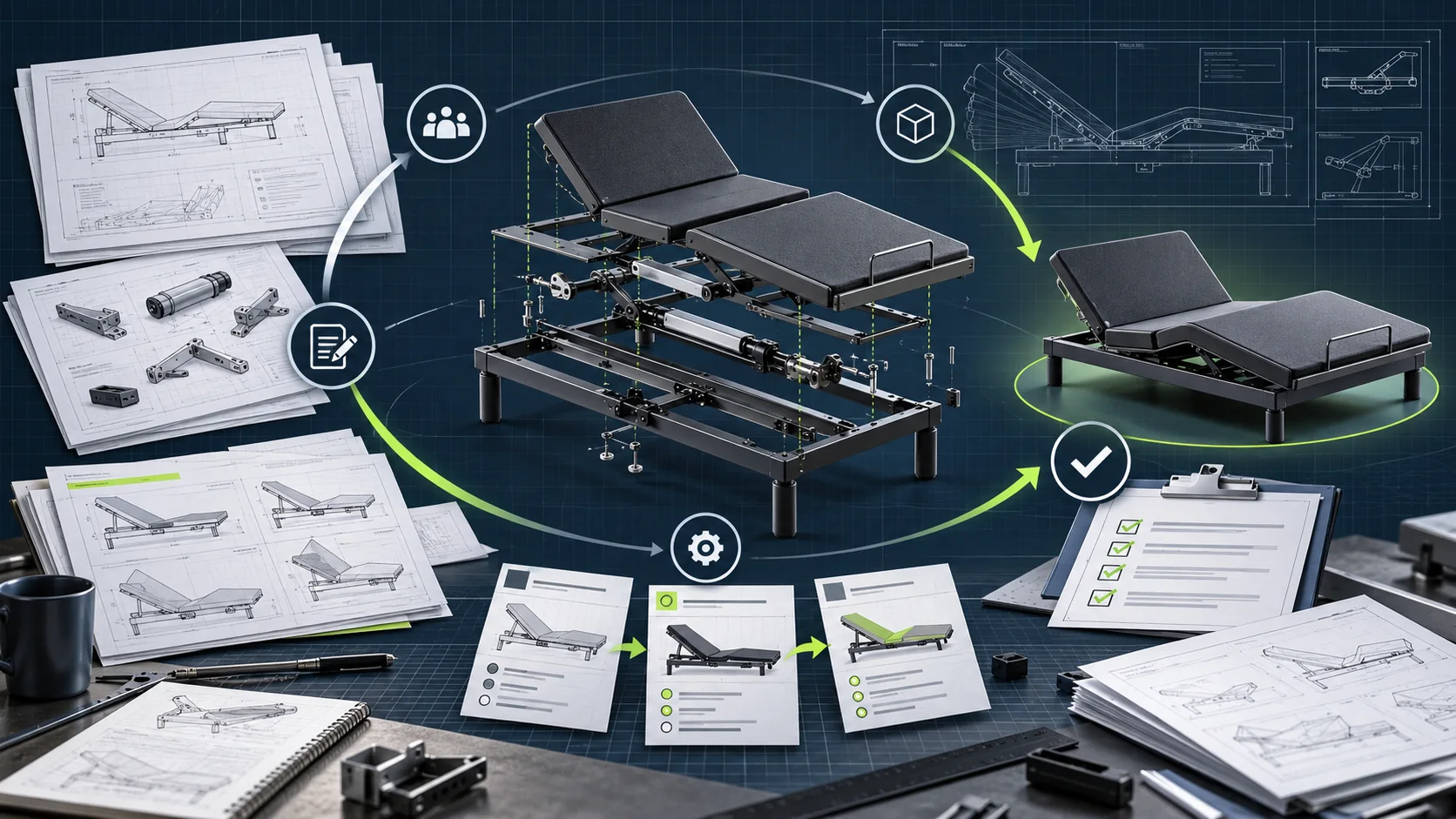
AI-generated concept illustration. It explains a generic revision workflow and is not a production drawing, a KCAI factory photograph or proof that a particular control process applies to every project.
Quick summary for OEM buyers
Use one controlled product baseline before approving a sample or production run. That baseline should reference the current drawings, bill of materials, user-facing configuration, packaging files and approved sample. After the freeze, do not replace a file silently. Issue a numbered change record, review the commercial and technical impact, define verification, obtain written approval and identify the first affected unit or order.
The objective is not to eliminate change. It is to make change visible before it reaches purchasing, assembly, quality inspection, packaging or after-sales support.
What should be included in an adjustable bed design freeze?
A design freeze is a decision gate, not a claim that a product can never change again. It records the configuration that the teams are authorizing for a specific stage, such as sample approval, pilot production or repeat production.
At minimum, the freeze pack should identify the following items by revision or date:
| Controlled item | What the record should identify |
|---|---|
| Product definition | Model name, size or market variant and intended configuration |
| Mechanical files | Assembly drawings, critical interfaces and component drawings where applicable |
| Bill of materials | Part references, approved alternatives and finish or upholstery references |
| Motion and control | Requested functions, handset or app configuration and compatible electrical items |
| Visual standard | Approved color, texture, stitching or visible workmanship references |
| Packaging | Carton structure, inserts, labels, manuals and artwork revisions |
| Verification | Required checks, responsible party and accepted evidence |
| Approval sample | Sample identifier, approval date and any signed exceptions |
If a value remains undecided, mark it as open rather than hiding it inside a note. A freeze with visible exceptions is safer than an apparently complete document built on assumptions.
The golden sample approval checklist provides a related method for recording the physical reference. The document baseline and physical sample should point to the same configuration.
When should a buyer raise an engineering change notice?
Raise an ECN whenever a proposed modification could make the delivered product differ from the approved baseline. The trigger is the effect of the change, not who requested it.
Common triggers include:
- replacing or revising a mechanical, electrical or upholstered component;
- changing a critical dimension, hole position, bracket, fastener or interface;
- changing a motion function, control behavior or compatible accessory;
- approving an alternative material, finish, fabric or supplier;
- changing a carton, protective insert, label, manual or packing sequence;
- correcting a drawing or bill-of-material discrepancy;
- responding to an inspection finding, assembly issue or service observation.
A spelling correction in a non-critical internal note may need only document control. A label, warning, instruction or identification change can require broader review because customers, logistics teams or service teams may rely on it. The change owner should classify the impact rather than assume that a small-looking edit is harmless.
A seven-step adjustable bed ECN workflow
1. Describe the proposed change
State the current condition, proposed condition and reason for the request. Attach marked drawings or images where they clarify the difference. Avoid vague instructions such as “improve the bracket” or “use the new remote.”
2. Identify every affected item
List the product variants, parts, files, samples, packaging elements and open orders that may be affected. Include related spare parts and service documents. This prevents a product change from leaving the replacement-parts list or manual behind.
3. Review the impact before approval
The review should address more than cost. Use a consistent matrix:
| Impact area | Review question |
|---|---|
| Fit and assembly | Does the change alter an interface, tolerance, tool or assembly sequence? |
| Function | Could movement, control behavior, noise or compatibility change? |
| Safety and compliance | Does a qualified reviewer need to reassess applicable requirements or evidence? |
| Appearance | Will the visible product differ from the approved reference? |
| Packaging and logistics | Do carton dimensions, protection, labels or packing instructions change? |
| Procurement | Are pricing, tooling, availability or approved-source assumptions affected? |
| Service | Do spare parts, troubleshooting instructions or replacement compatibility change? |
Record “no impact” only after the relevant owner has considered the question. A blank cell is not an assessment.
4. Define verification and sample requirements
Match verification to the affected area. A finish change may require an appearance sample. An interface change may require dimensional and assembly checks. A functional change may require a complete build review. A packaging change may require updated packing data and an agreed validation plan.
Do not claim that every change needs the same test. The appropriate method depends on the product, destination market, risk and buyer requirements. Where regulatory interpretation is involved, use a qualified specialist.
5. Approve the change in writing
The ECN should show who approved it and when. It should also list any conditions, such as approval pending a sample or updated document. Procurement approval does not automatically replace engineering, quality or compliance review.
6. Set the effective point
State whether the change applies to a named sample, purchase order, production date, batch or another traceable point. Also record how existing material and work in progress will be handled. Without an effective point, approved and superseded configurations can be mixed.
7. Close the record with evidence
Attach the verified output, update controlled files and confirm that purchasing, production, quality, packaging and service references use the approved revision. The ECN is complete only when the downstream documents agree.
Recommended engineering change record
A compact ECN can be more effective than a long form if every decision is explicit. Include:
- ECN number, date, project and requester;
- current and proposed revisions;
- reason and description of the change;
- affected models, parts, orders and documents;
- impact review and commercial implications;
- verification or sample plan;
- approval names, dates and conditions;
- effective production point;
- disposition of existing material;
- closure evidence and updated-file list.
Keep the record with the project files rather than only in an individual mailbox. The adjustable bed OEM timeline guide shows where design freeze and approval gates fit into the broader development process.
Common change-control failures
The first failure is approving a new price without approving the changed scope. The second is allowing filenames such as “final,” “final-new” and “latest” to replace revision control. Other recurring problems include approving an image without an updated drawing, changing packaging without updating the packing instruction, and introducing a new component without reviewing replacement-part compatibility.
Another risk is treating the golden sample as the only source of truth. A physical reference is valuable, but it cannot communicate every internal component, software setting, document or approved exception. Use the sample and controlled specification together.
Use one revision identity for each model, size and market combination
An adjustable-bed model name alone is not enough to control an OEM project. A useful release identity combines the model direction with the approved size, destination market, electrical configuration, visible finish, accessory set, packaging revision and document language. If any of those items changes, the team should decide whether the revision identity or approval evidence must change as well.
For a disassemblable product direction such as KD010-A2, cross-check mechanical interfaces, field-assembly instructions, fasteners, cable routing and packing files under the same revision. For an upholstered direction such as KD011-A3, keep the approved fabric or finish reference, visible workmanship criteria, motion-clearance review and surface-protection method aligned with the product and carton records.
These examples identify where revision conflicts can occur; they do not establish the final functions, dimensions, materials or certifications of a quoted unit. Those details require the current project specification and approved evidence.
Build change control into the supplier conversation
Before development begins, ask how both teams will number revisions, submit changes and identify effective production. Include this method in the custom development discussion and the wider OEM process. A supplier response should explain the workflow without making unverified promises about a specific project.
If you are preparing an adjustable bed project, send the current brief, drawings and list of open decisions with your inquiry. Request a quote to discuss the configuration and the records needed for the next stage.