On this page
Adjustable bed shipping damage analysis is the disciplined process of preserving field evidence, classifying the observed failure, comparing the received package with the approved pack-out, assessing the distribution route, identifying a supported cause and verifying corrective action. The investigation should begin before the carton is discarded and should distinguish observation from attribution.
Long frames, dense actuators, moving joints, upholstered surfaces and accessory boxes create several possible damage paths. A crushed carton may be the result of stacking, impact, moisture, inadequate protection, production variation or a combination of conditions. A useful investigation does not start by assigning blame. It starts by making the event reproducible enough to learn from.
Quick answer: preserve the package, product and route evidence together
Give distributors and customer-service teams a standard evidence form. Record the exact product and packaging revision, shipment and carton identity, external carton condition, opening sequence, internal protection, damaged component, functional effect and route context. Compare the received pack-out with the approved specification. Aggregate cases using consistent codes and denominators, then reproduce the supported failure mode through an appropriate engineering or transport test before closing the corrective action.
The ISTA packaging guide explains preshipment performance testing. This article addresses the next question: what should a buyer do when actual field damage appears despite the planned controls?
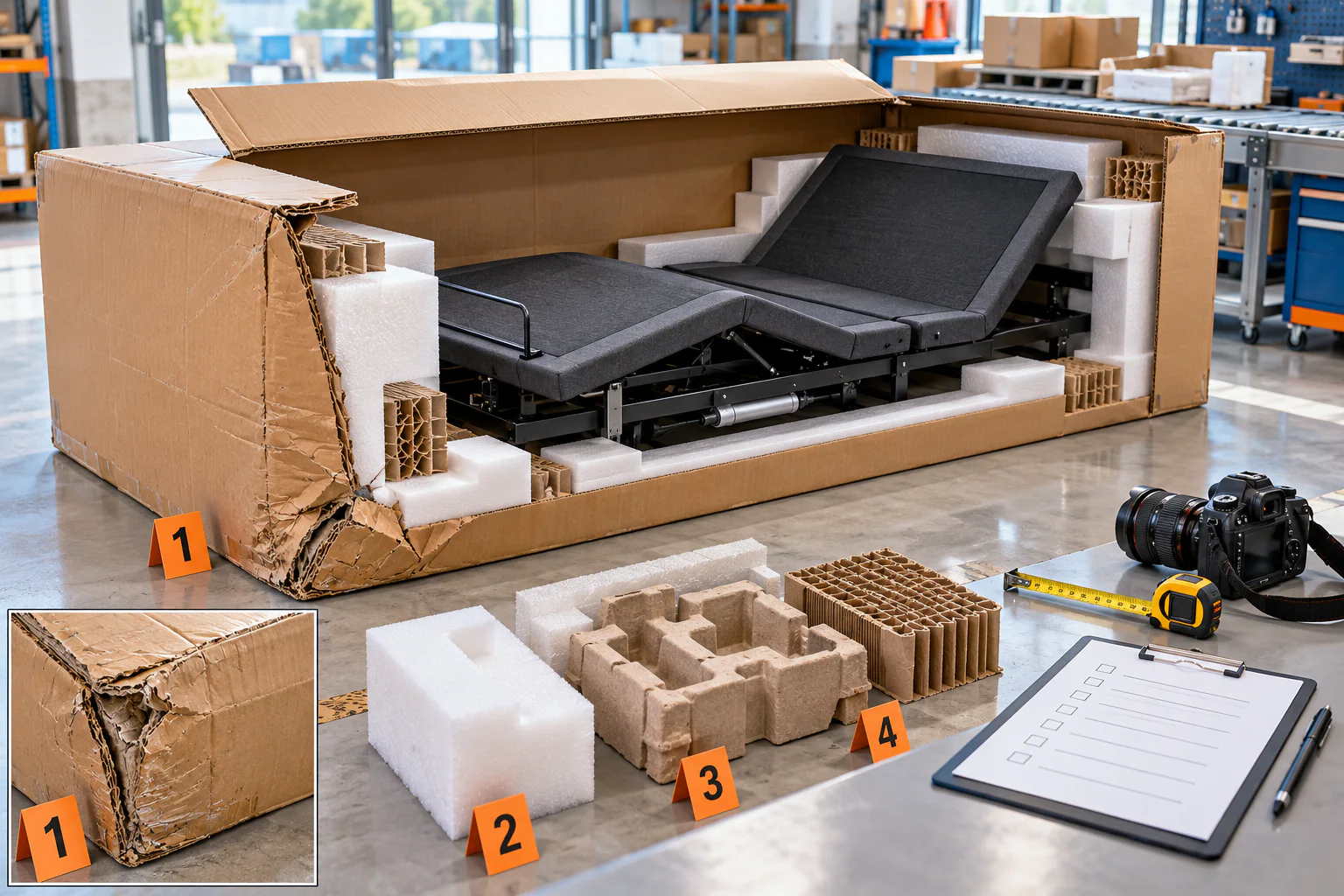
Preserve evidence before unpacking or disposal
The first photographs often determine whether the team can distinguish a product defect from packaging or handling damage. Ask the receiver to pause before removing damaged items, rearranging internal protection or discarding the carton.
Capture:
- purchase order, shipment, model, size and product revision;
- carton number within the set, lot or production reference and label details;
- all six carton faces, corners, edges, closures and visible punctures or compression;
- the orientation and condition of the package as received;
- each layer of the opening sequence, including inserts, bags, ties and accessory boxes;
- the exact location and type of product damage;
- loose, displaced or missing components and hardware;
- the functional condition before repair, where safe to assess; and
- known route, transfer, storage and delivery information.
Do not ask an end user to energize damaged electrical equipment or operate a mechanically unsafe product. A qualified party should decide what inspection is appropriate.
Use damage codes that separate facts from hypotheses
Free-text reports such as “bed damaged” cannot reveal a pattern. Use controlled fields for the observed condition and a separate field for investigation status.
| Evidence field | Useful examples | Why it matters |
|---|---|---|
| Carton condition | puncture, corner crush, edge crush, tear, wetting, no visible damage | Describes the received package without assigning cause |
| Product location | head section, foot section, side rail, actuator area, upholstery face, accessory box | Shows where energy or movement affected the product |
| Damage type | bend, fracture, abrasion, dent, cut, disconnected cable, loose hardware | Supports grouping and reproduction |
| Functional effect | cosmetic only, assembly blocked, movement affected, electrical condition unresolved | Connects damage to service priority |
| Pack-out conformity | matches approved layout, differs, unable to confirm | Tests whether production followed the released package |
| Cause status | open, suspected, reproduced, confirmed, unresolved | Prevents an early assumption from becoming a recorded fact |
The same codes should be used by the buyer, warehouse, service team and supplier. Link the record to the warranty and RMA data guide so shipping events can be compared with installation and component issues.
Compare the received pack-out with the approved revision
Retrieve the controlled packaging specification, packing instruction and approval sample for the shipped revision. Compare carton construction, internal protection, component orientation, restraint, clearances, hardware containment, surface protection and closure method.
Look for three types of difference:
- design difference: the approved package does not protect a known mass, edge, surface or moving part under the distribution hazards;
- execution difference: production used the wrong material, missing insert, incorrect orientation or inconsistent closure; and
- product difference: a component, dimension, mass distribution or protrusion changed without the packaging being reassessed.
Measure and document the difference. A photograph of a different insert is useful; a part reference, dimension or material record makes the conclusion actionable.
Reconstruct the distribution path
Ask which transport and handling stages the package encountered: palletized export, de-palletization, fulfillment storage, parcel sorting, last-mile delivery or customer handling. Note whether the packaged product moved individually or as a unit load and whether the route differed from the approved distribution plan.
ISTA advises users to understand the distribution environment, select tests that represent relevant hazards and regularly observe field distribution. Its guidance also cautions that a test can only evaluate hazards represented in the selected protocol (ISTA design and testing guidance).
This means a passed report is evidence about a defined packaged product and procedure. Check that the field unit used the same product and pack-out revision, and examine whether the actual route introduced a different hazard. Do not treat a laboratory report as a universal warranty against damage.
Calculate a comparable field-damage rate
A count without a denominator can mislead. Track damaged units against units shipped for the same model, package revision, channel, destination and period. Separate confirmed shipping damage from open or unrelated cases.
Use the data to answer practical questions:
- Is the pattern concentrated in one carton, route, warehouse or production period?
- Does the damage occur at the same product location and orientation?
- Did the rate change after a material, supplier or pack-out revision?
- Are packages with no visible carton damage showing the same internal failure?
- Does one product variant fall outside the range represented by an earlier test?
ISTA recommends maintaining shipment and distribution-damage records when test coverage is extended across related packaged products (ISTA support guidance). The buyer and manufacturer still own the risk decision for their specific range.
Move from suspected cause to reproduced failure
Create a short list of hypotheses supported by the field evidence. Examples may include unrestrained component movement, concentrated contact, insufficient clearance, an inconsistent insert, a vulnerable product feature or a hazard not represented in the prior test.
Select an investigation method that can distinguish among those hypotheses. This may involve dimensional inspection, material verification, a controlled handling reproduction, component protection trials or a transport-packaging test chosen with a qualified laboratory. Define product-damage and package-degradation acceptance criteria before formal testing.
Use new, representative production-intent samples for final verification. ISTA's guidelines emphasize representative samples and documented criteria. An exploratory test opened midway can help an investigation, but it should be separated from a formal pass/fail test where the procedure does not permit intermediate inspection.
Close corrective action with production evidence
Record the containment and permanent correction separately. Containment may protect pending stock or stop an incorrect pack-out. Permanent action may revise the product, insert, carton, packing sequence, inspection or distribution plan.
Before closure:
- release the changed drawings, bill of materials and packing instruction;
- define the effective production or shipment point;
- train and verify the affected packing operation;
- complete the agreed verification or retest;
- inspect initial production using the new revision; and
- monitor field results for the same damage code.
Update logistics cost using the actual solution rather than comparing packaging price alone. The adjustable bed logistics and packaging cost guide provides the broader cost framework.
If you are preparing a new pack-out or investigating a repeat damage pattern, send the product revision, carton data, distribution route and available evidence with your inquiry. Request a quote to discuss the model and packaging information needed for an OEM review.