The short answer: ISTA 3A is the packaging industry's standard way of asking "what happens when the carrier drops your box?" — before the carrier does it for real. Developed by the International Safe Transit Association for parcel-delivery shipments, it runs a packaged product through a lab sequence of drops, vibration, compression, and impacts that mimic the parcel network. For adjustable bed frames — heavy, long, and awkward — passing-style test documentation from your supplier is the difference between a packaging spec you can trust and a damage-rate surprise in month three. This guide explains what the test involves, why parcel carriers are so destructive, and exactly what to put in your supplier requirements. For the broader freight picture, see our adjustable bed logistics and packaging cost guide.
Why parcel carriers destroy weak packaging
A parcel network is an industrial sorting machine that happens to carry your product. Between the factory and the doorstep, a bed-frame carton typically faces:
- Conveyor drops and transfers — cartons fall from belt to belt at sort facilities, often corner-first.
- Stacking under heavier freight — your 30-plus-kilo carton becomes the bottom of someone's pile.
- Forklift and clamp handling — quick, rough, and optimized for speed, not your product.
- Last-mile handling — the final carrier, the stairs, the porch drop.
Adjustable bed components make this worse: long steel rails concentrate impact on corners, actuators and control boxes are dense point loads inside the carton, and hardware kits rattle loose and become projectiles. Packaging that looks fine on the factory floor fails at the third sort hub. ISTA 3A exists precisely because visual inspection of packaging is worthless — only tested packaging counts.
What the ISTA 3A procedure involves
ISTA 3A ("Packaged-Products for Parcel Delivery System Shipment") is a performance test, not a checklist. The lab takes the product in its actual shipping packaging and runs it through a defined sequence. While the exact protocol is the ISTA document itself (your lab will run the current revision), the hazard categories are:
| Test block | What it simulates | Why it matters for bed frames |
|---|---|---|
| Drop testing | Falls from conveyor height, corner/edge/face drops | Long cartons land corner-first; rails punch through weak corners |
| Vibration (rotary or random) | Truck and conveyor vibration over distance | Hardware kits loosen; fittings migrate inside the carton |
| Compression | Warehouse and vehicle stacking | Bottom cartons in a stack carry the load for days |
| Impact / shock | Sorter impacts, drops onto hard surfaces | Actuator mounts and hinge points take point loads |
| Atmospheric conditioning | Temperature and humidity exposure | Carton strength drops in humidity; ocean legs are humid |
The sequence matters: the drops weaken the carton, then vibration and compression finish the job — exactly like a real journey. A package that passes drops alone but fails the full sequence is a package that fails in the real network.
The drop-test sequence: what "passing" actually looks like
For furniture-scale cartons, the drop portion typically includes drops onto each face, each edge, and each corner from a specified height (height scales with package weight — heavier packages drop from lower heights, because physics). The pass criteria are judged on two things:
- Product condition — does the bed frame still function? Do the rails, actuators, and electronics survive intact?
- Package integrity — is the carton still containing the product and protecting it, or is it split open?
Note the honest framing: the test measures the packaged product, not the product alone. A superbly engineered bed base in a thin single-wall carton fails; a decent base in a well-designed double-wall carton with fitted foam inserts passes. Packaging is part of the product for anything that ships by parcel — budget and specify it that way.
One more caution: never accept a supplier's claim of "ISTA 3A passed" without documentation showing the test protocol, the package configuration tested (exact carton, inserts, and contents), and the lab that ran it. A pass claim for a different carton than the one you'll receive is not a pass claim for your shipment.
Also check the sample size behind the result. A single sample that passed tells you the design can survive; a small batch of samples tells you it consistently survives. Ask how many packaged units were tested, whether any failed and were redesigned, and what the retest results were. A supplier that shares a failure-and-redesign story is more trustworthy than one that claims a perfect first attempt — packaging engineering is iterative, and honest iteration beats a suspiciously clean record. Finally, confirm the tested carton matches the carton you will receive down to the ply and insert layout; suppliers sometimes test a reinforced "lab carton" and ship a lighter production version.
What to require in your supplier packaging specs
Translate the test into contract language. Your supplier packaging specification should require:
- Defined test protocol. "Packaged unit shall be tested per ISTA 3A (current revision) or an equivalent documented drop/vibration/compression sequence" — name the standard, not just "drop tested."
- Test configuration record. The exact carton (dimensions, ply, material), all inserts and cushioning, and the complete contents list as tested. Request exact carton specs from the factory — carton data is model-specific and cannot be responsibly estimated.
- Results documentation. Dated test report with photos of the package before and after, product condition assessment, and the lab or facility that performed it.
- Change control. Any change to carton, insert, or contents triggers re-testing or written engineering justification. Suppliers quietly "optimize" packaging cost; this clause keeps the test valid.
- Real-shipment damage tracking. Test results get you to launch; a monthly damage-rate report keeps you honest afterward. Set an acceptable threshold and a corrective-action trigger.
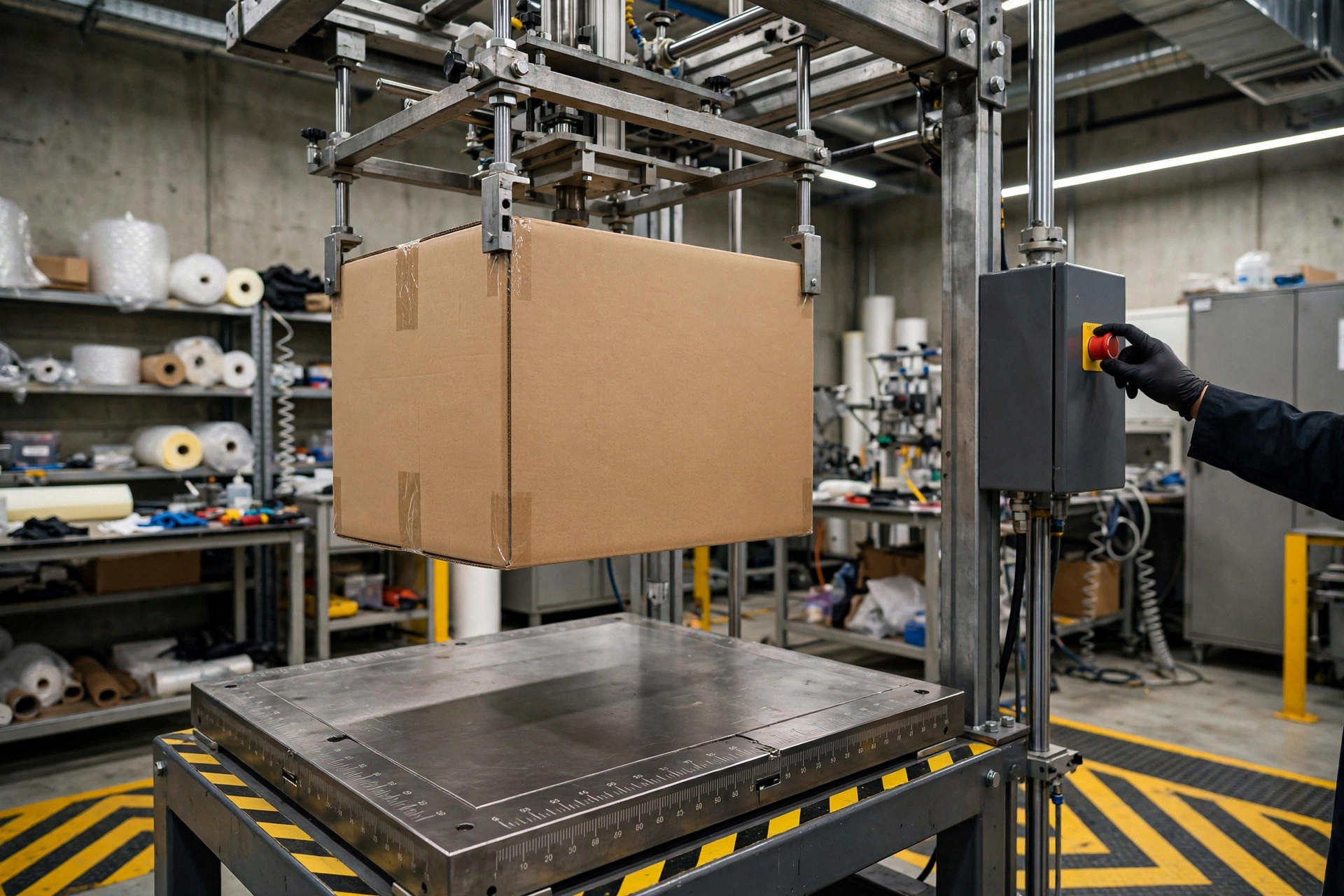
Illustrative AI-generated scene of a packaging drop test — not a photograph of actual KCAI testing.
Beyond drop testing: vibration, compression, and climate
Drops get the attention, but for ocean-plus-parcel journeys, two quieter hazards deserve equal weight in your spec:
Compression over time. A carton that survives a lab compression test for minutes may creep and collapse under stack load for weeks in a container. Ask how the packaging performs under sustained load, not just peak load — and confirm the factory's pallet stacking plan matches what your forwarder will actually do.
Humidity. Corrugated board loses a large share of its stacking strength in high humidity, and ocean containers are humid environments. Moisture-barrier bags, desiccants, and container ventilation are packaging decisions, not logistics afterthoughts. If your route includes an ocean leg, your packaging spec should say so explicitly.
Vibration loosening. Adjustable bed hardware kits — bolts, brackets, remote controls — migrate inside cartons under vibration. Fitted compartments and sealed hardware bags are not presentation details; they are damage prevention. Rattling contents become impact damage.
Packaging and product design belong together
The cheapest damage prevention is designed into the product. KCAI's split-frame platforms — the KD010-A2 and KD011-A3 (both 2000x900mm, knock-down by design) — pack as compact, dense cartons rather than long, fragile ones; dense cartons survive drops and stacking better by simple physics. The lifting systems use German OKIN and Haojiang actuators verified by 10,000+ cycle aging tests, and products are lab-tested under CNAS/SGS/TUV/UL protocols at the company's 25,000 sqm Dongguan factory. Packaging designed alongside the product, tested as a unit — that is what your supplier spec should demand, from any factory. Browse the electric adjustable bed base range to see the platforms this applies to.
Next step: put ISTA 3A in your supplier agreement
Packaging quality is invisible until it fails, and then it is the only thing that matters. Before your next order: require a named test protocol in the packaging spec, demand the test configuration record and dated results, add change control, and track real damage rates from shipment one.
Two ways to work with KCAI:
Path 1 — Wholesale proven platforms. Buy established models with documented packaging: request exact carton specs and available transport-test documentation with your quote request. You get packaging that was designed with the product, not wrapped around it afterward.
Path 2 — OEM/ODM customization. Designing a custom model? Our OEM/ODM services develop packaging alongside the product from the CAD stage — carton, inserts, and test documentation as part of the golden sample sign-off, not an afterthought before the first container.
Either way, start with the spec sheet. The factory that can show you its test documentation is the factory whose cartons you can trust.