The short answer: packaging decides your landed cost
An adjustable bed is a large, heavy, mechanically complex product — and that makes logistics, not the factory price, the biggest variable in your landed cost. The buyers who pay the least per unit are the ones who understand three things before placing the purchase order: how carton volume converts into container CBM and freight cost, whether the bed ships flat-packed or assembled, and whether the packaging has been engineered to survive transit. A 10–20% difference in packing efficiency can erase the entire margin between two suppliers' quotes. This guide teaches the CBM method step by step, explains flat-pack design principles, decodes ISTA 3A drop testing, and shows how to avoid dimensional-weight and oversize fees — from KCAI, a Dongguan-based manufacturer of adjustable bed base frames serving 100+ customers worldwide.
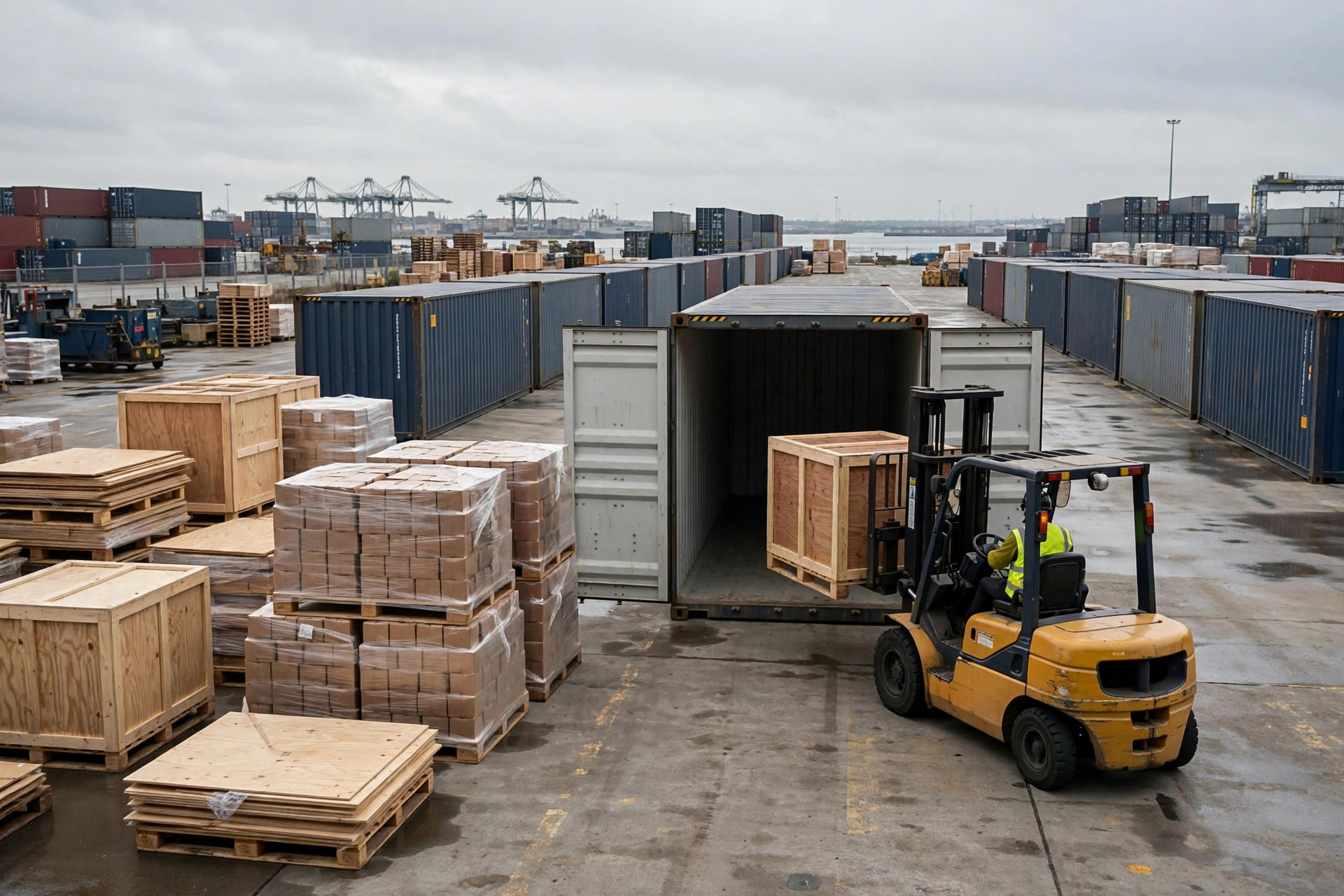
How carton dimensions become container CBM — the calculation method
Sea freight is quoted by container, and container capacity is measured in CBM (cubic meters). Your per-unit shipping cost is a simple division: the container's usable CBM divided by the number of units you can load. The math is elementary; the mistakes buyers make are almost always in the inputs.
Step 1: Get the finished carton dimensions — not the product dimensions
The most common error is calculating with product dimensions instead of carton dimensions. A base with a 2000×900 mm footprint does not ship in a 2000×900 mm carton: packaging adds centimeters on every side, accessories may ship in a second carton, and flat-packed vs. assembled changes everything. Rule one: never compute CBM from product dimensions. Request the exact carton length, width, height and gross weight per carton from the factory for your specific model. KCAI's KD010-A2 measures 2000×900 mm as a product — but its carton size is a separate specification, and your forwarder needs the carton figure.
Step 2: Compute per-carton CBM
Convert millimeters to meters, then multiply:
CBM per carton = (L ÷ 1000) × (W ÷ 1000) × (H ÷ 1000)
Worked example using the real KCAI base dimension 2000×900 mm: suppose the factory confirms a finished flat-pack carton of 2050×950×180 mm. Per-carton CBM = 2.05 × 0.95 × 0.18 = 0.35055 CBM. (Method illustration only — never invent carton sizes; always use the factory-confirmed carton spec.)
Step 3: Estimate container loading
Divide the container's usable CBM by the per-carton CBM, round down, and sanity-check the carton footprint against the container's floor plan. A 40HQ offers roughly 68 usable CBM; at 0.35055 CBM per carton the volumetric ceiling is about 194 cartons — but the real loading count is decided by floor tiling and stack-height limits, which is why the factory's confirmed loading plan matters more than your spreadsheet.
Step 4: Derive your per-unit freight cost
Per-unit freight = total container freight cost ÷ confirmed units loaded.
This number belongs next to the factory's unit price in your cost model. A supplier whose unit price is 3% higher but whose flat-pack carton loads 25% more units per container is almost always cheaper at landed cost.
| Calculation input | Where it comes from | Common mistake |
|---|---|---|
| Carton L×W×H (meters) | Factory-confirmed carton spec per model | Using product dimensions instead |
| Cartons per container | Factory loading plan or forwarder calculation | Assuming theoretical max CBM is achievable |
| Gross weight per carton | Factory packing list | Ignoring container payload weight limits |
| Freight rate per container | Forwarder quote for your port pair | Comparing FOB prices without freight |
| Per-unit freight | Container rate ÷ confirmed units | Choosing suppliers on unit price alone |
Flat-pack design principles for adjustable bed bases
An adjustable bed base is an awkward shipper: long, wide, and full of moving parts. Good flat-pack design turns that shape into stackable, container-friendly cartons without compromising the mechanism.
Split the mechanism from the platform. Separating the lifting system from the mattress platform lets each ship in its own flat carton, nested or stacked. KCAI's KD010-A2 is built this way: a split-design AI bed frame whose lifting system is separate from the mattress — which also isolates the precision mechanism from stacking compression.
Design the carton around the container. Professional factories work backwards from container internal dimensions (a 40HQ is about 12.03 m long and 2.35 m wide inside), choosing carton footprints that tile the width with minimal waste. A precise answer to "how does your carton tile the container" means the packing was engineered.
Protect the moving parts first. The lift mechanism, motors and control boxes are the highest-value, most damage-sensitive components. In a well-designed flat pack they sit in custom-molded cushioning at the carton's core, surrounded by structural frame parts that absorb impact. Ask which components get dedicated cushioning — the answer reveals whether the packing was designed or improvised.
Keep accessories fixed inside the main cartons. Remote controls (KCAI uses models such as SK.29.11, SK.34.09 and SK.50.17), power cables, legs and brackets should ship in fixed positions — not loose in a mixed master carton where they migrate and scratch finished surfaces. One damage claim on a scratched side rail costs more than the foam insert that would have prevented it.
Make the carton configurable. A factory with genuine OEM/ODM capability can adjust the configuration — single vs. double carton, accessory placement, stacking orientation — to your freight plan.
ISTA 3A drop testing, explained for buyers
ISTA 3A is a laboratory test standard from the International Safe Transit Association for parcel shipments. It simulates what a carton endures in courier, parcel and LTL networks: drop tests from specified heights, vibration tests mimicking truck transport, and compression tests mimicking warehouse stacking.
Why care? Damage in transit is a packaging engineering problem, and ISTA 3A is how you verify the engineering before hundreds of units ship. A factory that tested its packaging can state exactly which drop heights and vibration profiles its cartons survived; one that did not will answer with generalities. Listen for the standard name, the test lab, and the result — "our packaging is very strong" is not a test result.
The payoff is direct: a one-point reduction in damage claims on a high-ticket product pays for a great deal of packaging engineering. Note that ISTA 3A simulates parcel handling — container shipments face different stresses (stacking compression, humidity, long-duration vibration). Ask which transit mode the packaging was validated for, and whether container-specific measures such as moisture barriers are included.
KCAI's quality system runs on independent verification: products are lab-tested to CNAS, SGS, TUV and UL standards, and lifting systems undergo 10,000+ cycle durability testing. Ask for the same discipline on the carton — the test name, the lab, the pass criteria.
Dimensional-weight and oversize fees: the e-commerce seller's trap
Parcel carriers charge whichever is greater: actual weight or dimensional weight, calculated from carton volume. A large, light carton is billed as if it were heavy. On top of that, carriers publish oversize thresholds — maximum length or length-plus-girth limits — beyond which steep per-carton surcharges apply regardless of weight. A base that ships economically by sea container can become unprofitable by parcel if one carton dimension crosses an oversize line. The defense must be designed in before you order:
- Know your carrier's thresholds first. Get the dimensional divisor and oversize limits for every carrier and network you will use, in each target market. Treat them as design inputs.
- Design cartons under the line. Every finished carton should sit comfortably below the oversize threshold, with margin for measurement tolerance. Split-design bases have a natural advantage: two smaller cartons instead of one long one.
- Verify per model, per configuration. A Twin-size and a King-size configuration of the same base family can land on different sides of a threshold. Never assume one model's carton math applies to another.
- Model the fee into pricing. Build the worst-case dimensional-weight charge into your retail price model before committing to inventory — not after units sit in a 3PL warehouse.
- Ask the factory for carrier-aware packing. An experienced factory can propose carton splits to dodge oversize fees, but only if you share the thresholds during product development.
How our factory solves it: engineered packing from a 20-year manufacturer
Packaging engineering is a capability, not a feature — it comes from manufacturing depth. KCAI (Dongguan Kangcai Intelligent Technology) has manufactured adjustable beds and bed frames since 2004, from a 25,000 sqm facility with 100+ staff, serving 100+ customers worldwide. That scale makes packaging a designed system: carton configurations are developed alongside the product, validated in independent labs (CNAS, SGS, TUV, UL), and refined across high-volume container shipments.
The product architecture supports efficient logistics. The electric bed frame range — KD010-A2, KD008-A1, KD005-A1, KD011-A3, KD001-A3, KD007-A1, KD001-A7, KD001-A6, KD004-A3 and KD006-A1 — is built around the 2000×900 mm base dimension (Twin/Full/Double/Queen/King available as configurable options), using high-strength honeycomb aluminum panels, eco-friendly multi-layer boards and quality steel. Lifting systems are durability-tested for 10,000+ cycles and powered by German OKIN and Haojiang motors. With separable lifting systems and configurable dimensions, the factory can propose carton splits matched to your container plan or carrier thresholds — where the OEM/ODM engineering team earns its keep.
For buyers evaluating the KD010-A2: its separated lifting system and mattress platform is the structural reason it packs efficiently. Request the model's exact carton specifications and loading plan, run the CBM method from this guide, and compare per-unit landed cost against any competing quote. The numbers will speak.
A note on comfort: adjustable positions may help with reading, watching TV or general comfort. These are comfort features, not medical treatments — adjustable beds are not a substitute for medical advice, and anyone with a serious health condition should consult a doctor.
Buyer's checklist: ask these before you place the PO
- Exact carton dimensions and gross weight for my model and size?
- Units per 20ft, 40ft and 40HQ for my configuration?
- Which drop-test standard was the packaging validated against, and by which lab?
- Validated for container shipment, parcel shipment, or both?
- Can the carton configuration stay under my parcel carrier's oversize thresholds?
- How are the motor, lift mechanism and remote control cushioned and fixed?
- What moisture protection is included for sea freight?
- Packing list and loading plan in writing before I book freight?
Frequently asked questions
How do I calculate the CBM of an adjustable bed shipment? Measure each finished carton in meters (length × width × height) and multiply for the per-carton CBM, then multiply by the carton count. Always use the factory's confirmed carton size for your model — never product dimensions.
Can an adjustable bed base really ship flat-packed? Yes. Many electric adjustable bed bases ship flat or nested, with lift system, frames and accessories separated into stacked cartons. KCAI's KD010-A2 is a split-design frame whose lifting system is separate from the mattress platform, supporting efficient flat-pack shipping. Confirm the packed configuration before booking freight.
What is ISTA 3A testing and why does it matter for bed bases? ISTA 3A is a laboratory drop-and-vibration test standard for parcel shipments, simulating the impacts a carton receives in courier and LTL networks. Passing it means the packaging was engineered — not guessed — to survive real transit, reducing damage claims and return costs.
How can I avoid dimensional-weight and oversize surcharges? Keep every finished carton under each carrier's published thresholds, design packaging around those limits from the start, and verify carton size and weight per model. Split-design bases ship in smaller cartons than one-piece frames — one structural way to stay below the surcharge line.
What packaging information should I request from an adjustable bed factory? Exact carton dimensions and weight per model, units per 20ft/40ft/40HQ container, the drop-test standard the packaging passed, packing materials used, and whether the carton design is configurable for your market's carrier limits.
Start with the numbers: get a factory packing proposal
The cheapest adjustable bed to import is the one whose packaging was designed for your freight plan. KCAI's engineering team will prepare a model-specific proposal: exact carton specifications, container loading plans, and packaging validation details — for the KD010-A2 split-design frame, the wider bed frame range, or a custom configuration.
Two ways to work with us. OEM/ODM custom manufacturing — product and packaging engineered around your market's dimensions, carrier limits and brand requirements; start through our OEM/ODM page. Wholesale purchase of existing models — the proven range including the KD010-A2, shipped with factory-validated packing; send models and quantities via request a quote. Either path starts the same way: real carton numbers, real CBM math, and a landed-cost comparison you can verify.