On this page
Quick answer: A bed that pauses after several movements may have reached a component's permitted run/rest limit, but the same symptom can also result from a power interruption, a control fault, an obstruction, a connector problem or a mechanical overload. A pause alone does not identify a failed motor or prove that thermal protection operated. The useful question for an OEM buyer is whether the complete, identified bed configuration behaves as its approved instructions and component specifications say it should.
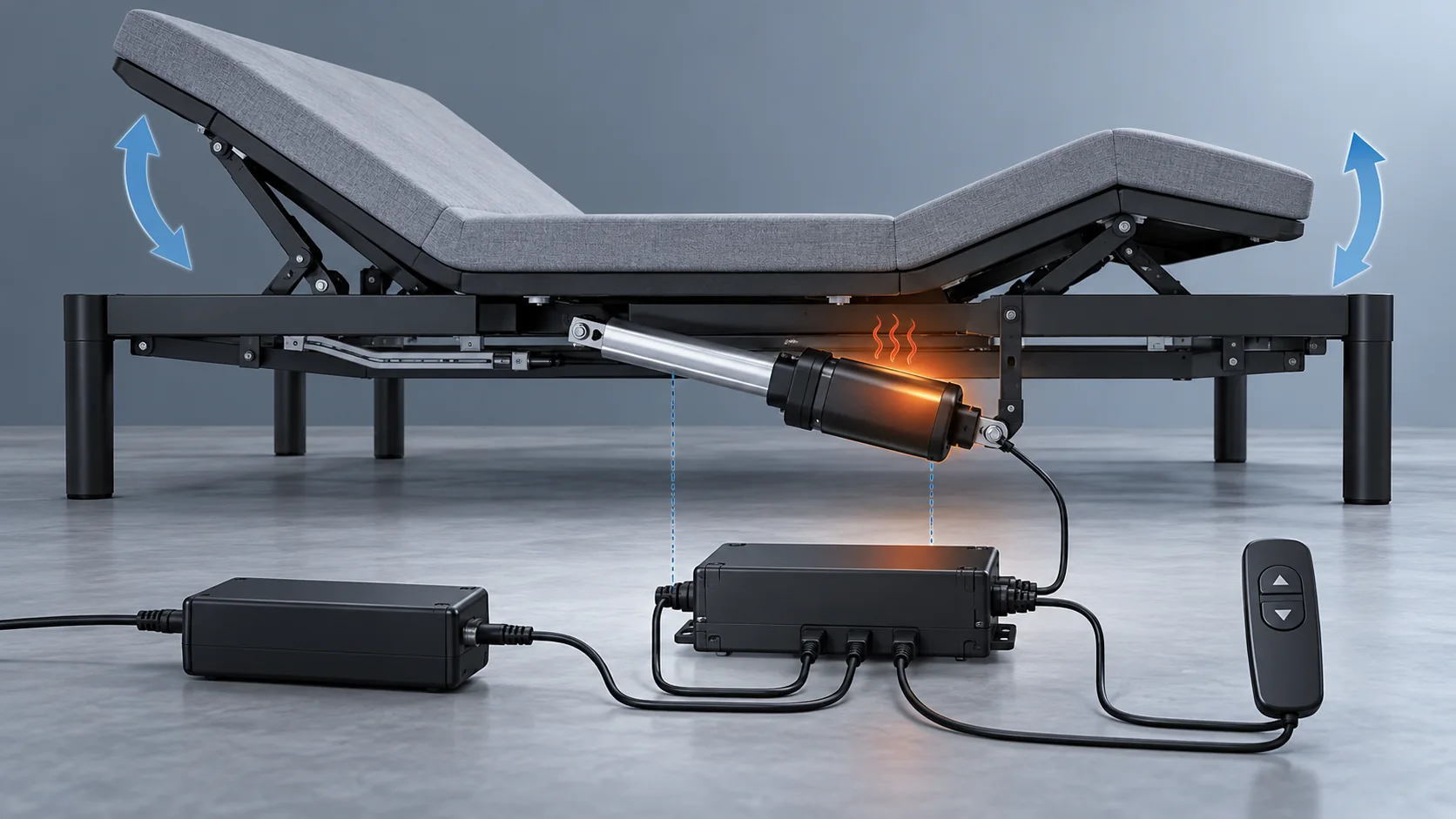
Conceptual AI illustration. It is not a KCAI model, wiring drawing, thermal test or claim that the pictured component is fitted to any KCAI bed.
A stop is a symptom, not a diagnosis
An adjustable base is a coordinated electrical and mechanical system. The remote sends a command; the controller and power supply make that command available to an actuator; the actuator moves a linkage and deck against the load present at that moment. If movement stops, the cause could be anywhere along that path. Replacing an actuator before isolating the condition can leave the actual fault untouched.
Begin with what was observed. Did one section stop while another still moved? Did the remote indicate a command? Was there a click, a change in motor sound or a loss of all power? Did the bed resume after a pause, after disconnecting and reconnecting power, or only after a technician corrected a connection? These observations are more useful than writing “motor overheated” in a return report.
| Observation on the sample | Plausible areas to investigate | Record before concluding |
|---|---|---|
| All functions stop at once | Supply, mains connection, controller, programmed limit or protection | Supply identity, indicator state, time of stop, response to controls |
| One motion zone stops | That zone's command path, connection, actuator, linkage or obstruction | Zone, direction, position and whether other zones operate |
| Movement slows as load changes | Load path, voltage at the approved system, friction or component limits | Load definition, position, speed method and visible interference |
| Movement resumes after a rest | A time- or temperature-related limit is possible | Run/rest history, ambient condition and the exact restart condition |
| A fault occurs only at one angle | Clearance, linkage geometry, cable route or travel limit | Position photographs and repeatable start/end points |
The table is a triage aid, not a diagnostic procedure for an end user. Keep hands and objects away from moving mechanisms; electrical and mechanical inspection belongs to qualified personnel following the actual product instructions.
What duty cycle means—and what it does not
Duty cycle describes an allowed pattern of operation under stated conditions. For an intermittent actuator, a specification may state a maximum running period followed by a minimum resting period. The simple time ratio is:
duty-cycle fraction = permitted running time ÷ (running time + required resting time)
For example, a LINAK CBH Advanced system manual specifies 2 minutes of continuous use followed by 18 minutes not in use for the system it describes. That is a third-party component-system example, not a specification for any KCAI model. It also shows why quoting only “10% duty cycle” would be incomplete: the allowable continuous run, rest interval and operating conditions matter to the buyer.
An actuator duty cycle is not a finished-bed load rating, a warranty period or a prediction of service life. LINAK's actuator guidance explains that operating pattern, load and ambient temperature interact. The exact relationship is component-specific. A bed assembled with a different actuator, controller, power supply and linkage needs its own approved limits and complete-system validation.
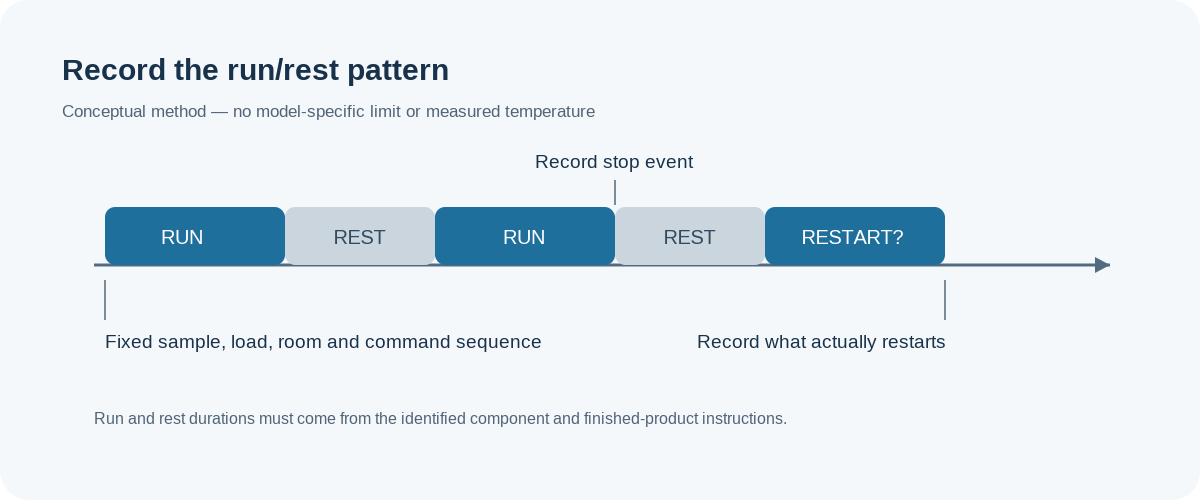
Technical schematic: the blocks show what to record, not a KCAI run/rest specification or measured temperature curve.
Keep four ratings separate in an RFQ
Buyers sometimes receive a motor force, bed capacity, cycle count and duty cycle in one sales sheet. They answer different questions:
| Claim or number | What it could describe | What the buyer needs beside it |
|---|---|---|
| Actuator force | A component's push or pull capability under defined conditions | Exact actuator identifier and component datasheet |
| Bed load rating | The complete bed's stated supported or moving load | Load distribution, included mattress, position and test method |
| Durability cycles | Repeated movements in a particular test | Tested assembly, load, motion range, acceptance criteria and revision |
| Duty cycle | Permitted running and resting pattern | Continuous-run limit, rest time, load and ambient conditions |
The motor and lifting-capacity guide examines force and load paths. This article focuses on time-dependent operation and repeatable diagnosis. Neither a higher force number nor a longer cycle-test result establishes that the sample may run continuously.
Run a comparable sample review
Set the test up so a second engineer can reproduce it. Identify the bed, not just the motor. Fix the sample revision, mattress, accessory set, supply configuration, room condition and starting position. Define the intended use sequence before operating the sample. If the supplier's manual specifies a rest period, follow it; do not deliberately defeat a protection feature to reach a marketing number.
- Capture the system identity. Record the sample ID, model and revision, actuator label, controller, power supply, remote and firmware reference where provided.
- Define the condition. Note ambient temperature, mattress and test load, including how the load is distributed. Use the same conditions for every comparison run.
- Define the movement. State the zone, direction, start position, end position and whether commands are sequential or simultaneous.
- Time the event. Record each command start, movement stop, rest start and successful restart with the same clock. Count repetitions and cumulative run time separately.
- Preserve evidence. Film the full bed and remote in one view where possible. Photograph the power and component labels without exposing customer data.
- Classify the outcome. Note whether the observed behavior matches the exact manual, is unexplained, or requires supplier engineering review. A resumed bed should not automatically be marked “thermal protection passed.”
Fillable motor-pause sample record
| Field | Entry |
|---|---|
| Project / sample / revision / test record ID | ______ |
| Actuator / controller / power-supply identifiers | ______ |
| Mattress and accessories fitted | ______ |
| Load amount, distribution and source of value | ______ |
| Room temperature and measurement location | ______ |
| Zone, command sequence and start/end position | ______ |
| Run 1, 2 and 3 start/stop times | ______ |
| Rest interval and restart response | ______ |
| Other zones operating during the event? | ______ |
| Video and label-photo references | ______ |
| Applicable manual or specification revision | ______ |
| Supplier explanation, corrective action and reviewer | ______ |
Three runs are suggested here as a record format, not a pass criterion or a claimed industry standard. The appropriate sequence and number of repetitions must come from the project test plan and the component's permitted usage.
Turn the finding into a buying decision
Suppose one proposed sample pauses during a showroom demonstration while another completes the same sequence. That is not enough to rank the motors. First check whether the two samples use the same load, mattress, commands, power supply and starting position. Then compare each behavior with its own documented operating limit. If one sample is operated beyond its specified duty cycle, the comparison is invalid; if it pauses within the stated operating range, request a documented investigation.
The RFQ should request the actual configuration's actuator and control references, usage limits, installation instructions, fault indicators, component replacement identifiers and a sample review plan. Ask which party will explain failures to the retailer and how a service team distinguishes a planned pause from a fault. The actuator-system guide covers the broader component comparison, while the returns triage guide helps route a field symptom.
Comparing an adjustable-bed program? Send the intended market, use sequence, shortlisted model and sample requirements through the RFQ form. Ask for the current configuration-specific operating limits and a documented review of any motor-pause behavior. KD001-A3 and KD010-A2 are model references for that discussion; no duty-cycle value is asserted here for either model.