On this page
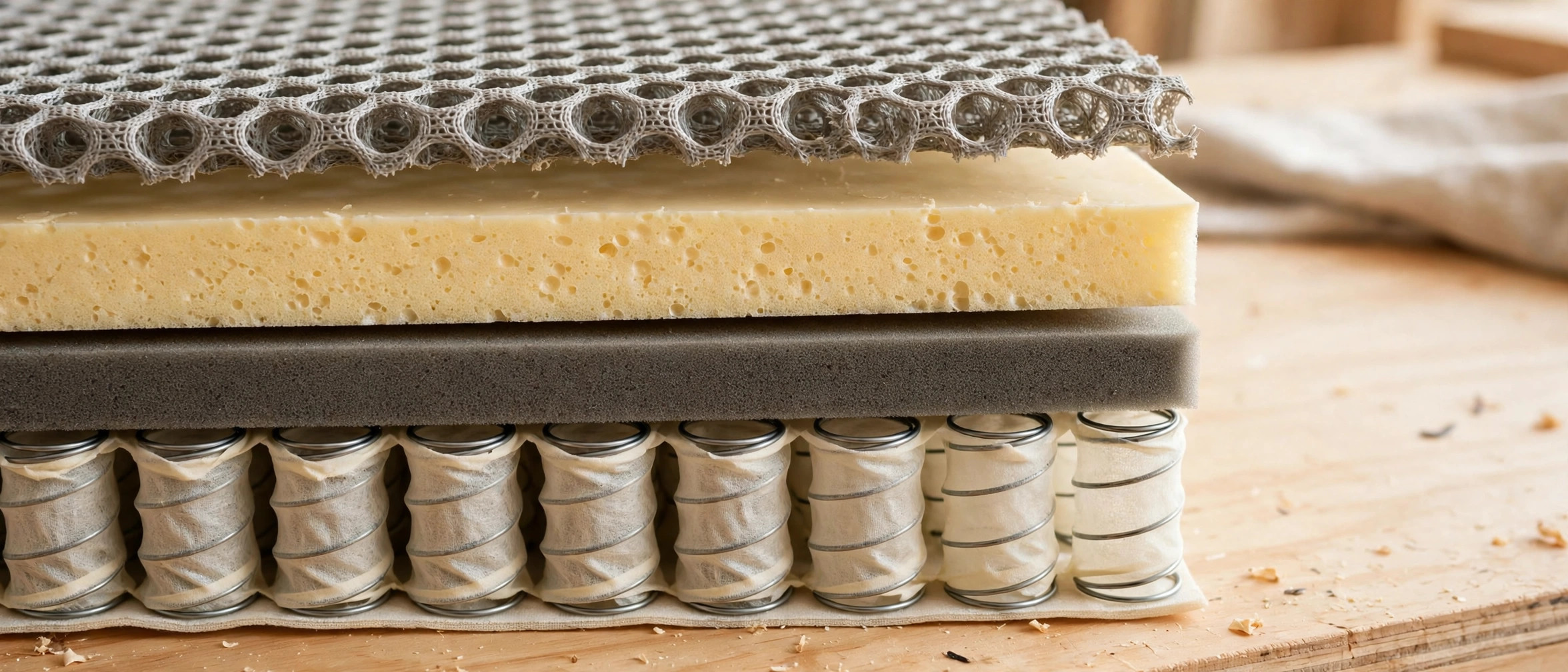
A buyer who orders an adjustable mattress by its dimensions alone is buying half a product. The other half is the material stack inside it — and on an adjustable mattress that stack works harder than the same materials in a flat mattress, because it bends. Every time the head or leg section rises, the layers at the hinge flex, compress and recover. Do that nightly for years and the difference between a material specified for bending and a material merely named on a specification sheet becomes a return, a complaint, or a repeat order. This guide explains each material named in KCAI's mattress catalogue — natural latex, high-density foam, pocket springs, 3D breathable material, graphene elastic cotton and the quilted cover, configured per model — what each one does under bending, and the exact questions a buyer should ask before ordering.
Why materials matter more on an adjustable mattress
A flat mattress has one job: support a body that barely moves. An adjustable mattress has two: support the body, and survive being bent. The hinge zone — the line where the head section meets the flat section, and where the leg section meets the flat section — is where every material decision is tested. A layer that is too stiff resists the bend and fights the motor. A layer that is too soft collapses at the hinge and leaves a visible crease. A layer that does not recover leaves a permanent fold after months of nightly use.
That is why the material list alone never answers a buyer's question. Two suppliers can both list "natural latex" and "high-density foam" and deliver mattresses that behave completely differently at the hinge, because the behaviour depends on the layer order, the layer thickness, the bonding between layers and the way the cover is quilted — details that belong in the model-specific specification, not in a catalogue headline. The buyer's job is therefore not to compare material names but to compare material behaviour: how the stack bends, how it recovers, how it breathes and how it wears. The rest of this guide takes the catalogue materials one by one and turns each into a set of questions for the factory.
The stakes are commercial, not academic. A mattress that creases at the hinge is the most visible defect an adjustable bed can have — the customer sees it every morning. A mattress that sleeps hot because its layers trap air generates the kind of complaint that no remote-control feature can fix. And a mattress whose layers separate at the hinge is a warranty claim the distributor pays for. Materials are where those outcomes are decided, long before the first container ships.
Natural latex: flex, rebound and what to ask
Natural latex is the comfort layer most buyers ask about first, and the reason is its combination of flex and rebound. Latex stretches and recovers, which is exactly what a hinge zone needs: a layer that follows the bend without cracking and returns to flat without a memory of the fold. Where natural latex is specified in a KCAI mattress build, it is part of the customizable layer stack, and its job is to conform to the body and recover when the pressure is removed; its position in the stack is set per model.
Three questions turn a latex claim into a verifiable specification. First, where does the latex sit in the stack? Latex near the surface governs the feel a customer notices on the first night; latex buried under thick foam contributes far less. Ask for the layer order in writing, top to bottom, for the exact model. Second, how is the latex specified for bending? Ask the factory how the layer is tested under repeated flexing, and whether the test evidence covers the full backrest range of the ordered model. Third, what is the latex content? This guide states no percentage and no density figure, because neither is published in the factory specification record used here. If a buyer needs a figure — for a retail claim, a certification file or a private-label specification — it must be requested on the official specification sheet for the exact model, and quoted only from that sheet.
A practical warning belongs here. "Natural latex" on a specification sheet is a material name, not a guarantee of content or performance. A buyer who writes a retail claim about latex content without a specification sheet behind it is writing a claim the distributor cannot defend. The safe retail line describes the feel — responsive, conforming, recovering — and leaves the figures to the document that actually states them.
High-density foam: the support layer
High-density foam is the workhorse of the mattress stack. It carries the body weight, defines the support feel, and — critically on an adjustable mattress — it is the layer most likely to take a permanent set at the hinge if it is specified for a flat mattress and then bent nightly. In KCAI's catalogue it appears as high-density sponge in the customizable layer stack, where it spreads load and gives the mattress its body; ask where it sits in the ordered model and what it sits on.
The buyer's questions for foam are about behaviour, not brand names. How does the foam recover after bending? Ask whether the factory tests the foam layer under repeated flexing at the hinge, and what the acceptance criterion is — a visual inspection for creasing, a thickness measurement after cycling, or both. How does the foam breathe? Foam is the layer most likely to trap heat, which is why its neighbours in the stack matter: a foam layer under a 3D breathable material behaves differently from the same foam under a sealed cover. And how thick is it, in which layer? Thickness changes the feel more than the material name does, so the layer order and the thickness of each layer belong in the written specification for the model.
As with latex, this guide states no density figure. Density values are not published in the specification record used here, and a number without a test method behind it is worse than no number at all — it invites a comparison the buyer cannot win and a claim the distributor cannot support. Request the figure on the official specification sheet for the exact model, with the test method stated, and file it with the product record. If the factory cannot supply it, the honest position is to describe the support feel and the bending behaviour observed on the sample, and nothing more.
Pocket springs: zoned support under bending
Independent pocket springs — individually wrapped coils — are listed on the KD003-B1 electric mattress page, and they solve a problem foam alone cannot: giving different support in different zones while still bending. Each spring moves independently, so the shoulder zone can give while the lumbar zone holds, and the spring unit as a whole can follow the curve of a raised head section without the rigid resistance of a connected coil unit.
That independence is also what a buyer should verify. Ask how the spring unit is constructed at the hinge: whether the pocketed rows are divided or scored to allow the bend, and whether the springs at the hinge are the same specification as the springs in the flat zones. Ask about the interaction with the layers above: a pocket spring unit under a latex layer feels different from the same unit under thick foam, so the layer combination — not the spring alone — is what the customer experiences. And ask about edge behaviour: whether the perimeter of the mattress is reinforced, and how the edge holds up when the bed is raised and the sleeper sits on the edge to get out.
The sample test for springs is simple and revealing. Raise the sample through its full range, slowly, and watch the hinge zone: the surface should curve smoothly, with no ridge where the spring unit resists the bend and no hollow where it collapses. Lower it and check that the surface returns to flat with no visible line. Then press along the hinge and along the flat zones and compare the response. A spring unit that behaves differently at the hinge than on the flat is a specification the buyer should question before ordering, not after the first customer complains.
3D breathable material and the quilted cover
Heat is the quiet complaint of adjustable mattresses. A mattress that bends well but sleeps hot will still generate returns, because the customer experiences the heat every night and the bend only when they adjust the bed. That is why the breathability layer matters as much as the support layers: 3D breathable material, which appears on some KCAI catalogue mattress pages, is the layer that moves air through the stack — confirm whether it is available on the ordered model — and knitted fabric with three-in-one quilting is the catalogue cover construction that holds the stack together.
The buyer's questions here are about the air path. Where does the 3D breathable material sit in the stack, and what does it connect to? A breathable layer sealed between two impermeable layers moves no air at all. How is the cover quilted, and does the quilting restrict the bend? A heavily quilted cover can stiffen the hinge zone, so the cover construction and the hinge behaviour should be tested together on the sample, not separately. And how is the cover finished at the hinge — is there a gusset, a stretch panel or a plain seam, and does the finish survive repeated bending without puckering?
The cover also carries the only visible branding the mattress will ever show, which makes its durability a retail issue as well as a technical one. Ask how the cover is cleaned, whether it is removable, and what happens to the quilting after repeated cleaning. A cover that cannot be maintained is a cover the customer will blame on the mattress, and the distributor will hear about it first.
Graphene elastic cotton and other configurable layers
Graphene elastic cotton appears on a KCAI catalogue mattress page with a qualification that matters: it is offered on some models only. It is a configurable layer, not a standard one, and a buyer must never list it as standard on every model. The same discipline applies to the whole stack: the layer configuration is configurable per model, which means the specification for one model is not the specification for another, even when the two models share a name family.
The right way to handle configurability is to treat the layer stack as an ordered choice, not a fixed recipe. Start from the catalogue materials — knitted fabric with three-in-one quilting, natural latex, high-density foam, pocket springs, 3D breathable material, and graphene elastic cotton, each where offered on the ordered model — and ask the factory to confirm, for the exact model and the exact order, which layers are included, in which order, and at which thickness. Then ask what changes if a layer is added or removed: does removing latex change the hinge behaviour, does adding a layer change the folded height, does a thicker stack change the way the mattress sits on the frame? Our layer configuration guide explains the structure of the stack in full, and this guide is its companion: the layer guide explains how the stack is built, this guide explains what each material in it does.
One more configurability question belongs in every RFQ: which combinations has the factory actually tested? A layer combination that exists on paper but has never been cycled through the lift range is an untested product, and the buyer should know that before ordering it. Ask for the test evidence that matches the ordered combination, not the evidence for a different combination in the same family.
A buyer's material verification checklist
Materials are verified on the sample, not in the catalogue. The test is short, it needs no laboratory, and it should be recorded per model before the first order.
| Check | What to record | Why it matters |
|---|---|---|
| Layer order | The full stack, top to bottom, from the written specification | Proves the ordered mattress is the specified mattress |
| Hinge flex | Surface curvature at full raise, creasing, recovery to flat | The most visible defect is decided here |
| Foam recovery | Thickness and feel at the hinge after cycling | A foam that takes a set becomes a permanent fold |
| Spring behaviour | Response at the hinge versus the flat zones | A spring unit that resists the bend fights the motor |
| Breathability | The air path through the stack, cover construction at the hinge | Heat complaints are decided by the air path, not the brand |
| Cover durability | Quilting, hinge finish, cleaning instructions | The cover is the only branding the customer ever sees |
| Documentation | Official specification sheet for the exact model and combination | Without it, no material claim can be defended |
Run the flex test the way a customer will use the bed: raise the sample through its full range, hold it, lower it, and repeat. Inspect the hinge zone in good light after each cycle. Check that the cover returns to flat, that no layer has shifted, and that the mattress still sits squarely on the frame. Our mattress flex sample evaluation guide sets out the method in detail, and our mattress compatibility checklist covers the frame-and-mattress fit that the material stack has to work within.
Two routes are open from there. For a buyer who wants to develop a mattress to a custom material specification — a particular layer stack, a private-label cover, or a market-specific feel — the OEM/ODM route is the way to develop it with the factory, from engineering review through sampling to mass production. For a buyer who wants to order an existing model with its catalogue material configuration, wholesale ordering is the direct path: confirm the layer stack on the official specification sheet, then request a quote through our request-a-quote page. Materials are where a mattress succeeds or fails — ask for the stack in writing, test the flex on the sample, and the mattress will behave in the customer's bedroom the way the specification sheet says it should.