On this page
Direct answer: An adjustable mattress is a complete construction, not a list of attractive materials. Buyers should compare each proposed stack by its named layers, order, controlled dimensions, articulation behavior, cover fit and the exact base or motion system used in the sample. No single layer recipe or test result can be assumed to apply across KCAI models.
The purpose of a layer review is to make an OEM quotation and later inspection refer to the same physical mattress. This guide covers that procurement task. For the broader question of whether a mattress and base work together, use the mattress compatibility checklist.
Start with a controlled construction record
A catalogue name such as “foam,” “latex” or “pocket spring” does not define a build. Request a revision-controlled bill of materials (BOM) identifying the cover, each comfort and support layer, any moving or structural parts, and the supplied accessories. Put the approved sample identifier beside the BOM revision. If a value is open, mark it as an open decision rather than treating a catalogue image as a specification.
| BOM field | What to compare | Evidence to keep with the sample |
|---|---|---|
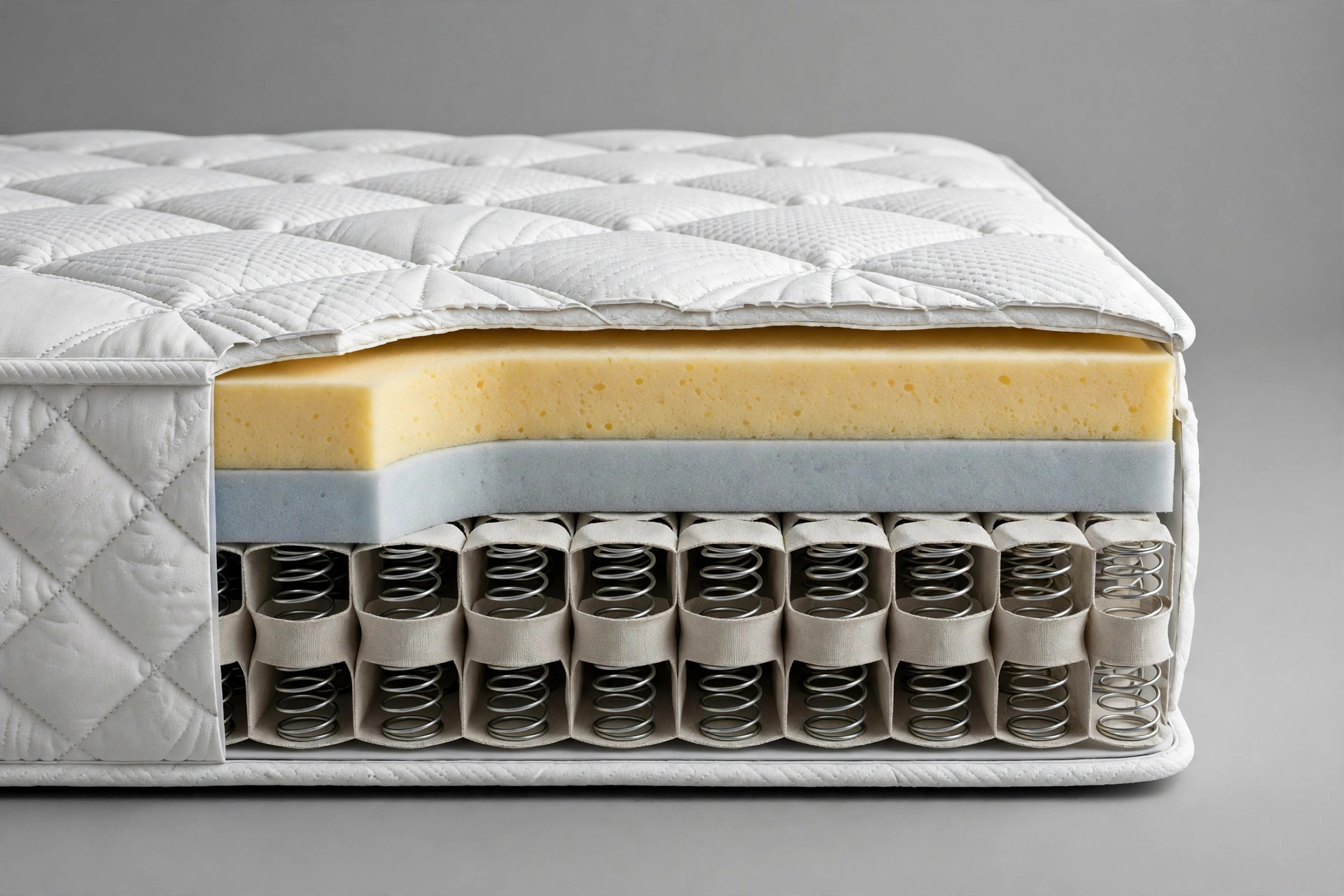
| Layer identity and order | Material name, supplier or grade where specified, and position in the stack | Current BOM and labeled cross-section |
| Dimensions | Overall size and each controlled layer dimension or tolerance | Drawing and measurement record |
| Cover construction | Fabric, quilting, seams, stretch direction and closure details | Approved cover sample and photographs |
| Motion interface | Mattress, moving platform and any supplied restraint or support surface | Paired mattress-and-base setup record |
| Configuration revision | What changed from the previous sample and why | Change log and approval date |
This table is a buyer document template. It does not describe the materials or dimensions of a particular KCAI mattress.
What each layer decision changes
Comfort materials influence feel, thickness and how the surface follows a bend. A support unit or structural layer influences how the stack holds its shape. The cover must accommodate movement without unwanted tension, wrinkling or seam stress. None of these effects can be determined from a material name alone; construction, thickness, attachment and the motion path also matter.
When a supplier proposes an alternative material, compare the complete revised sample with the approved reference. A change to one layer can alter total height, cover fit and bending behavior. Request the revised BOM, sample identification and the specific reason for the change. An “equivalent” label is not an approval criterion by itself.
Inspect the mattress at the moving interface
Test the mattress on the base or integrated motion system the buyer intends to sell. A reference base with different geometry can hide a problem at the hinge or edge. The mattress flex sample guide covers this paired review in more detail.
For a comparable sample record:
- Identify both mattress and base model, revision, size and supplied components.
- Photograph the flat starting position, including seams, edges and fixed deck reference points.
- Run the agreed movement sequence under recorded load and setup conditions.
- Return to the same flat reference posture before taking after photographs and measurements.
- Record visible changes at the cover, seams, layer edges and mattress-to-deck interface.
- Compare the result with acceptance criteria agreed before the review, then record exceptions and the next sample revision.
This is a sample-inspection framework, not a claim about a KCAI test result or expected service life. Buyer and supplier should agree the sequence, duration, repetitions and acceptance limits for the quoted configuration.
Choose by channel without inventing a product tier
Retail display, direct-to-consumer shipping and contract installation create different documentation and service needs. A showroom team may need a sample that clearly demonstrates cover feel and motion. An ecommerce team needs accurate size, weight and packing data for the exact carton. A contract buyer may prioritize cleaning instructions, replacement parts and batch traceability. These needs shape the questions for a quotation; they do not establish that a given KCAI model already meets a market or medical-use requirement.
For each channel, record the target customer, approved mattress and base pairing, required documents, packaging route, service owner and sample acceptance criteria. A lower-cost alternate should receive its own BOM revision and sample approval rather than silently replacing the reference stack.
Compare real model references separately
The KD003-B1 buyer guide and KD004-B1 product page provide two model starting points. They do not prove that the same layers, dimensions, controls or motion interface are supplied for both. Request each model's current construction record and quotation before choosing one for a brand program. The KD004-B1 buyer guide explains that separate model-evaluation task.
To move from a concept to an RFQ, send the intended market, mattress size, base or integrated-system reference, desired feel and cover, delivery format, and the documents your team needs. Request a configuration review with your sample questions and ask KCAI to identify which facts can be supported for the proposed model.