On this page
A mattress may fit an adjustable base when both are flat and still behave differently when the head or foot section moves. For a mattress brand, the important question is not simply whether the mattress bends once. It is whether the proposed mattress, base and support arrangement work together in the positions and use conditions the product program is designed to offer.
Quick answer: Identify the exact mattress and base samples, agree on operating positions and observation conditions, then document contact, visible deformation, mattress movement and return to flat using the same reference points. Treat the results as observations about that tested combination—not a universal rating for a product family.
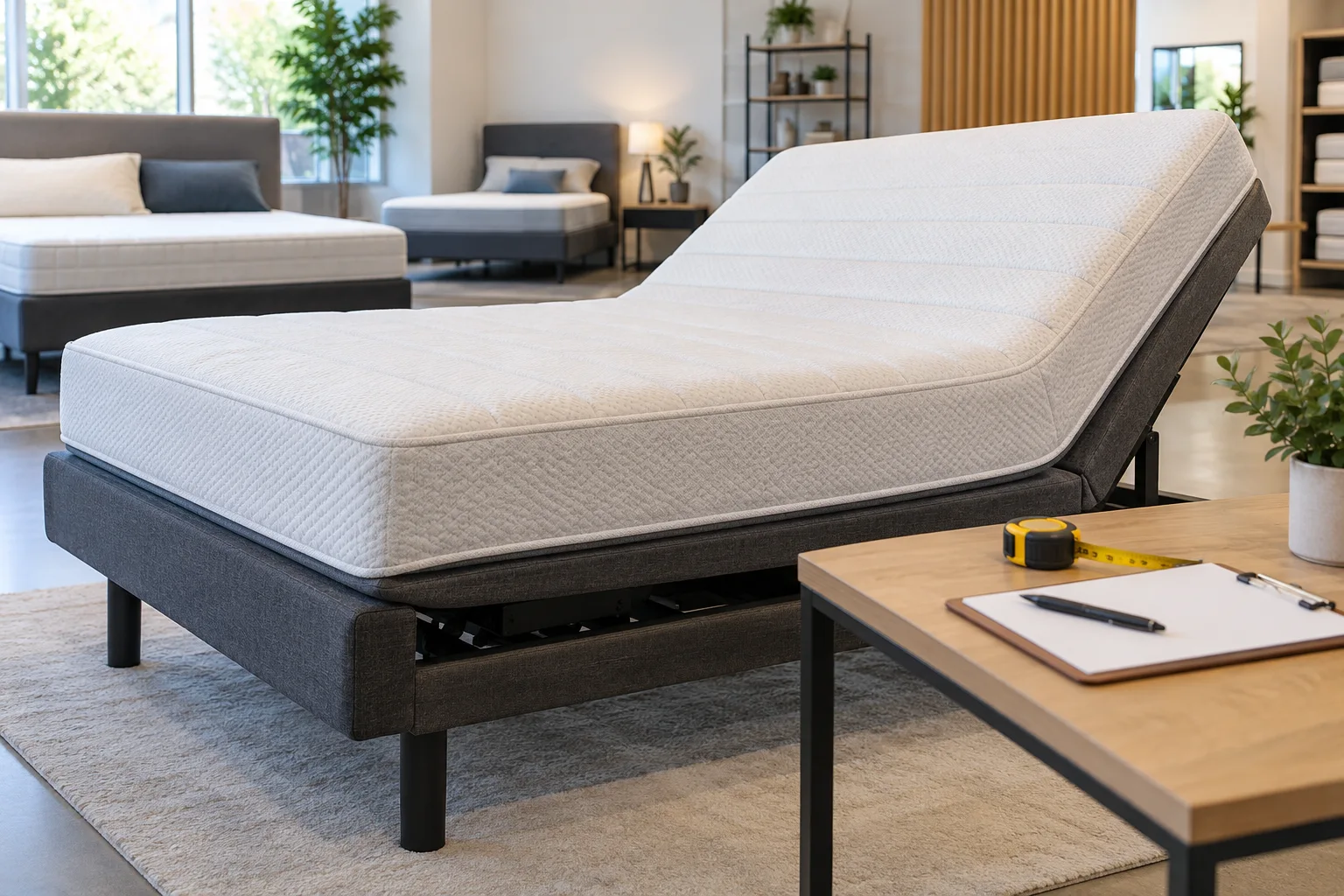
AI-generated editorial concept. It is not a photograph of a KCAI product, a test setup or a demonstrated result.
Start with a defined mattress–base combination
Record the mattress model and revision, finished dimensions, construction supplied for the sample and the base model, size, revision and support arrangement. Include the controller and positions actually available on the sample. If the planned retail product includes a surrounding furniture frame or retention component, identify those items as separate variables.
| Item | What to record | Why it matters to the buyer |
|---|---|---|
| Mattress sample | Size, revision, cover and construction record | A different build can behave differently |
| Base sample | Model, size, support and revision | The deck and moving sections define the interface |
| Retention and furniture | Supplied parts and clearances | A fit or movement observation needs its context |
| Operating conditions | Positions, mattress placement, load and repetitions | A later review must be comparable |
| Evidence | Photos, observer, date and record ID | The team can trace decisions back to the sample |
Do not assume that a thicker mattress, a particular foam type or a pocket-spring construction will automatically pass or fail. The observed result belongs to the configuration actually reviewed.
Agree on positions and measurement references
Before moving the bed, establish a flat starting position and identify stable reference points on the frame and mattress. Use the manufacturer's approved operating instructions. Record the head and foot positions to be reviewed, the intended mattress orientation, any applied load, the measurement unit and the number of repetitions selected by the project team.
Photograph the starting position from fixed viewpoints. Then use those same viewpoints at each selected position and after the unit returns to flat. A measurement without a stated reference point or operating condition is difficult to compare later.
The team should decide in advance what it wants to observe and who has authority to approve the outcome. This guide does not define universal test angles, cycle counts or pass thresholds; those require the appropriate model documentation and project requirements.
Observe contact, movement and recovery separately
Three observations answer different questions:
- Contact: Where does the mattress remain in contact with the support as the base moves? Note any visible gaps or interference and the position at which they occur.
- Movement: Does the mattress shift relative to the agreed reference points? Record direction and measured displacement using the same units and reference points.
- Return to flat: After returning the support to the agreed flat position, record any visible bunching, change in alignment or feature the team wants to review.
A gap or a shift is an observation, not automatically a defect. Compare it with the approved design, manufacturer guidance and project criteria. Do not force the mattress or place a body part inside moving areas; follow the manufacturer's instructions and use authorized personnel for the sample review.
Use a repeatable observation record
| Record field | Entry |
|---|---|
| Project / record number / date | ______ |
| Mattress and base model / revision | ______ |
| Support, retention and furniture configuration | ______ |
| Start position and fixed reference points | ______ |
| Positions, repetitions and load condition | ______ |
| Photo locations and measurement unit | ______ |
| Contact, displacement and return-to-flat observations | ______ |
| Open issue, decision owner and follow-up | ______ |
If another sample is evaluated, use the same record and note any deliberate differences. This makes a supplier conversation more precise than a comment such as “the mattress feels too stiff.”
Separate flexibility from retention
A mattress can articulate and still shift, or remain in place while the team has an unrelated concern about contact. Review those questions separately. The mattress retention guide explains directional movement and sample records; the compatibility checklist addresses the wider specification task.
For a product program considering the KD010-A2 frame or the KD004-B1 motion mattress, request a current drawing and sample brief for the exact quoted configuration. These are different product architectures; this article does not assert that a particular mattress has been tested with either model.