
On this page
Adjustable bed load capacity testing should answer a complete question: which approved bed configuration can support or move which defined load, in which position, for how long, under which acceptance criteria? A capacity number without those conditions is not a reproducible engineering claim.
OEM buyers should separate static support, powered movement, edge loading, asymmetric loading and durability. They should then connect every result to a production-intent sample and drawing revision. This approach is more useful than comparing the largest number printed in competing catalogues.
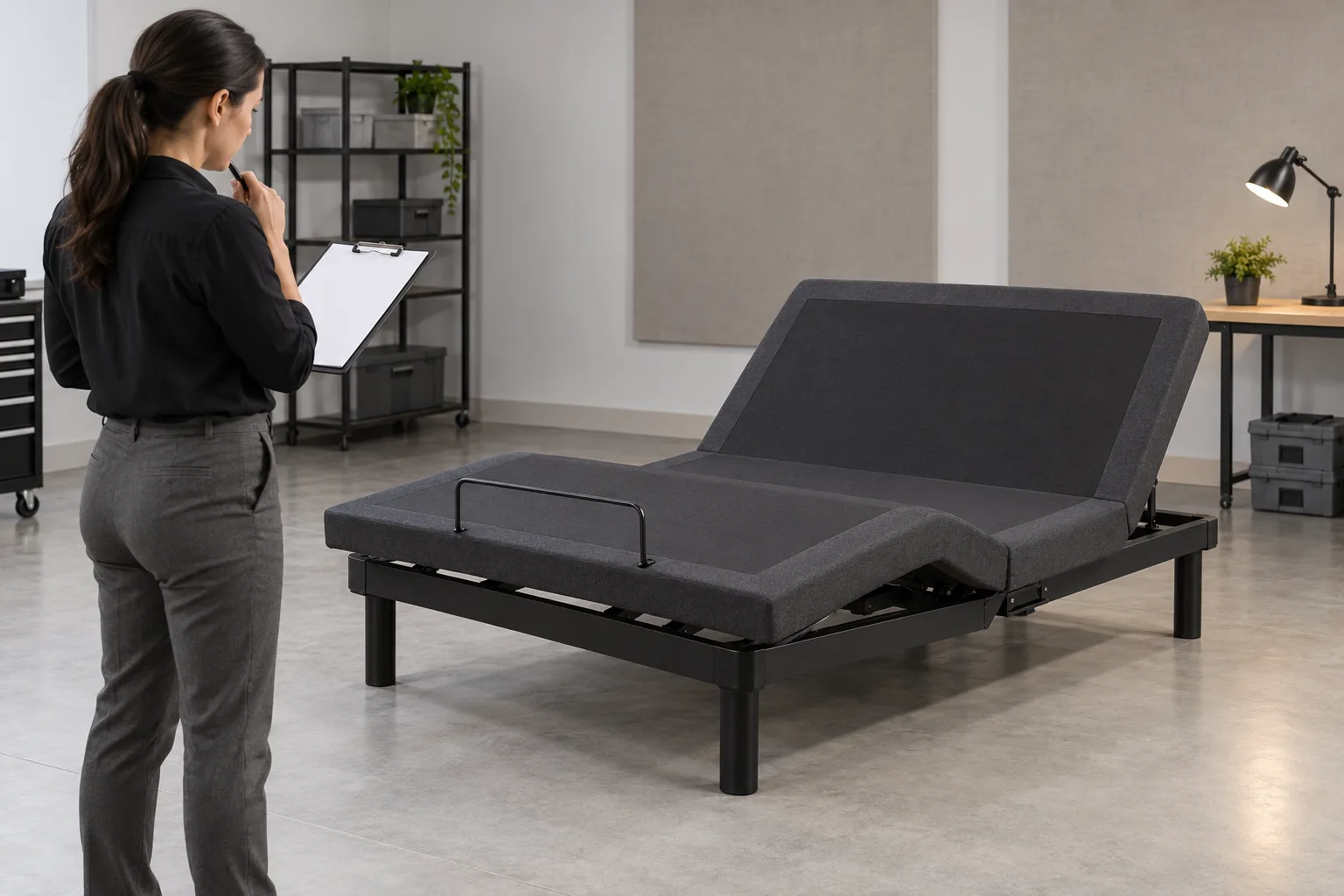
AI-generated generic editorial concept. It is not a KCAI model photograph, test or customer project.
Quick answer: the seven fields behind a credible rating
A usable load statement records:
- Product identity: model, size, revision and installed options.
- Load definition: total load, distribution and application fixtures.
- Bed position: flat, raised, transitioning or a defined worst case.
- Test sequence: preconditioning, application rate, hold time and repetitions.
- Acceptance criteria: allowable movement, damage, function and permanent deformation.
- Test authority: internal laboratory or external laboratory, with method and equipment records.
- Scope of claim: static support, powered movement, intended-user limit or another clearly named condition.
If one field is missing, ask for clarification before placing the value in retail copy, packaging or a purchase specification.
Why catalogue capacity numbers are difficult to compare
Two suppliers may publish the same nominal load while testing different products. One may use a small size in the flat position with a uniformly distributed load. Another may test a larger size through powered articulation. A third may quote an actuator's force rather than the complete bed's supported load.
These results are not interchangeable. The buyer should normalize the evidence in the same way that commercial teams normalize quotation scope.
| Published statement | Missing questions | Procurement risk |
|---|---|---|
| “High weight capacity” | How much, where applied and in which position? | Cannot compare or reproduce |
| One maximum value | Static support or powered motion? Which size? | Retail promise may exceed tested scope |
| Actuator force value | What is the linkage ratio and complete-system limit? | Component figure mistaken for finished-product capacity |
| Test passed | Which method, criteria, revision and laboratory? | Evidence may not cover the ordered design |
| Tested to a standard | Which edition, clauses, use category and deviations? | Standard name used without applicable scope |
Separate the load cases
A complete test plan does not need every imaginable condition. It needs the conditions that represent intended use, foreseeable misuse identified by the responsible parties, and applicable market requirements.
Distributed static load
This evaluates how the complete sleep surface and supporting structure respond when load is spread over a defined area. The report should show the loading platen or blocks, their placement, the support condition and the measurement points.
Concentrated and edge load
Entry, exit and sitting near the perimeter can concentrate load differently from lying in the center. The approved method should define where the load is applied and prevent an improvised fixture from creating an unrealistic point load.
Asymmetric load
Couples, split systems and partial occupancy can produce left-right or head-foot imbalance. Asymmetric testing can reveal twist, uneven leg loading, deck movement or interference that a centered load does not show.
Articulated load and powered transition
When the deck is raised, the linkage geometry and actuator mounts carry load differently. A static raised-position check is not the same as moving under load. The supplier and buyer should state whether powered operation is allowed at the declared user load and define the test sequence accordingly.
Repeated operation and durability
A one-time proof load and a repeated-operation test answer different questions. A proof test looks for immediate structural response under a defined condition. A durability sequence looks for wear, loosening, drift, noise change and loss of function over time. Keep the claims separate.
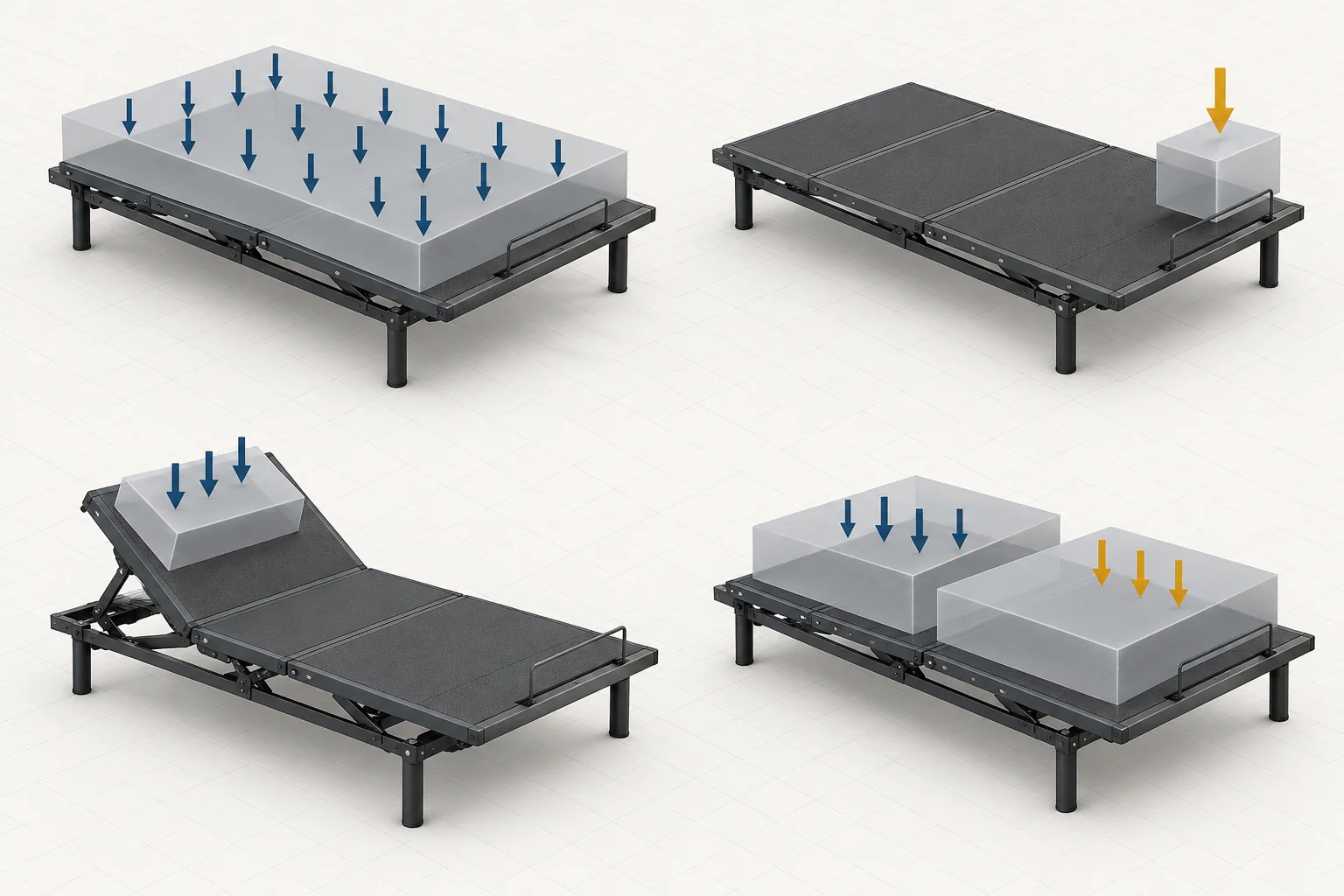
AI-generated editorial diagram. It illustrates load-case categories only and is not a test instruction, certified method or KCAI test result.
Use relevant standards without mixing product categories
BSI's summary of BS EN 1725:2023 states that the standard covers safety, strength and durability for fully assembled adult beds in domestic and non-domestic environments. It also notes exclusions, including medical beds, and identifies additional considerations for products with extra functions. Buyers should confirm the clauses and use category that apply to their exact powered bed.
UL Solutions lists UL 962 among the standards used for household and commercial furniture and describes evaluation areas that include mechanical stability, strength and integrity alongside electrical and fire hazards. A UL-marked component does not by itself establish certification of the finished adjustable bed. Verify the certificate, product identity and covered construction.
Medical beds are a separate product category with different intended uses and requirements. Do not describe a residential adjustable bed as a medical bed or borrow a medical-bed test statement unless the finished product is actually designed, assessed and documented for that scope.
Write measurable acceptance criteria before testing
“No failure” is too vague. Define what the inspector measures during and after each load case. Depending on the design, acceptance criteria may address:
- no fracture or separation of structural parts;
- no unsafe instability;
- no fastener release or joint migration beyond the agreed limit;
- no interference with cables, actuators or moving members;
- permanent deformation within an agreed drawing or functional limit;
- successful return to the flat position;
- control, synchronization and limit functions operating as specified; and
- no new sharp edge, pinch hazard or loss of retainer function.
The actual thresholds must come from applicable requirements and the approved product specification. They should not be invented after a test produces an inconvenient result.
Control the sample and setup
A test report is only useful when the tested sample matches the ordered product. Record size, upholstery or deck build, legs, fasteners, actuator, control system, accessories and software or control revision where relevant. Photograph model and revision labels without exposing confidential information publicly.
Before loading, document:
- assembly procedure and tools;
- floor or fixture condition;
- initial dimensions and level;
- fastener condition;
- electrical supply and control setup;
- mattress, platen or load-fixture details; and
- any deviation from the planned method.
After testing, inspect the same reference points. A video can help explain motion, but it should supplement rather than replace measurements and a signed report.
Distinguish factory screening from independent evidence
Factory testing is valuable for development, incoming checks and production monitoring. An accredited external laboratory may be required by a customer, certification program or market pathway. These roles are complementary.
ISO/IEC 17025:2017 sets requirements for the competence, impartiality and consistent operation of testing and calibration laboratories. Accreditation to ISO/IEC 17025 does not mean a laboratory is competent for every test. Check that the laboratory's accredited scope covers the requested method and product area.
Ask for the report issuer, method, equipment traceability, sample receipt date, test date, authorized result and any subcontracted work. When evidence is confidential, request a controlled review rather than accepting a cropped logo or an unauthenticated screenshot.
Link the test plan to size and configuration
Changing from Twin XL to Queen or King can alter span, torsion and handling. Changing legs, deck panels, upholstery, retainer or an actuator bracket can also change the system. Buyers need a family-coverage rationale showing why a tested configuration represents the variants being sold.
Create a matrix with rows for size and construction, then columns for structural drawing, actuator set, leg option, deck, test reference and approval status. Mark gaps as pending rather than assuming the largest or smallest size automatically covers the rest.
The KD010-A2 adjustable bed frame is a starting point for a model discussion. Its load rating, available sizes and supporting evidence must be confirmed for the exact quotation and destination.
Read a supplier's capacity statement step by step
A number on a product sheet becomes useful only when the buyer can identify the product and conditions behind it. Begin by recording the exact size, structure, support arrangement and revision. Then ask what the figure includes: the user load alone, a complete system including the mattress and bedding, or another defined basis. Do not decide the answer from the unit of measurement.
Next, distinguish the published rating from the test load and acceptance criteria. A report may describe a specific procedure or development check; whether it supports a customer-facing rating depends on its method, result, product scope and the responsible party's decision. A test load, actuator thrust or packaging limit should not be relabeled as finished-bed capacity without documented justification.
Finally, review the bed position and whether motion was part of the documented scope. Flat support, support at a raised position and moving under load answer different questions. If the report does not say which case applies, mark it as an open issue and request the missing context.
An example of two incomplete quotations
The following comparison is hypothetical and does not represent KCAI products or test results. Supplier A quotes a single headline value with no stated bed position. Supplier B provides a value for a specified size and a flat, evenly distributed setup, but its report says nothing about motion. Although B provides more context, neither statement alone establishes the performance of the complete mattress-and-base system during powered movement.
The buyer should ask both suppliers for the sample identification, load definition, relevant operating conditions, method and authorized report. If the two reports cover different cases, record them as different evidence rather than declaring one product stronger. The required evaluation belongs in the agreed technical brief.
Use a load-evidence comparison worksheet
| Evidence field | Proposal A | Proposal B |
|---|---|---|
| Model, size and revision | Pending | Pending |
| Claimed load and included items | Pending | Pending |
| Load placement and support | Pending | Pending |
| Bed position and powered motion scope | Pending | Pending |
| Test method and report reference | Pending | Pending |
| Acceptance criteria and result | Pending | Pending |
| Change or size coverage | Pending | Pending |
| Open issue and decision owner | Pending | Pending |
The worksheet is a purchasing tool, not a test method. Qualified personnel should define the relevant load cases, instrumentation, sequence, limits and safety controls for the exact configuration. Do not place improvised weights on a product or exceed its instructions in an attempt to reproduce a catalog figure.
Keep units, components and claims separate
If suppliers use different mass or force units, have the engineering team convert them consistently and retain the original units in the record. A force figure for an actuator should remain identified as a component value; it is not a direct conversion to the capacity of the finished bed. Linkage geometry, mounting, support and the intended load case all matter to the complete system.
Marketing copy should use the approved wording and conditions supplied by the responsible team. Do not remove qualifiers such as the tested size, distribution or mattress inclusion simply to make a claim shorter. When documentation is pending, leave the public number out rather than substituting a competitor's rating.
When a test report does not match the sample
Start with the report's sample identification. Compare the product size, legs or supports, deck, actuator, control and other relevant parts with the proposed bill of materials. If the report describes a different revision, ask the responsible technical team to explain whether that evidence can be applied to the new configuration.
Record the gap even if the products look alike. A buyer may request additional evidence, a technical assessment or a revised sample, depending on the project. A photograph of a label or a laboratory logo alone is not the report, and the report's existence does not automatically establish that a different product is certified.
Prepare the discussion across purchasing, engineering and retail
Purchasing needs a comparable specification and a clear open-issues list. Engineering needs the actual sample, intended load cases and an agreed acceptance method. Retail needs a claim it can explain to customers without leaving out restrictions. After-sales needs the approved revision and a way to identify the delivered product.
Bring those decisions together before final artwork or product listings are approved. If the stated configuration changes, review whether the evidence and public wording still cover it. This is a coordination process, not a promise of a particular load rating or an indication that a specific test has been performed.
Add load evidence to the golden sample package
Keep the following records together:
- approved product and structural drawings;
- declared load wording for technical and marketing use;
- test plan with applicable references;
- sample build record and photographs;
- raw measurements and authorized report;
- deviations and corrective actions;
- final acceptance decision; and
- change-control triggers that require review or retesting.
The golden sample approval checklist provides the wider document-control framework. Do not approve a capacity statement that cannot be traced to the same construction.
Request a testable OEM proposal
Send KCAI the intended market, use environment, sizes, mattress and surround, target load statement, required standard or retailer protocol, and whether the product must move under the declared load. KCAI can review available model directions and identify which details require project confirmation.
Request a quote and attach your validation matrix. The goal is not the largest catalogue number; it is a claim that procurement, quality, marketing and after-sales teams can all understand and support.