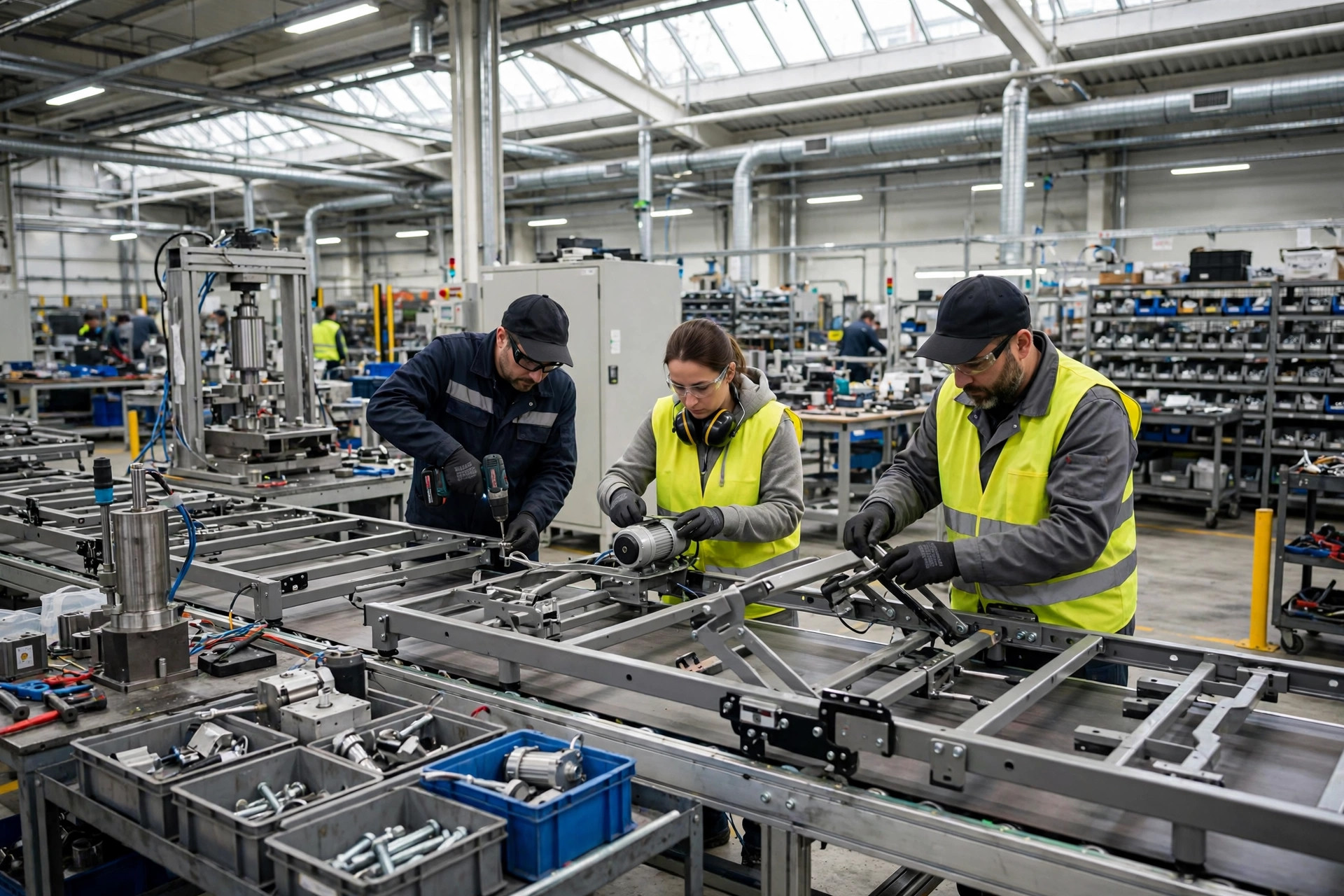
Cover image: an AI-generated illustration of a bed-frame production line.
An adjustable bed OEM project moves through five clear phases: CAD drawing and engineering review, prototyping, golden sample approval, lab testing and validation, and mass production ramp-up. Each phase ends with a decision gate — the buyer confirms what has been built before the factory proceeds. Understanding these furniture OEM sampling phases helps you plan purchasing calendars and avoid the rework that quietly eats launch schedules. Durations vary by design complexity, customization level, and order volume, so the most reliable plan is a project-specific schedule requested directly from the factory. For the broader supplier-evaluation context, see our complete guide to sourcing adjustable beds from a China factory.
The five phases, at a glance — use this as a checklist in factory conversations:
| Phase | Purpose | Buyer deliverable | Decision gate |
|---|---|---|---|
| 1. CAD drawing & engineering review | Translate the design brief into technical drawings | Technical drawings, material and mechanism specifications | Approve drawings and bill of materials |
| 2. Prototyping | Build the first physical units to verify the design | Functional prototype(s) for hands-on evaluation | Approve design, or request revisions |
| 3. Golden sample approval | Lock the final reference sample | Approved golden sample signed by both sides | Sign golden sample approval form |
| 4. Lab testing & validation | Verify durability, safety, and performance | Test reports and compliance documentation | Confirm test scope and pass criteria met |
| 5. Mass production ramp-up | Scale to volume with consistent quality | First-article inspection, production samples | Approve start of full production run |
Phase 1: CAD Drawing and Engineering Review
Everything begins on paper — or, more precisely, in the factory's CAD software. The buyer submits a design brief — target dimensions, adjustment functions, load requirements, materials, finish, and market-specific needs such as voltage standards. The factory's engineering team converts it into technical drawings: frame geometry, mechanism mounting points, actuator placement, upholstery cut patterns, and assembly sequences.
This is the cheapest stage at which to find problems: motor positions that conflict with support rails, fold-flat dimensions that miss container constraints, or fabrics incompatible with the upholstery process can all be corrected at near-zero cost. Review drawings with your own engineering team, confirming dimensions, load ratings, mechanism geometry, and every visible finish detail.
The decision gate for Phase 1 is signed drawing approval plus an agreed bill of materials. Once approved, the design is frozen for prototyping — changes after this point cost real time and money.
Phase 2: Prototyping
Prototyping turns drawings into something you can touch: one or more physical units built with production-intent materials and mechanisms. For adjustable beds, that means a working frame with real actuators — operate the head and foot lift through the full range, feel the mechanism's smoothness, listen for abnormal noise, and test stability under load.
Evaluate prototypes against a written checklist: welds and fasteners, coating quality, upholstery fit, cable routing. For elderly care or hospitality use, also assess grip points, emergency lowering behavior, and pinch-point protection.
Most projects need at least one revision round; plan for it rather than fearing it. Document every change request in writing with photos or marked-up drawings, and agree how each revision affects the downstream schedule. The decision gate is prototype approval: the buyer confirms the design is ready to become the golden sample.
Phase 3: Golden Sample Approval
The golden sample is the most important document in an OEM relationship — except it is a physical object. Once approved, it becomes the reference that locks in materials, dimensions, finishes, and functions for the entire production run. Every shipped unit is measured against it, in factory QC and any third-party inspection.
Inspect the sample as a demanding end customer would: operate every function repeatedly, examine welds and seams, verify dimensions, and compare finishes under proper lighting. Many buyers keep one signed golden sample at their office and leave the counter-sample at the factory, so both sides compare against the same standard.
Sign a formal approval form listing exactly what was approved — model name, revision, materials, finishes, functions — and have both sides retain signed copies. After this signature, any design change is a formal engineering change request, not a casual tweak. The decision gate is the signed golden sample approval.
Phase 4: Lab Testing and Validation
With the design locked, the factory validates performance. OEM adjustable beds are typically evaluated under lab protocols associated with testing bodies such as CNAS, SGS, TUV, and UL — covering mechanism cycle durability, load capacity, structural stability, upholstery flammability where applicable, and electrical safety for motorized components.
Agree on the test scope before testing starts: which protocols apply to your model, what the pass criteria are, and what documentation you will receive. Test reports give your sales team credible performance data and your QA team acceptance criteria for incoming inspection.
If a test fails, treat it as useful information. A mechanism failing a cycle test now would have failed in customers' homes later. The fix goes back through engineering review and, if it changes the product, may require golden sample re-approval. The decision gate is confirmed test results against the agreed scope.
Phase 5: Mass Production Ramp-Up
Volume production begins only now. A well-run factory starts with a pilot or first-article run: a small batch built on the production line with production tooling and line workers rather than the sample-room team. This exposes issues samples never show — slow fixtures, operator-varying upholstery steps, packaging that fails in real handling.
Request first-article samples and, for larger orders, consider pre-shipment inspection against the golden sample. Confirm packaging, labeling, barcodes, and shipping marks before full volume ships — port-side packaging errors are expensive to fix. Agree on in-line QC checkpoints and the acceptable quality level for the run.
Ramp-up is where the project-specific schedule matters most. Line capacity, material lead times, and seasonal factory loading all shape when goods ship, and these factors differ for every project — always request a written production schedule with milestones, not a verbal assurance. The decision gate is approval to start the full production run.
Planning Advice: Keeping Your OEM Timeline on Track
Most OEM delays are caused by buyer-side process gaps, not factory capacity. These practices keep the adjustable bed OEM timeline under control:
- Brief completely, once. A complete design brief — dimensions, functions, materials, target market, compliance needs — prevents the back-and-forth that stalls Phase 1, the most common early delay.
- Assign one decision-maker. Samples circulating among five reviewers take five times longer to approve. Designate a single approver with authority to sign each decision gate.
- Approve promptly, but thoroughly. A rushed golden sample approval creates expensive rework later. Set internal review deadlines and keep them.
- Freeze the design at the golden sample. Late changes restart validation. If a change is truly needed, make it a formal engineering change request with an agreed schedule impact.
- Lock packaging and labeling early. Artwork approvals and barcode registration take real time; start them in parallel with Phase 4.
- Request the schedule in writing. For every phase, ask the factory for a project-specific schedule with dates and decision gates, and track it in a shared document. Verbal timelines are not timelines.
How a Real Factory Structures the Process
A capable OEM partner organizes these phases as a managed workflow. KCAI Intelligent Sleep (Dongguan Kangcai Intelligent Sleep Technology Co., Ltd.) has operated as a furniture manufacturer since 2004, with a 25,000-square-meter factory, more than 100 staff, and over 100 global customers served. Its OEM/ODM programs cover smart adjustable beds, slat frames, leisure chairs, mattresses, and upholstered beds for home, elderly care, institutional, hospitality, and project applications — supported by roughly 30 years of furniture R&D experience and multiple invention and utility model patents.
In practice, that means an engineering team handling CAD and prototyping in-house, a sample process built around formal golden sample sign-off, and products evaluated under lab protocols associated with CNAS, SGS, TUV, and UL. When comparing partners, map your questions onto the five phases: Who owns the CAD review? How are revisions documented? Which lab protocols apply to my model? A factory that answers precisely is a factory that can hold a schedule. Explore our OEM/ODM services and the electric adjustable bed base line these processes support.
Frequently Asked Questions
What are the main phases of an adjustable bed OEM project? A typical project moves through five phases: CAD drawing and engineering review, prototyping, golden sample approval, lab testing and validation, and mass production ramp-up. Each phase ends with a decision gate. Ask your factory for a project-specific schedule, since timing depends on design complexity and order volume.
What is a golden sample in furniture OEM? The golden sample is the approved reference sample that locks in materials, dimensions, finishes, and functions before mass production. Every production unit is measured against it, so inspect and sign off on it carefully — any later change restarts part of the validation process.
How long does adjustable bed OEM sampling take? There is no universal answer: sampling time depends on design complexity, customization level, material sourcing, and revision rounds. Request a project-specific schedule from the factory with defined decision gates for each phase.
What lab testing applies to OEM adjustable beds? OEM adjustable beds are commonly evaluated under lab protocols associated with testing bodies such as CNAS, SGS, TUV, and UL, covering structural durability, mechanism cycling, load capacity, and electrical safety where applicable. Confirm with your factory exactly which tests will be run for your model.
How can buyers avoid delays in OEM production planning? Provide complete specifications up front, assign one decision-maker for approvals, approve the golden sample thoroughly but promptly, and lock in packaging and labeling details early. Most delays come from late design changes, not factory capacity.
Start your OEM project on a solid timeline
A clear phase structure turns OEM procurement from guesswork into project management: CAD review, prototyping, golden sample approval, lab testing, and a disciplined production ramp-up — each with a decision gate you control.
Path 1 — OEM/ODM custom development: Bring your design brief, target specifications, and compliance needs to our engineering team. We will walk through the five phases with you and provide a project-specific schedule from CAD drawing through mass production. Start the conversation through our OEM/ODM services page.
Path 2 — Wholesale purchase of existing models: Prefer proven designs? Source from our existing adjustable bed lineup — including the electric adjustable bed base series — with factory-direct wholesale terms. Share your target volumes and delivery window, and we will confirm availability and a project-specific production schedule.