On this page
An adjustable bed assembly torque specification is a model- and joint-specific control that tells an assembler which fastener to tighten, under what condition, with which tool and verification method. It should never be reduced to one generic torque number for the whole bed. Fastener diameter, grade, joint material, coating, lubrication, thread-locking method and load path all affect the correct engineering decision.
For OEM buyers, the practical objective is repeatability. A disassemblable bed should be capable of being assembled in the intended sequence without missing hardware, inaccessible joints or uncontrolled “tight enough” decisions. Ask the manufacturer to demonstrate the controlled process on the approved sample and to identify which steps occur in production and which remain for the end user or installer.
Build a fastener control plan before approval
A useful control plan maps every critical joint to the information needed for assembly and inspection.
| Field | Why it matters |
|---|---|
| Joint ID and location | Prevents instructions from relying on ambiguous phrases such as “front bolt” |
| Fastener identity | Connects the physical part to the drawing and bill of materials |
| Joint condition | Records washer, locking feature, coating or other relevant condition |
| Tightening sequence | Controls joints where order affects alignment or clamping |
| Engineering requirement | States the approved method or value for that exact joint |
| Tool and access | Confirms the fastener can be reached in production and in the field |
| Verification method | Defines how completion is recorded and how exceptions are handled |
Do not publish an unverified torque value in a customer manual. The responsible engineering team should establish and validate requirements for the exact joint. If a supplier proposes a value, request the basis and confirm that the production fastener and surface condition match the reviewed sample.
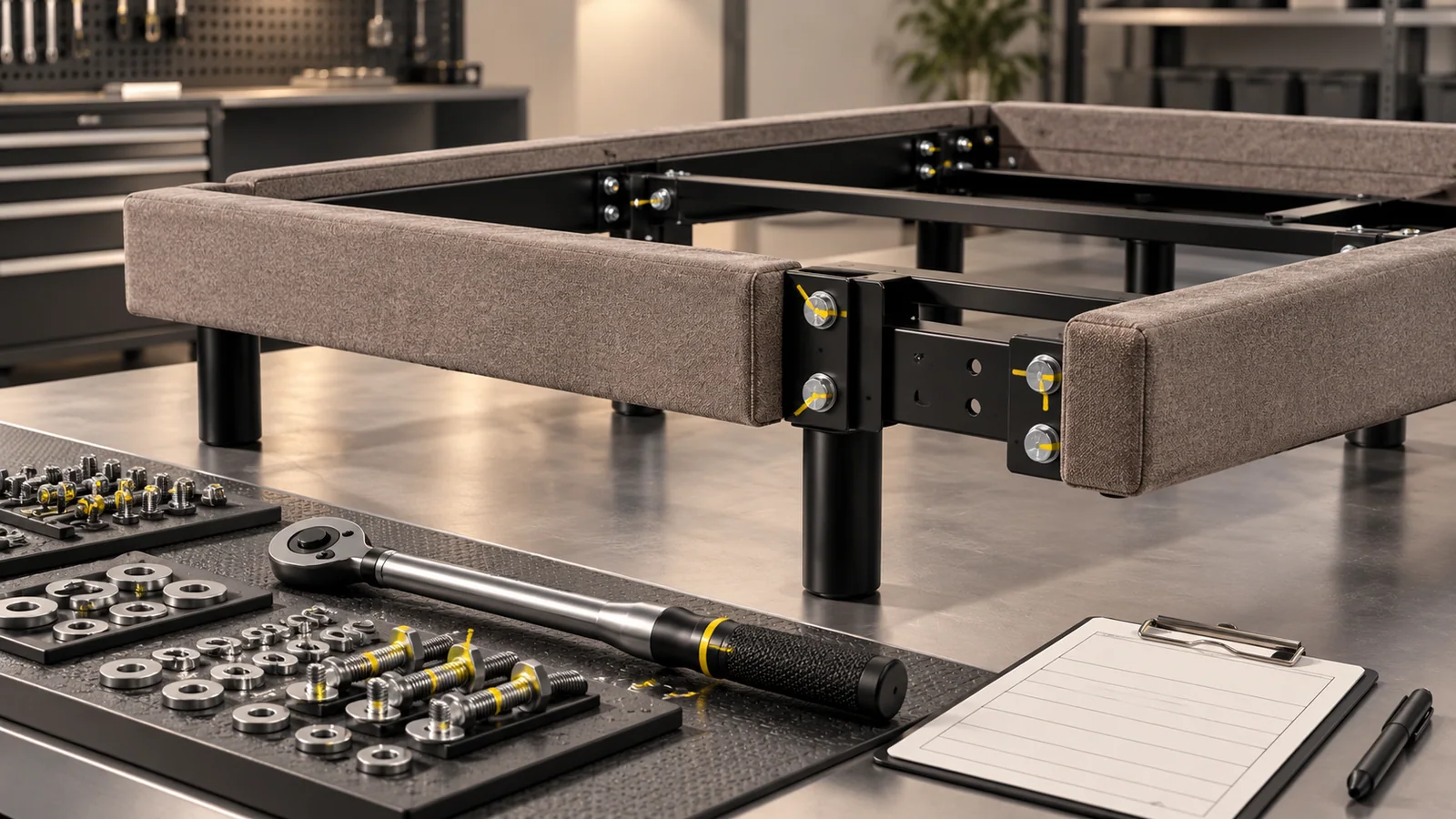
AI-generated editorial illustration. It is not a photograph of KCAI production, calibrated equipment or a verified torque specification.
Separate factory joints from field-assembly joints
Not every fastener has the same user or risk context. Divide the list into three groups:
- Factory-completed joints: assembled and inspected before packing; not intended for routine customer adjustment.
- Installer joints: completed during delivery or professional installation.
- End-user joints: explicitly shown in the consumer assembly instructions with supplied hardware and tools where applicable.
The KD010-A2 disassemblable electric bed frame is a relevant discussion starting point because packing and field assembly are part of its product concept. The exact fastener map and values, however, must be confirmed for the current model revision before ordering.
For each field-assembly joint, perform a usability review. Can the assembler see the hole alignment? Can the tool rotate without damaging upholstery? Can similar fasteners be confused? Is there a positive way to identify left and right components? A structurally sound joint can still produce poor field quality if the assembly method is unclear.
Why “tighten firmly” is not enough
Subjective instructions create variation. One person may stop early; another may damage threads or deform a bracket. A controlled specification should use an engineering-approved tightening method, and the manual should translate that method into instructions suitable for the intended assembler.
Several controls may be used together:
- keyed or captive hardware that reduces part confusion;
- fixtures that hold alignment during tightening;
- controlled production tools with calibration status;
- visual witness marks applied only after the defined step;
- inspection sampling appropriate to the joint and process; and
- a reaction plan for missing, damaged or out-of-condition hardware.
A paint witness mark is a process indicator, not proof of torque by itself. It should not be used to conceal a missing engineering requirement.
Run a sample assembly study
Before approving the golden sample, have a person who did not design the product assemble it from the intended packaging and instructions. Record:
- total hardware types and whether each is uniquely identifiable;
- tools required and whether they are supplied or specified;
- access problems, cross-threading risks and alignment difficulty;
- steps where upholstery, wiring or moving components could be damaged;
- the sequence used to reach the controlled joint condition; and
- the result of a complete motion, noise and stability check after assembly.
Do not convert the assembly time from one trial into a guaranteed customer result. The study is intended to reveal ambiguity and process risk, not to create a marketing claim.
Verify production evidence without overclaiming
Buyers can request evidence appropriate to the program, such as the released work instruction, tool list, calibration-control process, training record format and inspection record template. The exact documents shared may depend on supplier policy and project stage.
During a pre-shipment review, sample completed units and check that critical fasteners are present, correctly seated and traceable to the approved assembly method. Connect findings to the pre-shipment QC checklist instead of relying on photos of a torque wrench.
Manage changes after the sample is approved
A change to fastener source, coating, bracket thickness, washer, locking compound or tool method may affect the joint. Add these items to the engineering-change review. The adjustable bed design-freeze and change-control guide explains how to keep later substitutions from bypassing approval.
Use a simple change question: Does this change alter the joint's geometry, friction, clamping, load path, assembly access or inspection method? If yes—or if the answer is uncertain—send it to responsible engineering for review before production release.
Buyer approval checklist
- Every assembly fastener has a unique identity and location.
- Factory and field responsibilities are separated.
- Engineering requirements are controlled by model revision.
- The specified tool can access the joint without damage.
- Instructions and hardware packs match the approved sample.
- Witness marks are used only as defined process indicators.
- A complete motion and stability review follows assembly.
- Fastener or joint changes trigger documented review.
Buyer takeaway
Fastener quality is not the number of bolts in a frame. It is the consistency with which the correct hardware creates the intended joint. Buyers should approve the specification, assembly sequence and evidence together.
For an OEM sample review, send KCAI your target configuration and field-assembly requirements. We can identify which fastener, tool and instruction details need to be resolved before quotation or sample approval.