On this page
Senior living adjustable bed cleaning requirements should be written around the facility's actual cleaning process and the materials in the selected bed configuration. A finish that looks smooth does not prove that it tolerates a particular cleaner, and a generic “wipe clean” note does not establish suitability for every care environment. Buyers need an approved material reference, clear care instructions and a review by the people responsible for facility cleaning.
This checklist is intended for non-clinical residential and senior living furniture programs. If the bed will be used as patient-care equipment or in a clinical area, involve the facility's environmental services and infection-prevention professionals. They should set the cleaning method and frequency for the area, surface, resident population and applicable rules.
Quick answer: qualify the material against the facility's process
Before purchasing, identify the exact surface materials, upholstery and controls. Ask for care instructions tied to those references, then compare the listed products and methods with the facility's approved cleaning process. Review seams, recesses and accessible high-touch areas, test a representative sample using the facility-approved method where appropriate, and record any finish change that would require a new review.
The CDC advises healthcare facilities to ensure that finishes, furniture and patient-care equipment can be cleaned effectively and are compatible with the facility's disinfectants. It also recommends that procurement, cleaning program managers and infection-prevention or hygiene teams collaborate on selection decisions (CDC environmental cleaning programs). This framework is most directly relevant to healthcare settings; residential senior living operators should follow their own applicable policies and authorities.
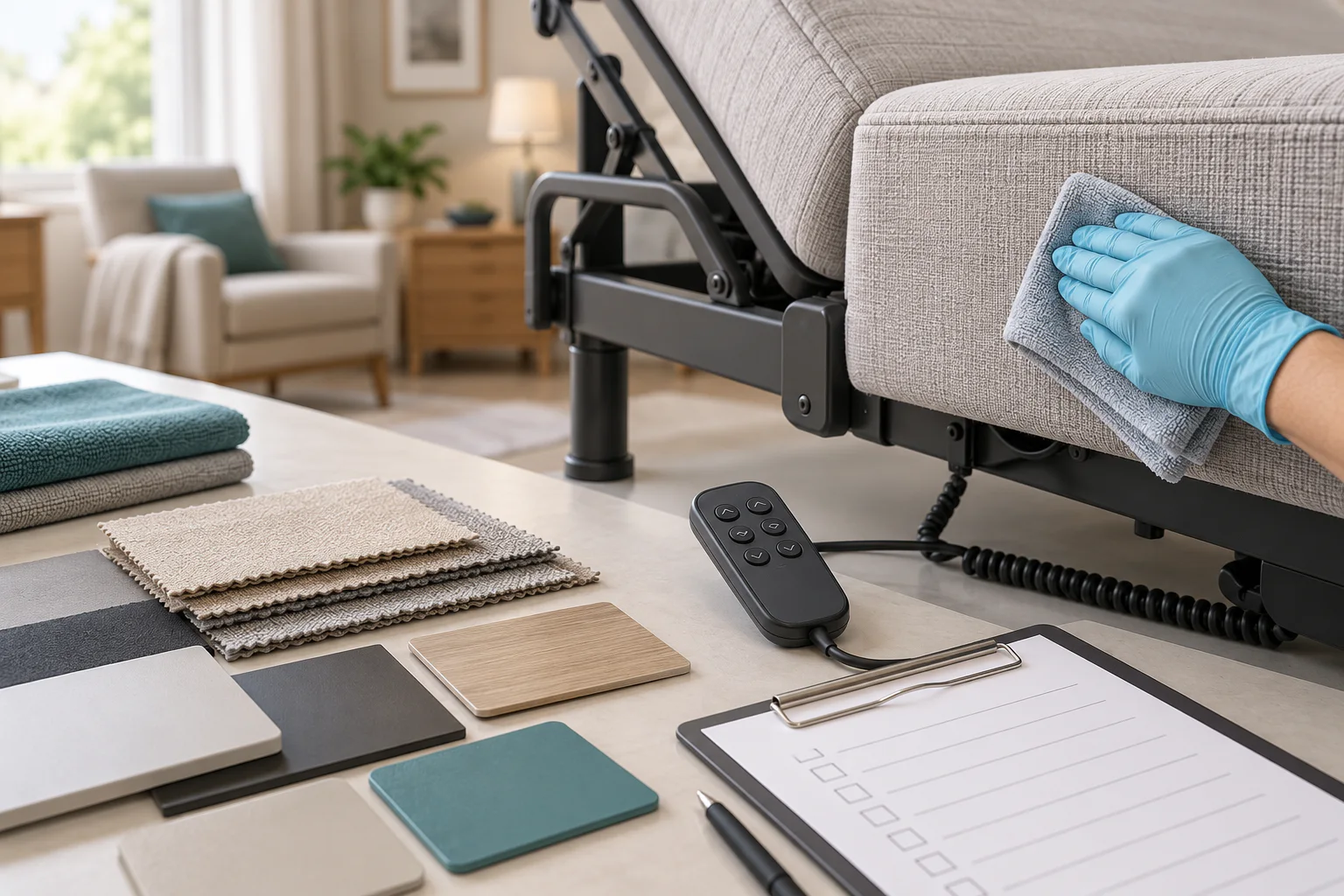
AI-generated editorial illustration. It does not represent a validated material, disinfectant test, infection-control outcome or specific product.
Inventory every surface in the selected configuration
Build the review from a bill of materials or controlled product list. Include the frame finish, upholstery, plastic housings, handset, cable jacket, mattress cover or interface, labels, connectors and each approved accessory. A replacement handset or new upholstery option may use a different material, so do not treat a family name as a compatibility record.
Map those items to how the facility uses each room. A private residential suite, shared assisted living room, therapy room and clinical patient area may follow different care policies. For each type, identify who cleans the bed, which surfaces they address, which products are permitted, and what records the facility retains. If a room may change use later, capture that scenario as an open decision.
| Review area | Questions for the supplier or facility | Evidence to retain |
|---|---|---|
| Frame and finish | Which cleaner or method is permitted? Are there finish restrictions? | Material reference and written care instructions |
| Upholstery and seams | How should seams, piping and repairs be handled? | Fabric or cover specification and care record |
| Controls and handset | Which cleaning method applies to buttons, screens and cable? | Component-specific instructions |
| Recesses and interfaces | Can the team access the identified areas without disassembly? | Visual review and cleaning procedure |
| Accessories | Does each rail, table, holder or adapter have separate guidance? | Approved accessory list and instructions |
| Change control | Which material or supplier change triggers reapproval? | Controlled revision and notification process |
Review cleanability without making health claims
Look for visible conditions that may complicate the facility's own procedure: narrow gaps, recessed controls, damaged coating, open seams, exposed fasteners or surfaces that cannot be reached without moving the bed. Note what staff can see and access during routine cleaning. This is an operational review, not a microbiological test and not evidence that the furniture prevents infection.
CDC guidance for healthcare settings discusses the importance of cleanable finishes and material compatibility. It does not mean every residential bed must use one material, nor does it support a blanket claim that a hard surface prevents infection. A facility should determine what its protocol requires for the room and item. Ask the materials supplier for evidence that applies to the exact finish and chemical exposure rather than drawing conclusions from generic descriptions such as “antibacterial,” “hospital grade” or “easy clean.”
For clinical environments, the FDA also describes a hospital bed system as including the frame and components such as the mattress, rails and accessories. Changes to those components can change the review scope. That guidance addresses hospital bed systems, so it should not be used to imply that residential furniture has medical-device status (FDA hospital bed information).
Check material and disinfectant compatibility
Ask the facility to provide the cleaner or disinfectant types it uses, including any relevant concentration, application, contact time or rinse instructions from the product label. The supplier's material documentation should state which conditions were assessed and any limits. If the required product is not covered, do not assume compatibility. Ask the relevant material manufacturer for a written assessment or conduct an agreed evaluation on representative samples.
Define acceptance criteria before testing. Criteria can include visible changes that matter to the buyer, such as discoloration, tackiness, cracking, peeling, loss of legibility or deterioration after the agreed exposure. Any laboratory test, number of cycles or acceptance threshold must come from the actual project protocol; this guide does not prescribe a universal method. Keep evaluation conditions, sample identifiers and results with the material revision.
The upholstery specification guide helps buyers control textile and finish references. The compliance and quality control guide explains how to connect documents to the exact product configuration.
Resolve conflicting instructions before choosing the product
If the facility's required disinfectant or contact time is not covered by the material instructions, record the gap against the exact surface and revision. Ask the material or product manufacturer for a written compatibility assessment, then have the facility's cleaning lead decide whether an approved alternative process is available. Do not shorten a disinfectant's required contact time or substitute a cleaning product solely to avoid damage without the facility's approval.
| Open issue | Record for the decision | Release action |
|---|---|---|
| Required cleaner is not listed for the upholstery | Material ID, cleaner, concentration and application conditions | Hold material approval until compatibility is resolved |
| Handset and frame have different care limits | Part-specific instructions and the areas staff must clean | Agree a separate procedure for each component |
| A sample shows cracking, fading or damaged labels | Sample ID, exposure method, observations and decision owner | Review the result and any proposed material or instruction change |
These are procurement decision examples, not evidence that a specific KCAI configuration has passed a cleaning test. For healthcare settings, CDC guidance on environmental cleaning supplies addresses use according to the cleaning product manufacturer's instructions, including the required contact time.
Make instructions usable for facility staff
Care instructions should name the product and material revision, permitted cleaning method, prohibited chemicals or tools, relevant power precautions, and how to report damage. Avoid shorthand that requires staff to guess whether a process applies to upholstery, controls or metal components. If the bed has a wired handset or moving cable, the instructions should explain how to prevent liquid entry and cable strain according to the product documentation.
The facility should determine the cleaning schedule and staff responsibility under its own policy. Suppliers can provide product-care limits; they should not prescribe infection-control protocols without the appropriate role and evidence. For a multi-room order, provide a stable document location and revision method so housekeeping teams do not rely on an outdated copy.
Pilot the care process before rollout
- Select a representative bed, mattress, material set and approved accessories.
- Review supplier care instructions with the facility cleaning lead.
- Apply the facility-approved process to the sample under agreed conditions.
- Record visual observations and any effect on controls, labels, seams or finish.
- Resolve unclear instructions and confirm any limits with the relevant material supplier.
- Approve the product, material and instruction revisions together.
- Define how future material, cleaner or accessory changes will be reviewed.
If the bed is intended for a clinical patient-care area, include infection-prevention, facilities and clinical equipment staff in the review. Their protocol and the exact product's approved instructions govern. Do not transfer evidence from a similar model without confirming that the materials and components match.
What to include in an RFQ
State the room type, destination market, material references, facility-approved cleaning products, cleaning ownership, required care documents, accessory configuration and review criteria. Ask suppliers to identify the evidence available for the exact quoted revision and list any exclusions. Keep claims about antimicrobial properties, infection prevention or clinical suitability out of the specification unless those claims are supported for the intended product and market.
For a material or configuration discussion, share the room use, cleaning process and document requirements through the Request a quote form. KCAI's current proposal and product-specific care information should define the project; this general article does not establish a cleaner compatibility result.