On this page
An adjustable bed cable routing guide should define the approved path, retention points, movement allowance, strain relief and service access for every wire harness on a specific model revision. The route must remain controlled from flat through all intended positions without contact with sharp edges, moving joints or foreseeable pinch and abrasion zones.
For an OEM buyer, a neat flat-position photograph is not enough. The harness must be observed while the bed moves, after it returns to flat, and after relevant assembly or packaging changes. The practical output is a controlled route with inspection views—not a promise that one routing pattern fits every adjustable bed.
Map the harness before testing motion
Start by identifying every connection in the electrical system. A simple harness map should show the power supply, control box, actuators, remote receiver or control interface, optional accessories and any junctions. It should also record connector identity and the frame location used for retention.
| Review point | Buyer question | Evidence to request |
|---|---|---|
| Harness identity | Does this cable belong to the approved model and revision? | BOM reference or controlled harness list |
| Connector seating | Can similar plugs be confused or partly inserted? | Connector map and sample inspection |
| Strain relief | Is load transferred away from the terminals? | Close-up views and movement observation |
| Retention | Can clips, sleeves or ties shift during articulation or shipping? | Route photos at several positions |
| Edge protection | Can the harness rub against a cut, drilled or moving surface? | Edge-condition and clearance review |
| Service access | Can a replaceable component be disconnected without damaging the harness? | Service sequence on the approved sample |
The map should be reviewed with the actual product, not only a CAD view. Upholstery, mattress decks, brackets and packaging restraints can change the available space.
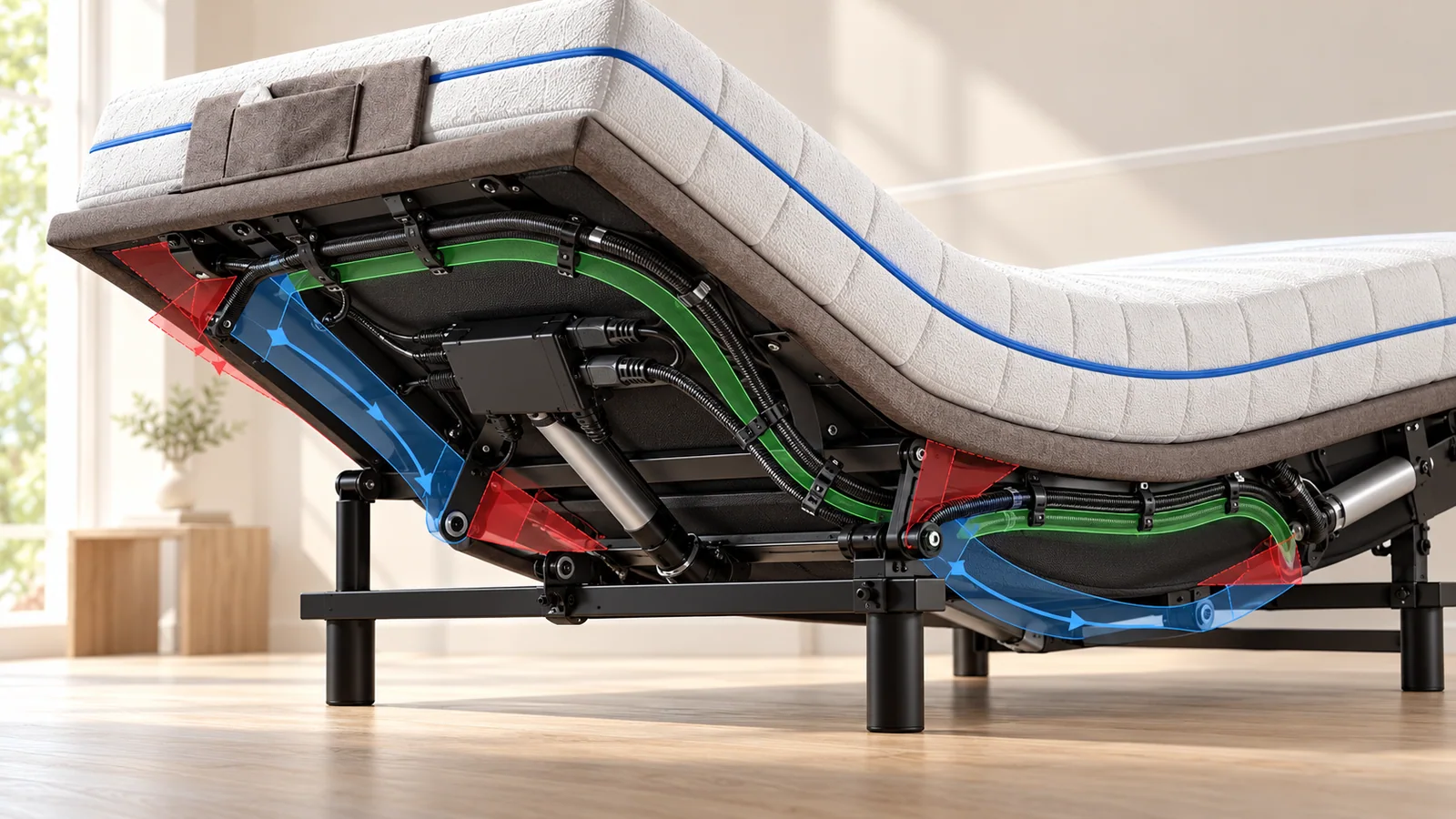
AI-generated editorial illustration for explaining a review method. It is not a KCAI wiring diagram or evidence of a tested product configuration.
Review the entire motion envelope
Have qualified personnel follow the product's approved safety procedure, observe from clear vantage points and keep hands and tools away from moving joints. Move the sample through the intended range and stop at intermediate positions, because clearance at the endpoints does not prove that the cable is clear in between.
Use a repeatable observation sequence:
- Start with the bed disconnected and inspect for initial contact, twists or trapped sections.
- Confirm connectors, strain relief and retention points against the harness map.
- After the qualified team clears the area, restore power under the approved procedure and move one function at a time.
- Watch every transition where linkages pass, sections fold or a service loop changes shape.
- Repeat with combined motions that the approved controller permits.
- Return to flat and inspect for new scuffing, tension, clip movement or connector displacement.
The KD001-A3 upholstered adjustable bed frame is one model buyers can discuss for an upholstered program, but its exact cable routing and available options must be confirmed for the current quotation and sample.
Five cable-routing risks to document
1. Tension at maximum articulation
A harness can look loose in the flat position but pull against a connector when the head or leg section rises. The approved route needs sufficient movement allowance without leaving uncontrolled loops.
2. Pinch and shear zones
Keep wires out of closing gaps and crossing linkages. Mark the reviewed keep-out areas on the route drawing so later clip or bracket changes cannot quietly move the cable into them.
3. Abrasion and sharp edges
Look beyond obvious cut metal. Repeated contact with a bracket corner, fastener thread, moving sleeve or rough surface may damage insulation over time. Engineering should determine appropriate routing, protection and validation.
4. Connector loading
The connector should not act as the harness's strain relief. Check whether movement, gravity, packaging restraint or service handling can pull on terminals or allow partial disconnection.
5. Service confusion
When connectors are similar, service teams may cross-connect parts or replace the wrong revision. Use controlled identification and a service instruction that reflects the actual model.
Include packaging and installation in the review
Shipping restraints, folded frames and compressed upholstery can move a harness away from its approved position. After the packaging concept is stable, unpack a representative sample and inspect the route before energizing it. Confirm that cable ties intended only for shipping are clearly distinguished from permanent retention.
Field assembly creates another risk. A leg, bracket or fastener may be installed through a cable path if the instructions do not show the keep-out area. Connect this review to the adjustable bed assembly torque specification guide so wiring and fastener steps do not conflict.
Control changes that affect the route
Recheck cable routing after changes to:
- actuator or control-box supplier, body size or connector orientation;
- harness length, connector, sleeving or branch point;
- frame holes, brackets, moving links or mattress-deck panels;
- clip type, location or adhesive method;
- upholstery, foam or dust-cover construction; and
- folding, carton restraints or assembly sequence.
Even when the electrical schematic remains unchanged, a mechanical revision may change the motion envelope. Route review therefore belongs in the same change-control process as the frame and electronics. See the design-freeze and change-control guide for a practical framework.
Buyer sample-review checklist
- Harness map matches the sample and bill of materials.
- Connectors are fully seated, identifiable and retained.
- Strain relief protects terminals throughout motion.
- Service loops have enough movement but remain controlled.
- No cable contacts reviewed pinch, shear, heat or abrasion zones.
- The route is checked at flat, intermediate and maximum intended positions.
- Packaging and field assembly do not disturb the route.
- Photos and inspection points are tied to a model revision.
Buyer takeaway
Cable management is an engineering control, not a cosmetic cleanup step. A strong OEM review links the electrical map, mechanical motion, packaging and service process to one approved route.
To discuss an adjustable bed sample, send KCAI the target model, control functions and destination program. We can identify the routing, connector and change-control questions that should be resolved before approval.