A disassemblable adjustable bed base is a powered platform designed so defined structural and accessory components can be packed separately and assembled at the destination. For ecommerce, that architecture must be specified as a complete delivery system: components, protective pack, carton identity, customer instructions, functional checks and replacement-part logic all need to match the same revision.
The goal is not simply to fit metal parts into a smaller box. The goal is to deliver the correct parts in usable condition, guide an unassisted or supported assembly, verify powered movement after setup and give the service team enough information to resolve a problem without guessing.
Key takeaways
- Design the component hierarchy, packaging and assembly sequence together.
- Give every packed part one controlled identity across drawing, manifest and instructions.
- Approve the product after destination-style assembly, not only before disassembly.
- Separate visible damage, missing parts, assembly errors and functional faults in reporting.
- Compare landed cost only after current carton and handling data are confirmed.
The ecommerce specification has six linked layers
| Layer | Buyer must control | Failure if left open |
|---|---|---|
| Product revision | Exact platform, movement and interface configuration | Carton or instructions describe another version |
| Component set | Every section, leg, bracket, fastener, cable and control | Missing or unrecognized parts stop assembly |
| Protective pack | Restraint, separation and protection for each component | Abrasion, impact or component-to-component damage |
| Carton identity | Carton count, contents and set relationship | Warehouse or customer receives an incomplete set |
| Assembly handoff | Ordered steps, tools, cautions and functional check | Incorrect setup becomes a product complaint |
| Service record | Part references, revision and diagnostic route | Wrong replacement is selected or sent |
The layers are connected. A component change may require updates to the pack, manifest, instructions, inspection method and service list.
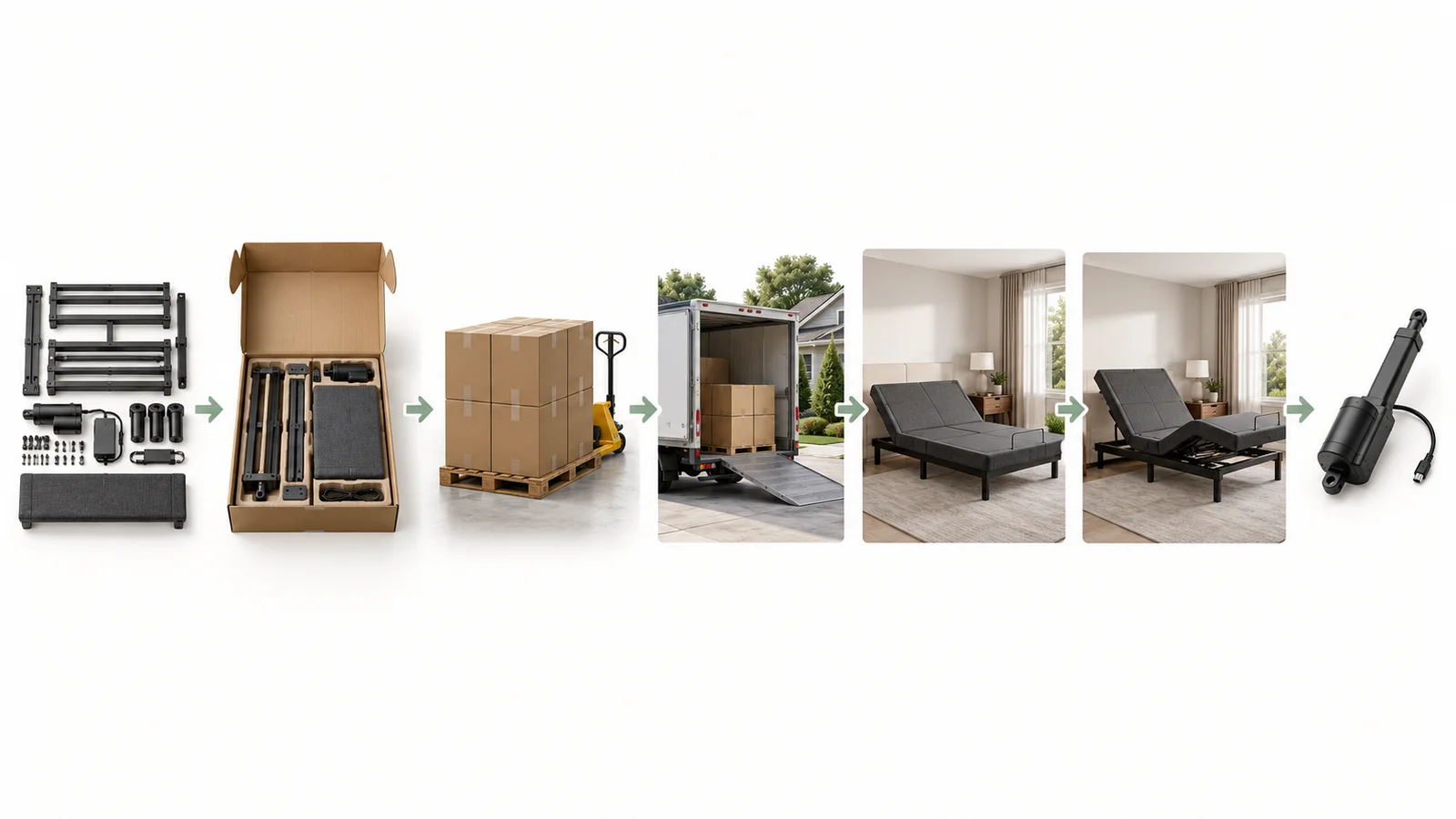
AI-generated editorial workflow. It is not a KD010-A2 packing plan, assembly manual, logistics record or performance result.
Start with a controlled product boundary
Before discussing carton dimensions, define the sellable set. A useful boundary identifies the moving platform sections, structural connectors, legs, mattress retainer, brackets, fasteners, handset, control box, power components, cables, accessories and documents.
KCAI presents KD010-A2 as a disassemblable electric bed-frame direction with an open metal structure. The current catalogue establishes the direction; the project quotation must confirm packing dimensions, assembly method, sizes, movement, controls and included parts.

Current KD010-A2 catalogue product view. Confirm the quoted revision, components, packing and final-assembly method before ordering.
Do not borrow a parts list from another size or similar-looking frame. A shared marketing name does not prove that connectors, cables or fasteners are interchangeable.
Build one component hierarchy
Every team should use the same component names and references: engineering, production, packing, inspection, customer support and replacement-parts staff. The hierarchy can be simple, but it must be consistent.
- Name each assembly. Divide the product into platform sections, support structure, motion system, control system and accessories.
- Name each packed part. Give legs, brackets, cables, fastener packs and documents a clear identity.
- Map parts to cartons. Show where each item is packed and which cartons form one complete sellable set.
- Map parts to assembly steps. Use the same names or visual references in the customer instructions.
- Map serviceable items to the revision. Prevent a replacement from being selected by appearance alone.
A manifest should let a warehouse operator or customer answer “Do I have the complete set?” before assembly begins.
Design protection around the real handling route
Ecommerce products may be transferred, stacked, turned or carried several times before reaching the room. Packaging should control movement inside the carton and separate heavy, sharp or finished components from one another.
Review:
- how platform sections and structural members are restrained;
- protection at corners, edges and protruding interfaces;
- separation between coated metal, fabric surfaces and loose hardware;
- cable and connector protection;
- the location and closure of the fastener kit;
- carton orientation and handling information; and
- whether a damaged carton can be tied to a specific component set.
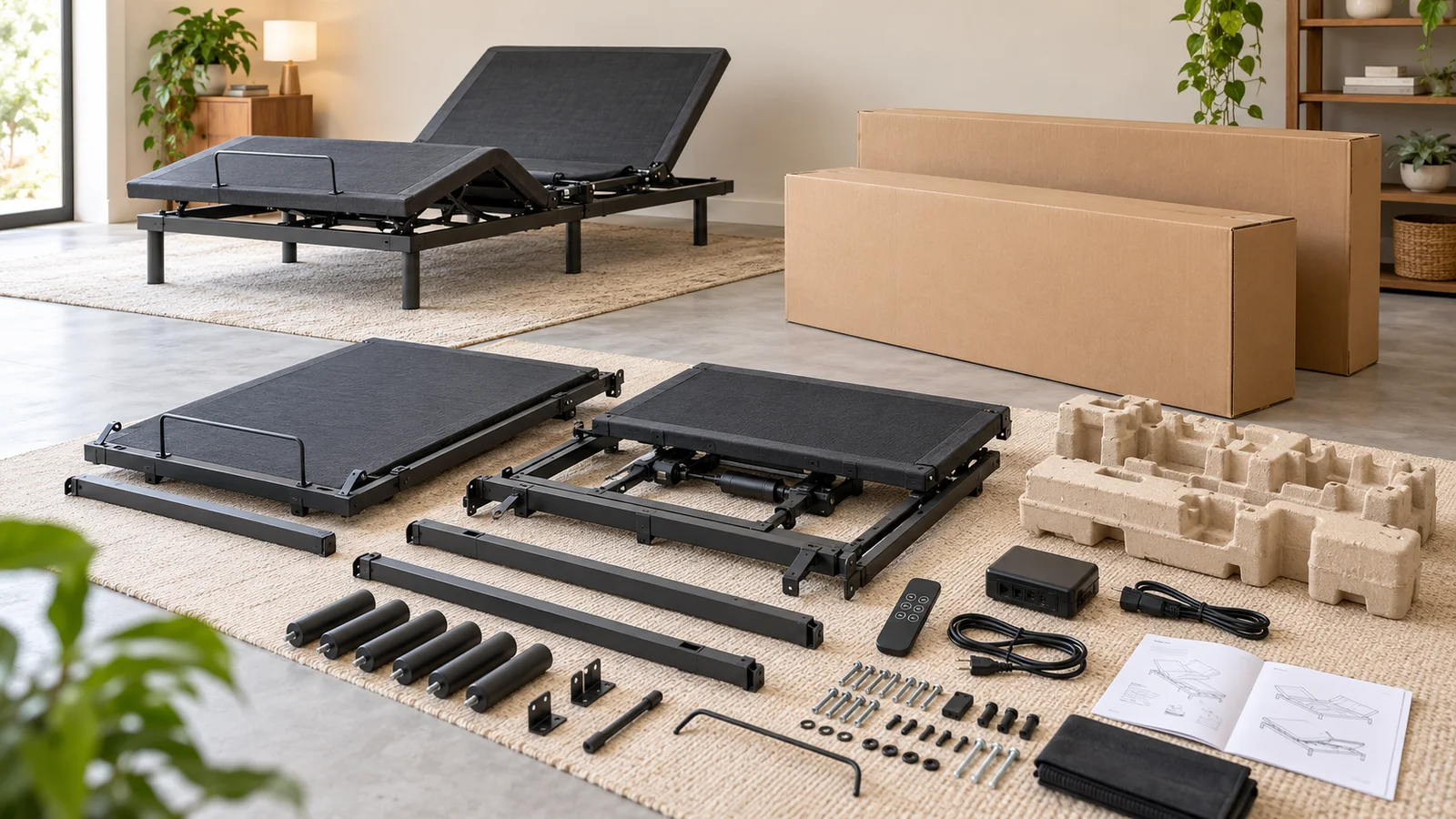
AI-generated generic packaging concept. It does not show the actual KD010-A2 parts, carton count, internal protection, dimensions or instructions.
Request the current sealed-carton dimensions, gross weight and internal packing layout when they are available for the quoted revision. Use the CBM and container calculation guide to compare the complete route without inventing savings.
Approve the destination assembly, not a factory shortcut
The most useful assembly review starts with the production-intent packed set. The reviewer should use only the tools, documents and assistance intended for the customer or installer.
Record:
- Inventory check. Can the complete set be identified before work starts?
- Step order. Are orientation and connection decisions clear at the moment they occur?
- Fastener control. Can similar parts be distinguished without trial and error?
- Cable route. Do cables remain clear of moving or pinching interfaces?
- Final placement. Can the assembled product be positioned without relying on an unstated factory method?
- Function check. Does the approved setup procedure verify controls and required movement before use?
- Recovery path. Do instructions say what to do if a part is missing, damaged or unclear?
Do not publish a setup-time claim from an experienced factory technician and present it as a customer result. If assembly time matters commercially, define the user profile and test method first.
Separate the four common complaint paths
One generic “product problem” field slows diagnosis. Ecommerce support should distinguish:
- visible transit damage: identify the carton, damaged area and affected part before assembly;
- missing or incorrect part: compare the received set with the revision-controlled manifest;
- assembly issue: record the step, orientation, fastener or connection that blocked progress; and
- functional issue: record the completed setup, control behavior, connectors checked and observed movement.
This separation helps the support team ask for useful photos or records and avoids sending a powered component when the actual problem is a missing bracket or unclear instruction.
The after-sales parts guide explains how revision control and connector identification support more reliable replacement decisions.
Calculate logistics only from confirmed data
Disassembly may reduce a shipping envelope, but it does not automatically reduce total cost. Compare the current package on all relevant inputs:
- sealed external dimensions and carton count;
- gross weight per handling unit;
- loading and pallet assumptions;
- parcel or last-mile limits for the target route;
- warehouse handling and set-control needs;
- destination assembly labor or support; and
- damage, missing-part and service exposure.
The flat-pack adjustable bed base guide provides the carton-volume calculation method. Keep all unpublished inputs marked “to be confirmed” until the supplier and logistics partner provide current data.
Send a complete ecommerce RFQ
A useful request should state the destination market, sales channel, customer-delivery model, desired product direction, mattress plan, required movement, control preference, installation environment, packing constraints, user-document languages, evidence needs and service expectations.
Ask the supplier to return:
- an identified product or development revision;
- included-parts and carton manifests;
- current packing information;
- assembly and function-check plan;
- sample stages and acceptance records;
- document and evidence availability; and
- a visible list of unresolved exceptions.
KCAI can review KD010-A2 or another electric adjustable-bed-base direction within an OEM/ODM discussion. Submit the route-to-customer and packaging brief through the request-a-quote form. The final quotation, controlled drawing, approved sample, packing sheet and instructions—not this generic guide—must define the ordered product.