On this page
An adjustable bed power supply specification should identify the complete electrical configuration for one model, revision and destination program: input requirements, adapter output, cord and plug, control box, actuators, connectors, labels, included documents and the status of applicable evidence. Buyers should not assume that changing only the plug creates a market-ready product.
Electrical requirements and acceptable evidence vary by destination and sales channel. Use qualified compliance specialists to determine the applicable rules. The sourcing task is to prevent an approved component from being mixed with an unreviewed cord, connector, label or complete-product configuration.
Create one configuration sheet per destination program
The sheet should be controlled like a product drawing. Every line must refer to the exact part proposed for the production unit.
| Configuration field | Buyer review question |
|---|---|
| Product model and revision | Which finished adjustable bed does this sheet cover? |
| Destination and channel | Where and how will the product be sold? |
| Power supply identity | Is the proposed adapter the same model covered by the supplied evidence? |
| Input and output | Do ratings match the destination supply and downstream components? |
| Cord and plug | Is the complete cord set identified, not just the plug shape? |
| Control box and actuators | Are voltage, connectors, functions and current configuration compatible? |
| Labels and manual | Do physical markings and instructions match the approved components? |
| Evidence status | What is verified, what is pending and what applies only to a component? |
Never convert a catalog statement into a compliance conclusion. Record document issuer, exact model, scope and status, then have the appropriate reviewer determine whether more complete-product work is needed.
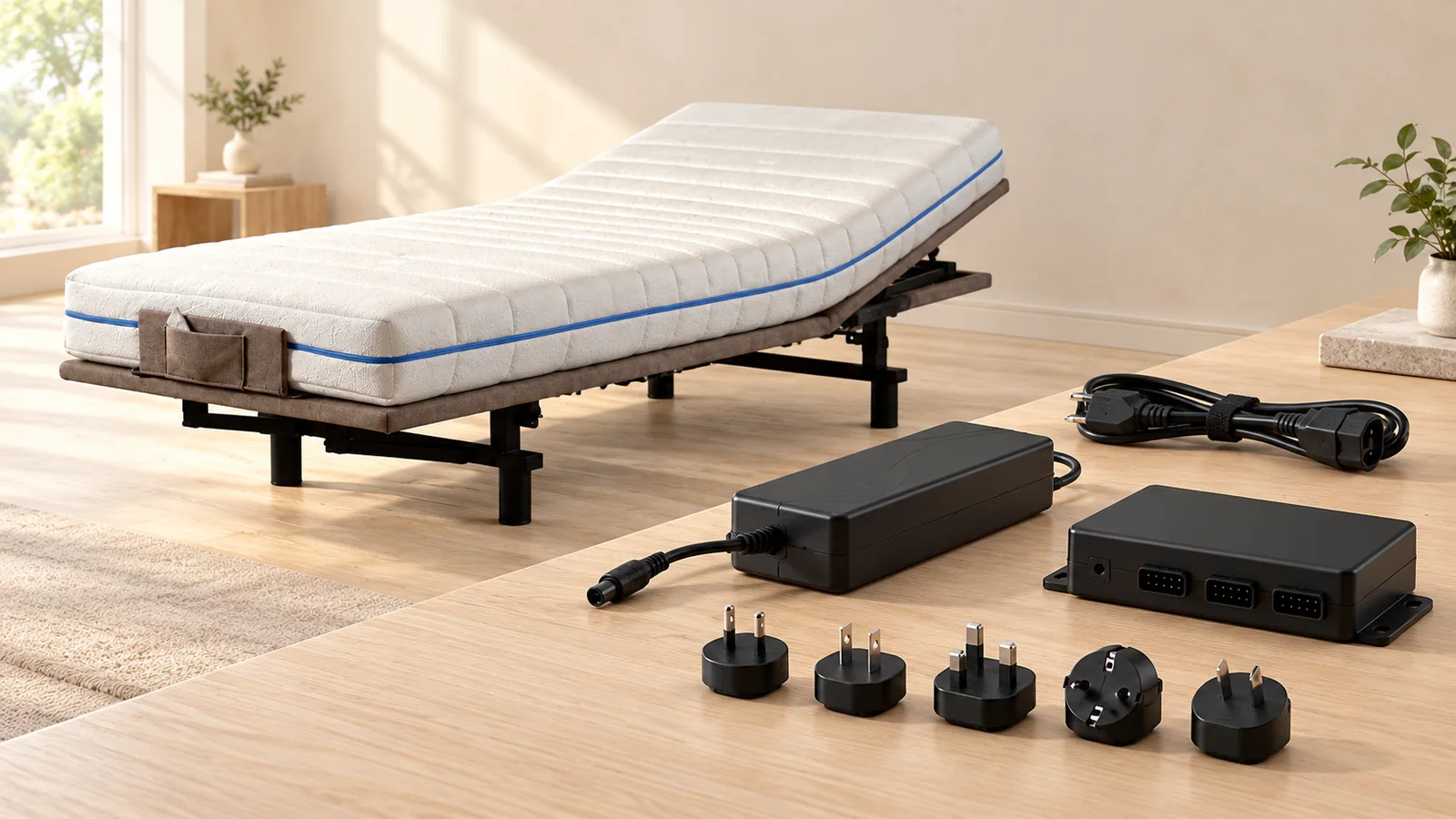
AI-generated editorial illustration. It is not a KCAI electrical specification, market approval or certification record.
Plug shape is only one part of localization
A plug may physically fit a socket while the total configuration is still unsuitable. Review the cord construction, connection to the adapter, input range, polarity or grounding arrangement where relevant, cable length, strain relief, labels and documentation as one system.
The buyer should also define who supplies any detachable cord. If a distributor substitutes a local cord after import, document that responsibility and confirm the replacement remains compatible with the approved configuration and applicable requirements.
For an upholstered base such as the KD001-A3 adjustable bed frame, electrical options should be confirmed in the current quotation. A product page is a discussion starting point, not a substitute for a destination-specific configuration sheet.
Match the power chain, not isolated components
The power chain typically includes an external supply or power entry, a control box, one or more actuators, a control interface and optional accessories. A change near the beginning of that chain can affect behavior elsewhere.
Review at least:
- power-supply input and output against the selected control system;
- connector keying, pin arrangement and retention;
- actuator and accessory compatibility with the control box;
- expected combined operation permitted by the controller;
- routing, strain relief and service access; and
- labeling and instructions that describe the delivered configuration.
Do not infer complete-product performance from an adapter nameplate. Run the engineering and validation plan appropriate to the final system. The adjustable bed control systems comparison helps buyers define user-facing control choices before electrical details are frozen.
Distinguish component evidence from product evidence
An OEM file may contain documents for an adapter, motor, cord or control box. Buyers should ask four questions for every document:
- What exact model or family does it cover?
- Who issued it, and how can its status be checked?
- Which destination or requirement is it intended to support?
- Does it cover a component or the finished adjustable bed configuration?
Keep unanswered items in an evidence matrix rather than describing the product as “certified.” The electrical safety and certification guide explains this evidence-first approach in more detail.
Validate the localized sample
After the configuration sheet is approved, the sample review should compare the physical parts with that sheet. Photograph labels and connectors, confirm part identities, operate all intended functions and inspect the harness through the full motion envelope. Include abnormal or fault-condition work only as defined by the responsible test plan and qualified personnel.
Review the user experience as well. The cord should reach the intended power location without becoming a trip, pinch or abrasion hazard in the planned installation. Instructions should identify the delivered power components and should not show a different plug, adapter or control box.
Put substitutions behind change control
Common late substitutions include a different adapter factory, cord set, connector, enclosure or label. Even when a replacement appears electrically equivalent, it may not have the same evidence, mechanical fit, temperature behavior, cable routing or service compatibility.
Require written approval before substitution. Update the configuration sheet, evidence matrix, manual images, labels, bill of materials and sample record as applicable. If the destination market changes, start a new localization review instead of copying the previous file.
RFQ questions for adjustable bed suppliers
- Which power-supply, cord and plug options are proposed for the named destination?
- What exact control box, actuators and connectors are included?
- Which documents apply to which component model?
- What complete-product review or testing is proposed or still open?
- Are labels, manuals and packaging included in the localization scope?
- Which electrical substitutions require buyer approval?
- How are production part identities and revisions recorded?
Buyer takeaway
Power localization is a configuration-management task. The safest commercial practice is to approve one documented electrical system for one model and destination, then prevent uncontrolled substitutions.
For a private-label program, send KCAI the destination, desired control functions and document requirements. We can identify the electrical configuration details that need to be confirmed before quotation and sample validation.