On this page
During an adjustable bed power outage, the bed does not have one universal response. Depending on the selected actuator and control configuration, it may stop in its current position, support a limited emergency return, use a separately specified backup source or require an approved service procedure. An OEM buyer should define the required outcome before sample approval, then verify it from each permitted position and document what happens when mains power returns.
The critical sourcing question is not simply, “Does the bed have a battery?” It is: what function must remain available, under which conditions, and with what maintenance and instructions? During an actual outage, users should follow the instructions for their exact model; they should not force the mechanism, reach into moving joints or improvise a power source.
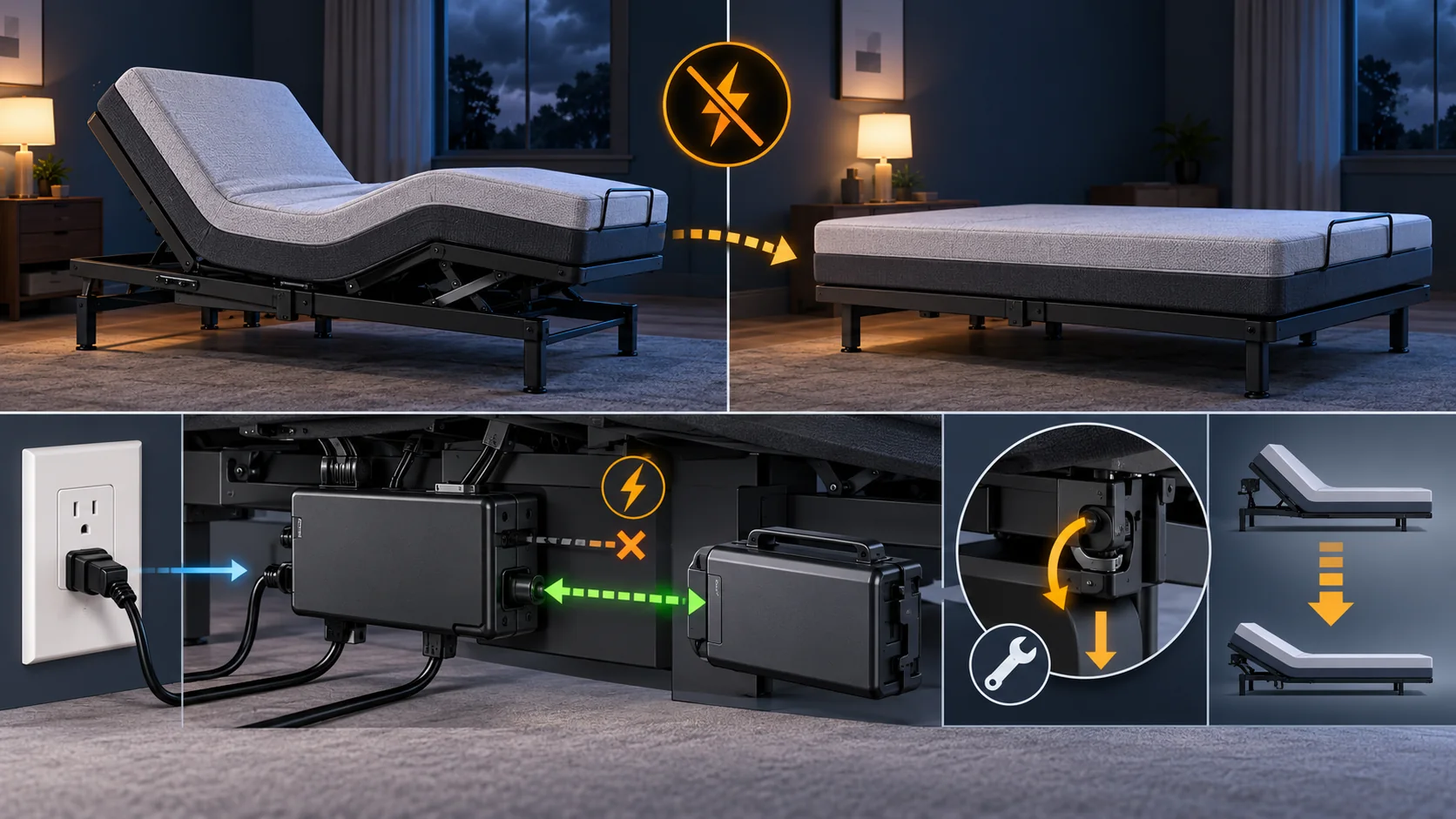
AI-generated concept illustration. It compares generic specification paths and is not a KCAI product schematic, proof of a supplied backup system or a representation of an exact model.
Quick comparison: four power-loss responses
The terms “battery backup,” “emergency lowering” and “power backup” are often used loosely. Separate them during the request-for-quotation stage so that the supplier can answer against one defined requirement.
| Specification path | Intended outcome | Questions the buyer must close |
|---|---|---|
| No backup function | The bed stops when mains power is lost and resumes only after acceptable power is restored | What position can remain safely occupied? What recovery and troubleshooting instructions are supplied? |
| Temporary emergency return | A specified energy source supports a limited movement toward an agreed position | Which movements are allowed, how many attempts are expected, what battery is approved and how is it checked? |
| Rechargeable backup or external UPS | A separate system supports an agreed operating period or number of movements | What load, runtime, charging, replacement, storage and market-specific requirements apply? |
| Manual or service release | An authorized person follows a mechanical or service procedure | Is the procedure user-accessible or service-only? What tools, precautions and reset steps are required? |
Do not infer these options from the appearance of a frame, remote or control box. The choice affects electrical architecture, packaging, instructions, service parts and commercial scope.
1. Define the required outcome before discussing components
A buyer may want the bed to return flat, move only the back section, preserve its position or continue limited operation. Those are different requirements. “Include battery backup” does not identify which outcome to validate.
Write the requirement as an observable result. For example:
- the test starts with the platform in named elevated positions;
- mains power is disconnected using the agreed method;
- the authorized user follows the documented emergency procedure;
- the bed reaches the agreed endpoint or stops within an accepted range;
- the system remains stable during the movement;
- after power returns, normal operation and any required reset are checked.
The positions, endpoint, number of attempts and acceptance criteria belong in the project specification. They should not be invented after a sample has already been approved.
2. Distinguish emergency energy from normal operating power
A small non-rechargeable battery arrangement may be intended for occasional emergency movement rather than everyday use. A rechargeable pack or external uninterruptible power supply may have a different purpose, charging method, storage behavior and service life. The approved device also needs to match the control architecture and destination market.
Ask the supplier to identify:
- the exact purpose of the backup source;
- the approved battery, pack or external device reference;
- whether it is included, optional or buyer-supplied;
- installation orientation and connection method;
- storage, replacement and disposal instructions;
- test conditions and limits;
- how the customer can identify an exhausted or incorrectly installed source.
Do not substitute a locally available battery or UPS without a compatibility review. A connector that fits does not prove that the voltage, polarity, current delivery, charging behavior or control logic is suitable.
3. Check control recovery when mains power returns
Power restoration is part of the test. The control box, handset, app or synchronized pair may need to reconnect, reinitialize or recover stored positions. The outcome can also change if the outage occurred while the bed was moving rather than stationary.
The buyer should ask whether the selected system:
- resumes normal movement immediately after acceptable power returns;
- requires a reset, pairing or initialization sequence;
- retains or clears programmed memory positions;
- reports a fault or needs a service check after an interrupted movement;
- behaves differently in single-base and synchronized configurations.
These questions belong beside the remote-control specification, not in an isolated battery note. If a control component changes, the power-loss and recovery procedure should be reviewed again.
4. Review cable routing and service access
Emergency provisions are useful only when the intended person can reach and identify them without creating a new hazard. The approved base, surrounding furniture and mattress can change access to the control box, backup connector or release point.
For a finished-bed program, inspect access with the actual frame opening, retainers, upholstery and floor clearance. Confirm that normal movement does not pinch the backup lead or block access to the relevant component. If a manual procedure is service-only, the instructions should say so clearly and identify the trained role rather than presenting it as a consumer operation.
The bed-frame fit guide provides a broader interface checklist. Power-loss access should be one explicit item within that review.
5. Build a repeatable verification plan
A useful validation does more than unplug a flat display sample once. Agree a small matrix that reflects the selected configuration and intended use.
Precondition the sample
Identify the model, size, revision, actuator and control configuration. Install only the approved energy source where one is specified. Record the mattress or representative load condition used for the review and any setup steps required by the supplier.
Test from the defined positions
Start from each agreed position, disconnect mains power and follow the written procedure. Record the movement, endpoint, unexpected sound or fault, and whether another emergency movement remains available. Do not extrapolate results from one position to every position.
Restore power and verify recovery
Reconnect power using the documented sequence. Confirm normal controls, paired operation and applicable memory or reset behavior. If the procedure leaves the system in a service state, confirm how it returns to normal use.
Repeat after relevant changes
Review the test whenever an actuator, control box, power supply, handset, wiring harness, battery device or related instruction changes. Use a controlled engineering record rather than assuming that a component replacement has no effect.
Evidence to request before approving the specification
An OEM approval pack can remain concise while still being traceable.
| Evidence item | Procurement purpose |
|---|---|
| Configuration list | Identifies the model, revision and compatible power components reviewed |
| Written outage procedure | Tells users or service teams exactly what to do |
| Verification record | Shows the starting condition, method, result and recovery check |
| Approved-device reference | Prevents unreviewed battery or UPS substitutions |
| User and service instructions | Aligns the product, packaging and after-sales response |
| Spare-part reference | Supports compatible replacement of controls, leads or backup items |
| Change history | Shows when the approved behavior or component set changed |
Electrical evidence and destination-market requirements should be reviewed by qualified parties for the selected configuration. The electrical safety and certification guide explains why a generic component logo or supplier statement does not automatically establish product-level compliance.
How to brief KCAI on a specific product direction
KCAI's public catalogue provides several architectures that can start a requirements discussion, but the pages do not establish one universal power-loss feature. For a disassemblable direction such as KD010-A2, ask how the selected control and emergency components are identified, packed, connected and checked after destination assembly.
For an upholstered direction such as KD011-A3, add questions about access through the surrounding structure, protection of cables and the approved service procedure. For any slatted platform direction, verify the exact control architecture and approved options for the quoted revision rather than assuming a backup feature.
For any of these directions, send the required outage outcome, destination market, electrical input, control expectations, furniture integration and evidence list. Ask KCAI to confirm what is available, optional or unavailable for that specific quotation. Do not assume that a feature shown on one model or component can be transferred to another.
Add the power-loss answer to the retailer handover
A buyer needs a model-specific answer to three customer questions: What happens if power disappears while the bed is raised? Can the bed be lowered without mains power? What should the customer do when power returns? Record the actual instructions and any approved emergency provision for the exact configuration. A normal flat-position button does not establish that it works without power.
| Handover item | Buyer entry |
|---|---|
| Model, size and control revision | Pending |
| Power-loss behavior in supplied instructions | Pending |
| Approved recovery or lowering procedure | Pending |
| Person authorized to perform service | Pending |
| Customer-support wording and manual revision | Pending |
Hypothetical support call
A retailer receives a call after a household power failure. Instead of recommending an unverified battery or forcing the mechanism, the team identifies the model, checks the current instructions and routes the customer to authorized support. This is not evidence that a KCAI product includes emergency lowering. Link the process to the retailer installation documentation guide and record compatible components using the after-sales parts guide.
Request a configuration review
Send KCAI the intended model direction, destination market, electrical input, required power-loss outcome, control expectations, surrounding furniture details and evidence list. Request a quote to review what can be offered for the selected project revision. Final features, batteries, procedures, compliance evidence and commercial terms require written confirmation before approval.