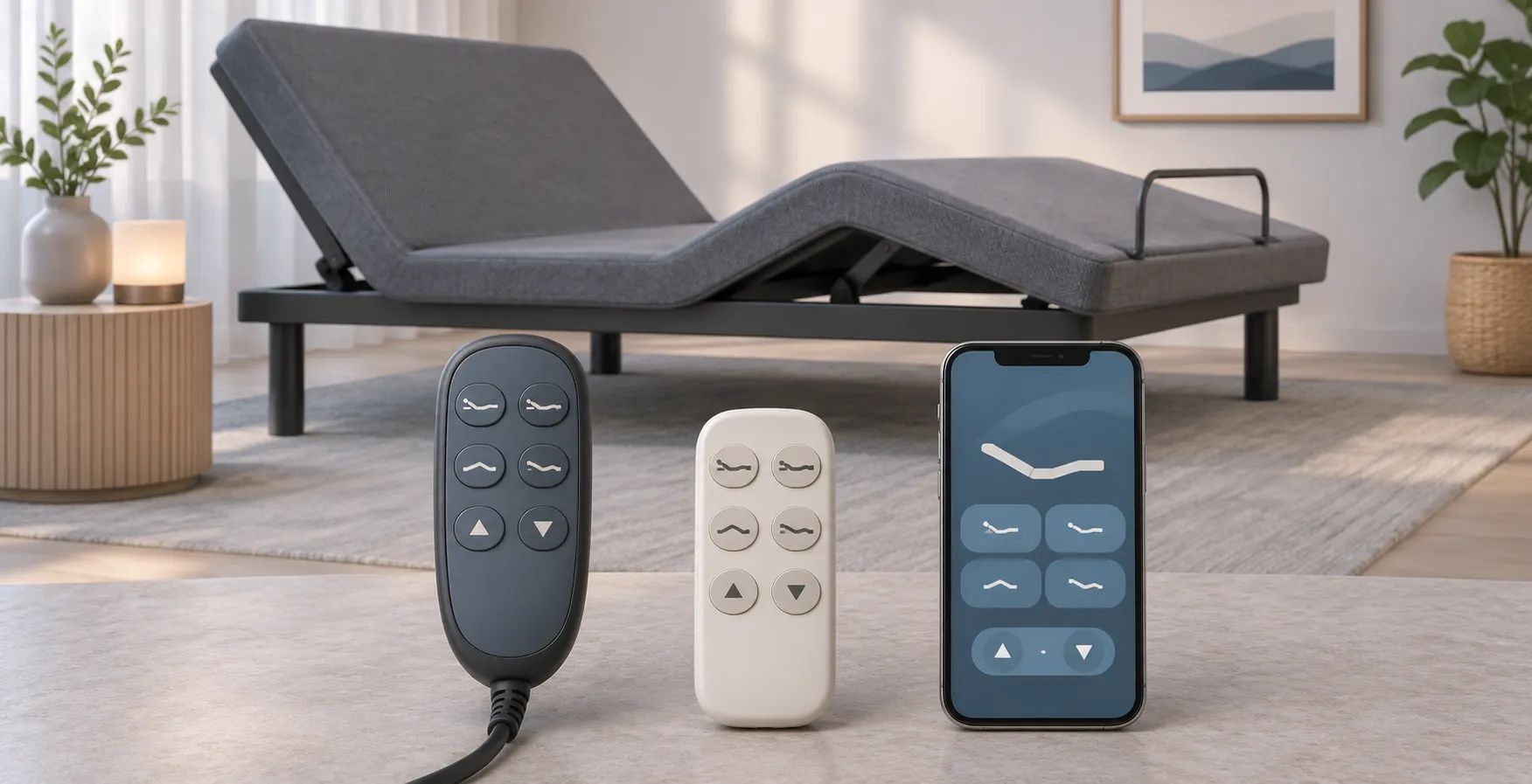
Wired handsets, wireless remotes and app interfaces are control architectures, not fixed entry, mid and premium tiers. Their functions, cost and support burden depend on the exact bed, control box, radio hardware and software scope.
Choose the user tasks and service requirements first, then ask the supplier which control options are validated for the quoted model and destination.
Last updated:
Quick answer: compare the whole control system
A wireless remote can have fewer functions than a wired one, and an app can be an optional interface rather than a distinct bed model. Compare actual functions and total support scope, not the label.
| Option | Useful buyer question | Evidence to request |
|---|---|---|
| Wired handset | Does the cable length, routing and button layout suit the user and bed? | Part number, function map, cable-routing and sample check |
| Wireless handset | What powers, pairs and recovers the handset if it is lost or fails? | Radio variant, battery and pairing instructions, destination evidence |
| App interface | Who owns device pairing, accounts, updates, privacy and support? | Control architecture, software responsibility and offline behavior |
Define functions and failure behavior
- List the motion zones, buttons, presets and accessory controls required for the project.
- Check which functions operate on the specific sample and control-box revision.
- Ask what happens after a power interruption, lost remote, battery depletion, failed pairing or app outage.
- Record accessibility, labeling language, child-lock or lockout requirements where relevant.
- Confirm replacement handset availability, compatibility and pairing support over the service period.
Map radio obligations to the destination
A wireless handset or connected module may be radio equipment. In the US, FCC equipment-authorization rules can apply to intentional radiators, including remote-control transmitters. In the EU, the Radio Equipment Directive sets the route for in-scope radio equipment. The responsible product team must determine the route for the actual hardware, frequency and market; a wired handset is not the same radio configuration.
Ask for the transmitter and receiver identities, equipment authorization or declaration as applicable, and the product and component scope of each record. A radio module's document does not by itself settle the complete product's labeling, integration or other requirements.
Ask KCAI for the model-specific option map
Request a current list of wired, radio and app options for the selected KCAI model. The response should identify compatible control-box and handset revisions, included functions, any software owner, sample status, commercial differences and documents for the destination. Do not assume app branding, over-the-air updates or a particular radio approval is available from a generic product-family description.
Frequently asked questions
Can the adjustable bed app carry my brand?+
Possibly, depending on the selected platform, software ownership and agreed development scope. Request a model-specific feasibility and responsibility statement before making the claim.
Does every wireless remote need an FCC or CE certificate?+
Do not assume one universal document. Determine the applicable US equipment-authorization or EU radio-equipment route for the exact transmitter, receiver, integration and destination.
Is an app control always better than a handset?+
No. Compare required functions, offline behavior, user accessibility, privacy and support with the buyer's channel and service model.
Related
Compare Control Configurations
Get a specification and quote for your adjustable bed program.