On this page
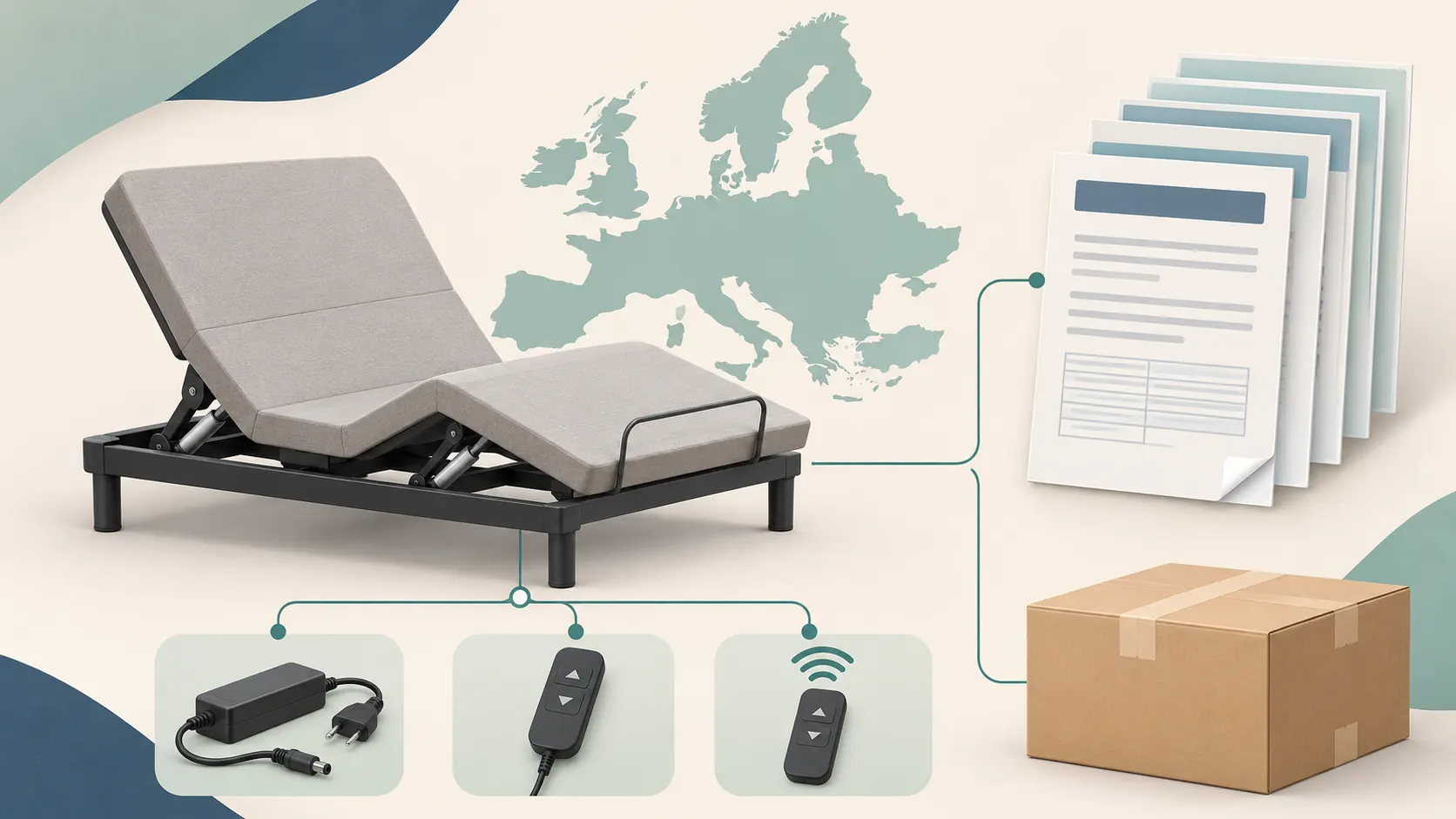
Cover image: AI-generated editorial concept, not a KCAI product, certificate or shipment.
An adjustable bed's EU compliance file starts with the product you will actually sell: its intended use, power arrangement, controls, radio features, materials and destination countries. A supplier's generic “CE certificate” or component report does not settle the obligations for every finished-bed configuration. Before placing an order, identify the applicable EU rules, the economic operators and the evidence that links the declared product to the unit you will receive.
Quick answer: build a product-to-rule map before asking for reports
| Question | Record the answer for your model |
|---|---|
| What is being sold? | Complete bed or base, model and revision, private label, intended consumer or other use |
| How is it powered and controlled? | Power supply input/output, motor and control models, plug, wired or radio remote |
| Where will it be sold? | EU member states, instructions and safety-information languages, online or offline route |
| Which rules apply? | Product-specific EU legislation, general consumer-safety duties and any national requirements |
| Who has which role? | Manufacturer, EU importer, distributor, brand owner and any authorised representative |
| What proves the assessment? | Applicable declaration, technical file references, testing or notified-body records where required |
The European Commission's CE guidance says a CE mark may be used only for products within EU rules that require it. It is the manufacturer's declaration of conformity after the applicable assessment, not an approval issued by a central EU office. Start with scope; do not apply a fixed list of directives to every adjustable bed.
Check electrical, EMC, radio and substance scope separately
The Low Voltage Directive (LVD) covers electrical equipment within defined input or output voltage ranges: 50–1,000 V AC or 75–1,500 V DC. A mains power supply may be relevant, but its rating alone does not prove how every part of a complete bed is classified. Record the supply and finished-product configuration, then have the applicable route confirmed.
Electrical and electronic apparatus may also raise electromagnetic-compatibility questions. If a product or included control is radio equipment, assess the Radio Equipment Directive (RED). RED covers safety and EMC objectives for radio equipment; the European Commission explains that radio equipment within RED's scope is not separately subject to the LVD and EMC directives for that equipment. This does not automatically classify the entire bed or any separately supplied power adapter. A wired-only model and a wireless variant may require different evidence maps.
The RoHS Directive restricts hazardous substances in electrical and electronic equipment within its scope. Check whether the finished product and relevant components fall within that scope and what material-control evidence supports the claim. Do not assume that a named laboratory report is the only possible route to conformity.
For consumer beds, consider the General Product Safety Regulation (GPSR). The Commission's guidance says it complements product-specific EU rules for risks they do not address. Furniture-related safety questions therefore do not disappear merely because an electrical rule applies. Intended medical use may change the product route; make that a separate classification decision, not a marketing assumption.
Request the correct declaration and technical basis
Where CE marking applies, ask for a signed EU declaration of conformity (DoC) identifying the manufacturer, product, applicable legislation, date and signatory. Compare its model and variants to the order and label. Ask what standards, design assessments, tests or notified-body documents support the declaration for the actual configuration. The Commission's conformity-assessment guide explains that routes differ by product rule; a third-party certificate is not universally required.
A separate power-supply declaration or component test can help trace the electrical build, but it does not replace assessment of the finished product where that is required. Record the power supply, motor and control part numbers in the purchase specification, then ask how substitutions are reviewed. The electrical-mark verification guide shows how to match the declared build to the delivered one.
Confirm the EU economic-operator roles
The manufacturer is responsible for the conformity assessment and declaration. The EU importer has its own duty to check that the manufacturer has carried out the applicable assessment and supplied required identification, markings, instructions and safety information. The EU business compliance guide also describes importer identification on the product, packaging or accompanying documentation. An authorised representative acts under a written mandate; it is not a substitute for checking which business actually imports or sells the product.
If a buyer has a bed made and sells it under its own name or trade mark, it may be treated as the manufacturer for relevant EU rules. Record the brand owner and contractual roles before assuming that the Chinese factory will be the named manufacturer. Avoid assuming that the DoC must name the importer; the DoC and importer contact marking serve different purposes.
Check the online offer separately from the carton
For a consumer product covered by the GPSR and offered through distance sales, the European Commission's business guidance identifies information that must be clearly and visibly presented in the offer. The review includes the manufacturer's name and postal and electronic address, product identification and picture, and applicable warnings or safety information in a language easily understood in the destination member state. Where the manufacturer is established outside the EU, it also includes the EU responsible person's name and postal and electronic address.
| Before a listing goes live | Buyer action |
|---|---|
| Identify the model | Match the image, model and variant to the approved product record |
| Assign the responsible person | Confirm the applicable economic-operator role and contact details with the compliance owner |
| Review safety information | Compare the offer, product markings and accompanying instructions for the destination market |
| Control changes | Recheck affected listings when the manufacturer, responsible person, product or safety information changes |
This is an offer-review checklist, not a complete statement of every obligation. Determine the product's scope and the roles of each party with a qualified reviewer; a carton label alone does not complete the online-offer review.
Pre-order document checklist
| Item | Buyer check |
|---|---|
| Product definition | Exact model, revision, intended use, electrical and radio options |
| Applicable-rule assessment | Legislation and assessment route for the finished product and relevant separately supplied parts |
| DoC where required | Signed, current, and traceable to the ordered configuration |
| Technical basis | Standards and supporting records appropriate to each applicable rule |
| Labels and traceability | Product ID, manufacturer details, importer details and required marks |
| Instructions | Destination-country language and safety information required for the sales route |
| Change process | Written decision on whether a component or design substitution affects the declaration |
Check these before production release and again if the build changes. Use the power-supply and plug guide for market-specific configurations and the pre-shipment QC checklist to verify that shipped labels and components match the approved file.
Request model-specific documents from KCAI
Send the model, destination countries, intended use, brand arrangement and electrical options through KCAI's OEM/ODM page. Ask for the current configuration and document references applicable to your order. Your EU compliance lead should confirm the legal scope and importer obligations for that exact product before it is placed on the market.