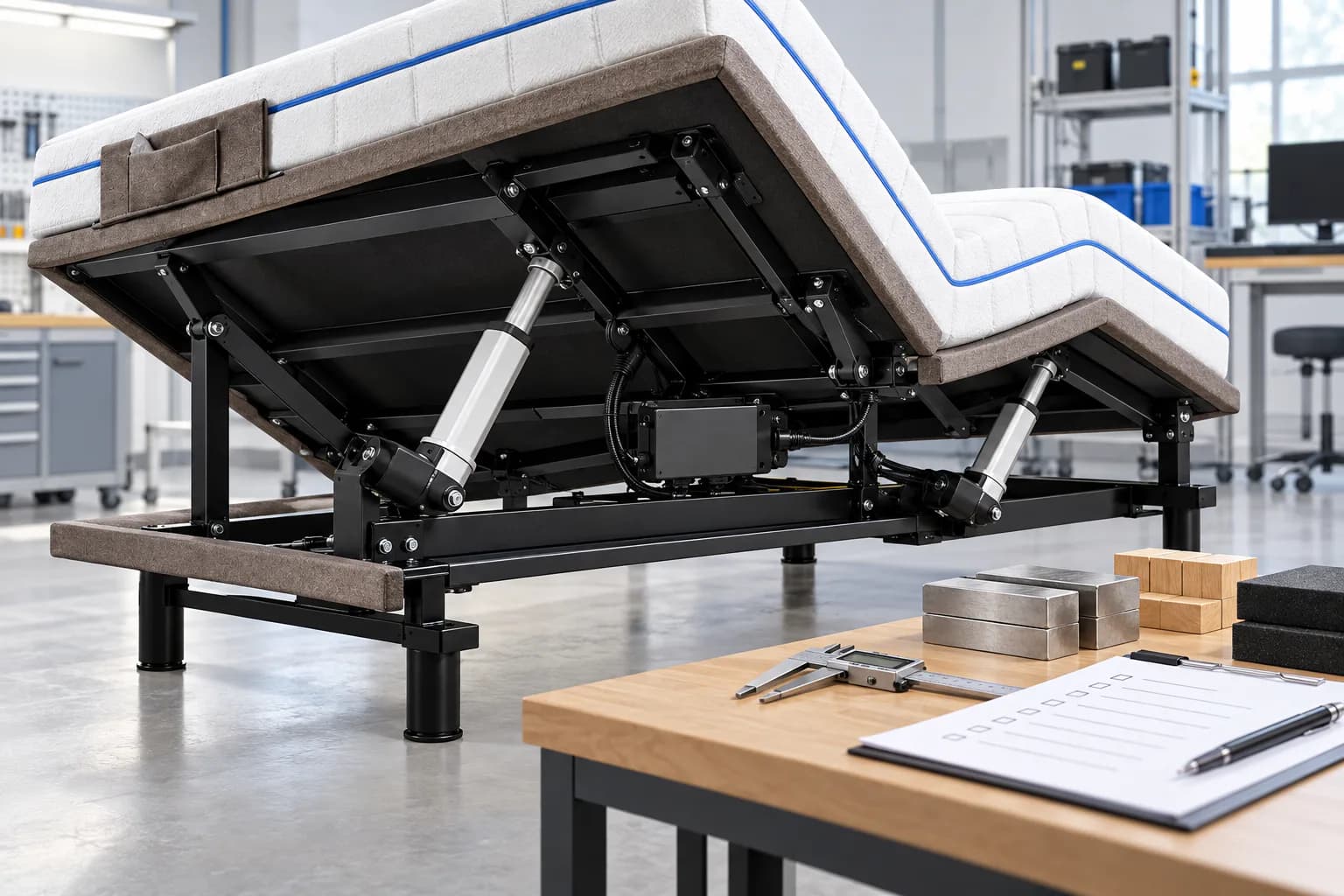
Adjustable bed motors and lifting capacities cannot be compared by motor count alone. Motor count does not identify which functions or zones move independently; lifting capacity is a rating for the complete tested system, including actuators, linkage, frame, mounting points, controls and the stated test conditions.
For a valid comparison, ask every supplier for the same model-specific inputs and separate static load, dynamic articulation load and actuator thrust instead of treating them as interchangeable numbers.
Last updated:
What motor count can tell a buyer
| Configuration | What it may control | What still requires verification |
|---|---|---|
| Single motor | One motion or a mechanically linked movement | Travel, load basis, duty cycle and complete-system test |
| Dual motor | Commonly independent head and foot movement | Whether both zones can run under the stated load |
| Three motor | A third function or a split-zone arrangement | The exact three powered zones and their control logic |
| Four motor | Multiple independent comfort or support zones | Zone definition, synchronization and failure behavior |
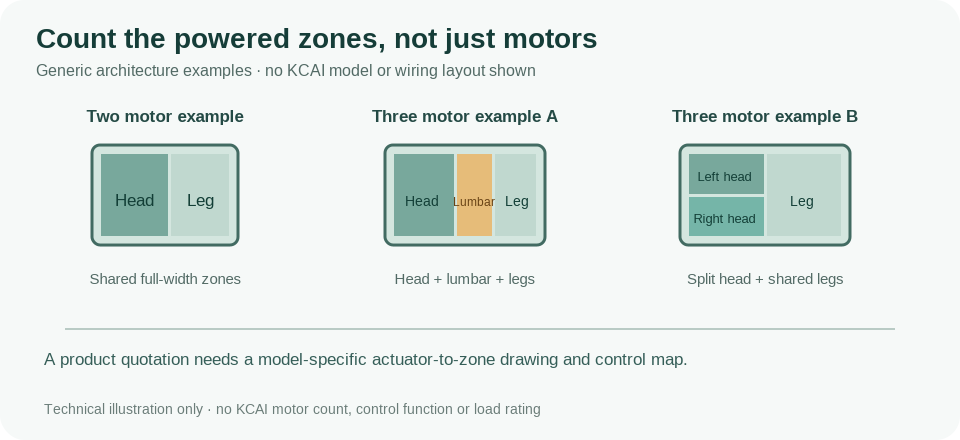
Two versus three versus four motors: map the controlled zones
An actuator count is a component count, not a movement drawing. Two three-motor designs can serve different needs: one may move full-width head, legs and a separate lumbar section; another may move the left head, right head and shared legs. These are generic architecture examples, not confirmed KCAI model configurations.
For the quoted model and revision, request an actuator-to-zone drawing and a remote-button map. Check whether left and right sections share motion, whether the additional zone is included or optional, and what moves when each command is used.
| Example architecture | Possible powered zones | What the count does not prove |
|---|---|---|
| Two motors | Full-width head/back and legs | Independent left/right movement or a tested load rating |
| Three motors, layout A | Full-width head/back, legs and lumbar | Independent positions for two sleepers |
| Three motors, layout B | Left head/back, right head/back and shared legs | Powered lumbar or independent left/right legs |
| Four motors | Depends on the actual design and zone map | Any specific pillow, lumbar, split or load capability |
How to compare lifting capacity across adjustable bed models
| Comparison input | Question to ask | Evidence to retain |
|---|---|---|
| Static load | What load can the flat, stationary structure support under the stated setup? | Model-specific method and result |
| Dynamic load | What load can articulate through the stated range and test cycle? | Loaded functional or cycle-test record |
| Actuator thrust | What is the rated force for each specified actuator? | Actuator datasheet matched to the bill of materials |
| Duty cycle | How long may the system operate before its required rest period? | Component specification and control protection |
| Test configuration | Which mattress, frame size, load placement and motion range were used? | Report tied to the quoted product revision |
What actuator thrust does not prove
Actuator thrust is a component rating, not the same as occupant capacity or safe working load. Geometry changes the force required at different points of travel, and the frame and mounting brackets must transfer that force without unacceptable deformation. Never convert newtons directly into a marketing load claim without the complete-system engineering and test basis.
A practical supplier comparison sequence
- List the functions and zones required for the target product.
- Record motor count, actuator make and model, rated thrust and duty cycle.
- Request static and dynamic ratings with definitions and test conditions.
- Confirm that the evidence covers the exact frame size and quoted configuration.
- Repeat the function check on the approved sample with a representative load plan.
How KCAI approaches this
Ask KCAI for a current model-specific sheet covering motor count and identity, motion functions, input voltage, plug type, controls and the available load or cycle-test evidence. Verify the values against the selected revision; do not apply one model's rating to another.
Frequently asked questions
How do adjustable bed motors and lifting capacities compare across models?+
Compare motor count and function separately from system load ratings. Then verify actuator make and model, thrust, duty cycle, frame size, motion range, static-load definition, dynamic-load definition and the test conditions for the exact product revision.
Does a higher actuator thrust mean a higher adjustable bed load capacity?+
Not by itself. Thrust is one component input. The complete system rating also depends on linkage geometry, frame strength, mounting points, controls, load distribution and how the assembled bed was tested.
Do more motors make an adjustable bed stronger?+
No. More motors usually add independently controlled functions. Strength and usable load require a model-specific rating and test basis for the complete assembled system.
What evidence should buyers request for adjustable bed lifting capacity?+
Request the exact model and size, load definition, load placement, mattress or fixture setup, motion range, test duration or cycle count and the recorded result. The evidence should match the quoted product revision and bill of materials.
Why can two adjustable beds with similar motors have different load ratings?+
Actuator mounting geometry, linkage leverage, frame stiffness, deck structure, fasteners, control protection and load distribution can differ. A similar motor specification therefore does not establish the same complete-system rating.
Related
Spec Your Motor System
Get a specification and quote for your adjustable bed program.