The short answer: an adjustable bed base ships mostly air. A fully assembled base encloses a huge empty volume that you pay to move; a flat-pack (knock-down) base ships as stacked sections and fittings in a compact carton. For KCAI's split-frame platforms — the KD010-A2 (split AI bed frame) and KD011-A3 (split frame with side rails), both 2000x900mm — knock-down design is engineered in from the CAD stage, not improvised at packing time. The result: less dead space, lower freight cost per unit, fewer damaged-in-transit claims, and a product the end user can carry upstairs in one box.
This guide explains how split-frame flat-pack design works, what it changes in your freight math, what to demand in a supplier's packaging specification, and where flat-pack makes sense — or doesn't — in your assortment. For the full freight-cost picture, see our adjustable bed logistics and packaging cost guide.
What "flat-pack" means for an adjustable bed base
Flat-pack — also called knock-down (KD) — means the product ships disassembled and is assembled at the destination. For an adjustable bed base, that typically means:
- The bed deck splits into two or more hinged sections that fold or separate for packing.
- Side rails, legs, and headboard brackets pack alongside the deck instead of adding to the assembled footprint.
- The actuator, control box, remote, and hardware kit (bolts, brackets, tools) travel inside the same carton in dedicated compartments.
The critical point buyers miss: not every adjustable base can be flat-packed well. A frame designed as a welded one-piece unit and then "made shippable" by a packing team will have weak points at the improvised joints. A frame designed as a split frame from the start — like the KD010-A2, whose name literally means a split-apart design — has its load paths, hinge geometry, and connector strength engineered for disassembly and reassembly. Ask your supplier which category their product falls into.
Split-frame construction: the KD010-A2 and KD011-A3 approach
Two KCAI platforms illustrate purpose-built flat-pack design:
KD010-A2 — the split AI bed frame. The defining feature is in the name: the frame splits apart (对拆), and its lifting system is separated from the mattress. Base dimensions are 2000x900mm, with Twin/Full/Double/Queen/King configurations available as configurable options. The split architecture serves two purposes at once: it enables compact knock-down packing, and it lets buyers pair the base with mattresses independently — a merchandising advantage covered in our electric adjustable bed base range.
KD011-A3 — the split frame with side rails. The same split-frame logic, with integrated side rails (围框) for buyers who want a finished furniture look without sacrificing pack efficiency. Also 2000x900mm.
Both run on German OKIN and Haojiang actuators, with lifting systems verified by 10,000+ cycle aging tests — the same durability standard as KCAI's non-split platforms. Flat-pack does not mean light-duty.
| Design aspect | Purpose-built split frame (KD010-A2 / KD011-A3) | Welded frame, "packed down" later |
|---|---|---|
| Joint strength | Engineered connectors, tested as part of the platform | Improvised split points, weakest at the joint |
| Packing density | Designed so sections nest; carton sized to parts | Carton sized to the assembled envelope |
| Assembly | Documented steps, hardware kit included | Often ambiguous; missing-bracket risk |
| Cycle testing | 10,000+ cycles on the as-assembled platform | Test data may not reflect the shipped configuration |
| Size options | KD010-A2: Twin/Full/Double/Queen/King configurable | Usually one fixed size |
How knock-down design changes your carton math
Freight is priced on volume (CBM), not just weight, for ocean shipping — and on dimensional weight for parcel carriers. The method to compare pack formats is straightforward:
- Get the assembled envelope. For reference, the KCAI frame platforms use a 2000x900mm deck. The assembled unit's shipping volume is that footprint times its crated height — nearly all of it dead space.
- Get the flat-pack carton CBM. Request exact carton specs from the factory: carton dimensions, gross weight, and units per carton. Do not accept freight quotes built on estimated carton sizes.
- Divide. The ratio of assembled-envelope volume to flat-pack carton CBM tells you how many more units fit per container — the number that actually moves your landed cost.
Because carton dimensions vary by model, packaging generation, and even the hardware kit contents, no responsible source can publish one "typical" carton size for you to plan around. The factory that designed the split frame is the only party that knows the exact carton. Request the packing spec sheet, verify it with a sample shipment if the order is large, and only then lock your freight budget. (For the CBM calculation method itself, see our logistics and packaging cost guide.)
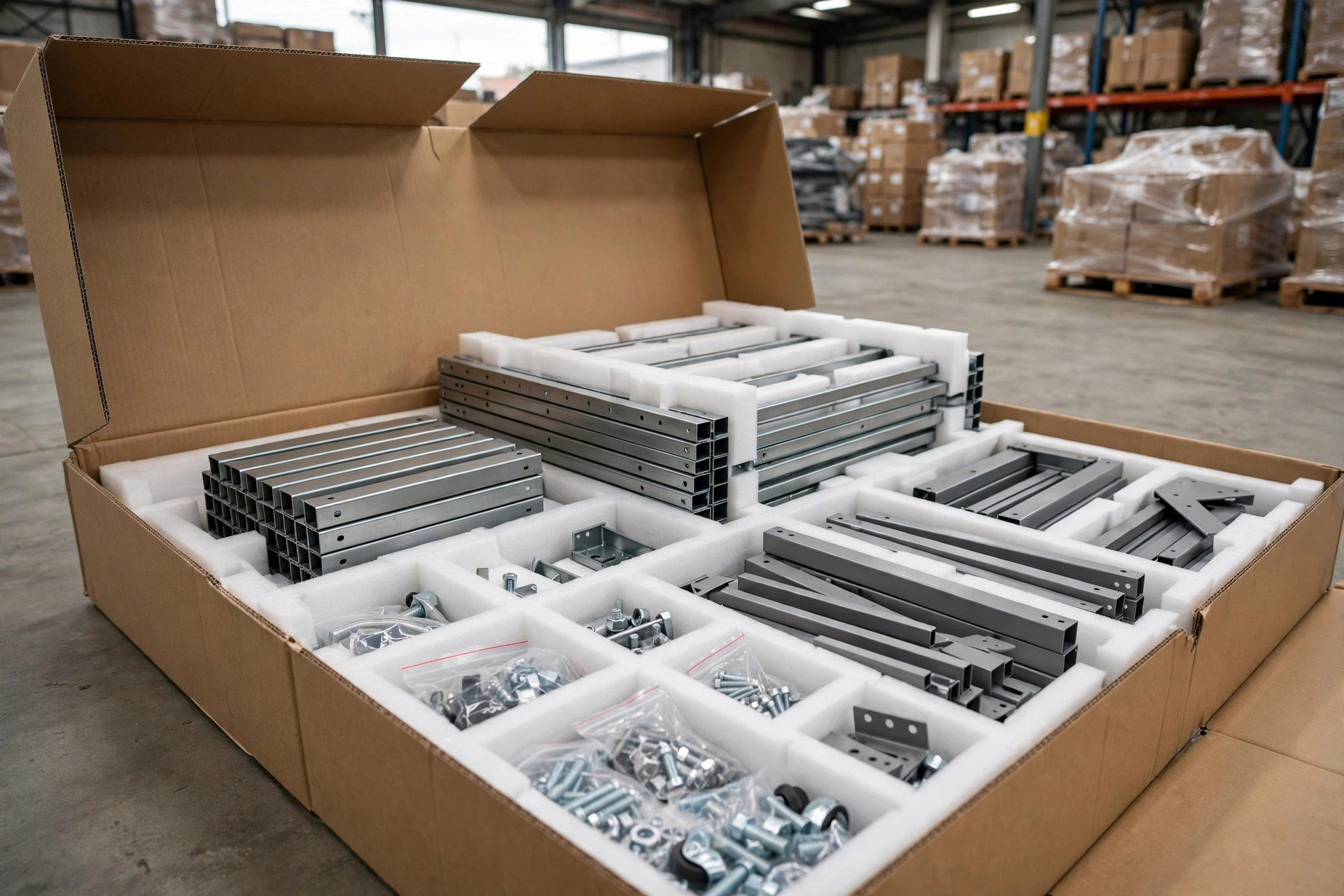
Illustrative AI-generated scene showing knock-down frame packaging — not a photograph of the actual product.
What to verify in a supplier's packaging spec
A packaging spec sheet is a sourcing document, not a marketing sheet. Before you approve a supplier, the sheet should answer all of these:
- Exact carton dimensions and CBM — per carton, per model. Not "about", not "typical".
- Gross and net weight — per carton, so your forwarder can quote accurately.
- Packing method — carton ply, foam or honeycomb inserts, edge and corner protection, moisture barrier if ocean freight.
- Parts manifest — every bolt, bracket, remote, and manual accounted for, so missing-part claims are traceable.
- Transport test documentation — drop-test or vibration-test results for the packaged unit. (See our ISTA 3A drop testing guide for what to require.)
- Palletization and container loading plan — how cartons stack, and what the factory's own loading team recommends.
Red flag: a supplier that quotes freight "included" but cannot produce the carton CBM behind the number. That quote is a guess wearing a uniform.
Flat-pack vs. pre-assembled: total landed-cost comparison
Flat-pack wins on freight, but the honest comparison includes the full landed cost:
| Cost factor | Flat-pack (split frame) | Pre-assembled |
|---|---|---|
| Ocean freight per unit | Lower — more units per container | Higher — ships dead space |
| Parcel / last-mile cost | Lower dimensional weight | Often triggers oversize surcharges |
| Warehouse storage | Denser stacking, smaller footprint | Bulky, fewer units per pallet position |
| Damage in transit | Lower — compact cartons survive handling better | Higher — large panels are damage magnets |
| Assembly labor | Shifts to end user or dealer (clear instructions needed) | None at destination |
| Customer experience | Requires a good manual and hardware kit | Unbox-and-use simplicity |
For B2B buyers — distributors, retail chains, project and hospitality supply — flat-pack is usually the right answer: your customers are moving volume, and freight dominates their cost. For direct-to-consumer brands where the unboxing experience is part of the marketing, weigh assembly friction honestly against the freight saving. Many brands solve it with a short assembly video; the manual in the box is rarely enough.
What the factory does differently for flat-pack
Designing for knock-down changes the engineering, not just the packing tape. At KCAI's 25,000 sqm Dongguan factory — in operation since 2004, serving 100+ global customers — split-frame platforms are drawn as split frames from the first CAD model: hinge and connector geometry, load distribution across the split line, and the packing nest are developed together. The lifting systems (German OKIN and Haojiang actuators) are then cycle-tested 10,000+ times on the as-assembled platform, and products are lab-tested under CNAS/SGS/TUV/UL protocols. That is why a split frame from this factory carries the same durability story as a welded one — it was tested as the thing the customer actually assembles, not as an idealized lab sample.
Next step: get your exact carton specs
Flat-pack math is simple; the inputs are not. Before you finalize any freight budget or assortment plan, request the packing spec sheet for the exact model and configuration you intend to buy — carton dimensions, CBM, gross weight, parts manifest, and transport-test documentation. Everything else is arithmetic.
Two ways to work with KCAI:
Path 1 — Wholesale proven split-frame models. Buy the KD010-A2 or KD011-A3 as they exist: tested platforms, known packing specs, in-production. The fastest route to market when the standard 2000x900mm configuration fits your assortment — request exact carton specs with your quote request and plan freight with real numbers.
Path 2 — OEM/ODM customization. Use a split-frame platform as your starting point and adapt it: sizes (Twin/Full/Double/Queen/King configurations are configurable on the KD010-A2), fabrics and finishes, control packages, packaging design, and branding. Our OEM/ODM services cover the full path from CAD drawing to golden sample to mass production.
Either way, the conversation starts the same: tell us your target market and expected volumes, and we'll send the packing specs that let you calculate true landed cost.