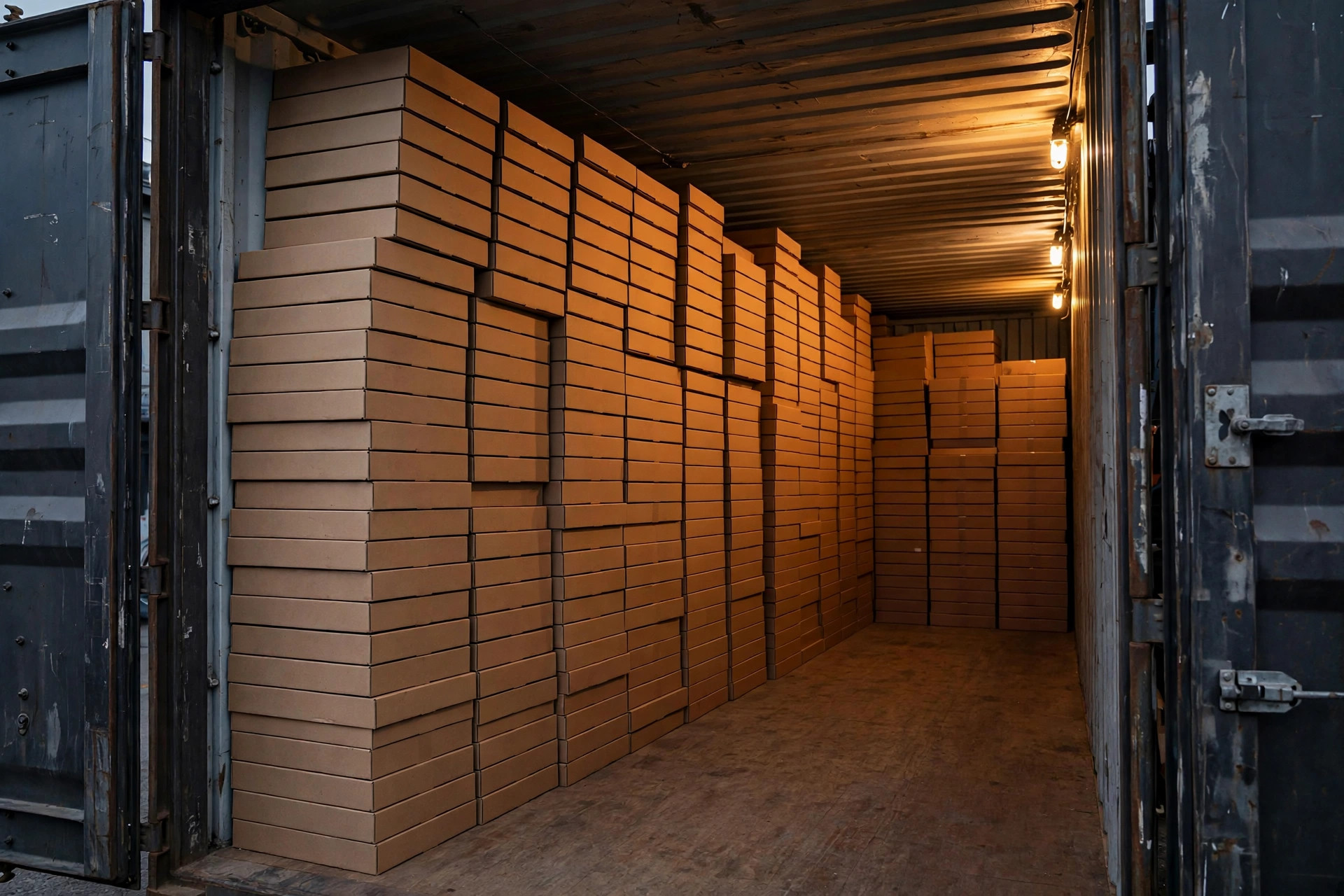
The Short Answer: CBM for Adjustable Bed Shipments
CBM (cubic meters) is the single number that decides what your adjustable bed shipment costs to move: total CBM = length × width × height in meters for each carton, multiplied by quantity, summed across every carton in the order. Freight forwarders bill the higher of actual gross weight and volumetric weight (CBM × the carrier's volumetric factor), and bed frames are volume-heavy: flat, split cartons fill a container long before weight limits kick in. The calculation takes five minutes — measure each carton in meters, multiply L×W×H, add them up — but getting the inputs right is what most buyers get wrong. Below: the exact method, a 40HQ worked example, the 40HQ-vs-20GP decision logic, and the carton-spec checklist to request from the factory.
Why CBM Decides Your Freight Bill
Ocean freight for full containers is sold by the box, not by the kilo — so why does CBM still matter? Because CBM decides which box you need, whether you are paying for air, and what you pay for less-than-container load (LCL). Adjustable bed bases are textbook volume-heavy cargo: steel frames, wood panels, motors, and control boxes pack into flat, rigid cartons that occupy far more space than their weight suggests. In LCL, carriers charge the greater of actual and volumetric weight, so a light shipment can still bill like a heavy one. In FCL, unused cubic meters are money spent on air, while an under-booked container means rebooking fees or a rushed split shipment. For the companion topics — packaging design, damage control, and freight strategy — read our adjustable bed logistics and packaging guide.
The CBM Formula and How to Measure a Carton
The formula itself is simple:
CBM per carton = Length (m) × Width (m) × Height (m)
Total shipment CBM = sum of (CBM per carton type × quantity of that type)
The errors almost never come from the formula. They come from the measurements feeding it. Use this checklist every time:
| # | Step | How to do it | Mistake to avoid |
|---|---|---|---|
| 1 | Measure the sealed carton | Tape-measure the finished, sealed carton — tape, bulge, and all | Using product dimensions instead of carton dimensions |
| 2 | Record L, W, H in centimeters | Longest side = L, second side = W, vertical = H | Mixing centimeters and meters across carton types |
| 3 | Convert to meters | Divide each side by 100 | Calculating in cm and misplacing the decimal point |
| 4 | Multiply L × W × H | Keep three decimal places | Rounding to one decimal before the final total |
| 5 | Multiply by quantity, then sum carton types | One worksheet line per carton type | Assuming every carton in a set is identical |
Two rules deserve emphasis. First, measure the carton, never the product: a bed base with a 2000×900 mm footprint ships in a larger carton once you add protective packaging, corner guards, and the motor box. Second, treat each carton type as its own line item — base sections, motor and control box, and remote and accessories usually travel in different cartons with different dimensions.
Worked Example: CBM Math for a 40HQ Shipment
Illustrative example only — this demonstrates the method, not a real carton spec. The 2000×900 mm base is KCAI's real bed-frame footprint (e.g., the KD010-A2 split-style AI adjustable base); the 0.30 m height and order quantity are hypothetical. Request exact carton specs from the factory before booking.
Step 1 — per-carton CBM. Take our hypothetical carton: 2.00 m × 0.90 m × 0.30 m.
0.54 = 2.00 × 0.90 × 0.30, so one carton = 0.54 CBM.
Step 2 — scale to the order. For a hypothetical order of 100 such cartons (an arithmetic example, not a loading plan):
54.00 = 0.54 × 100, so the order totals 54.00 CBM.
Step 3 — sanity-check against container capacity. A 40HQ offers roughly 67 CBM of usable space in typical carrier figures — confirm with your forwarder, as usable capacity varies by line. Reuse this worksheet format with your real numbers:
| Line | Item | Calculation | Result |
|---|---|---|---|
| A | Carton L × W × H (m) | 2.00 × 0.90 × 0.30 | — |
| B | CBM per carton | A | 0.54 CBM |
| C | Cartons in order (hypothetical) | 100 | 100 |
| D | Total shipment CBM | B × C | 54.00 CBM |
| E | Typical 40HQ usable capacity | Confirm with forwarder | About 67 CBM |
| F | Headroom on paper | E − D | About 13 CBM |
"On paper" is doing heavy lifting in that last line. Real loading also depends on stacking limits, weight distribution, and door clearance. The worksheet tells you whether a 40HQ is plausible; your forwarder's loading plan tells you whether it is real. Never present a worksheet total as a confirmed load plan — label it estimated pending the forwarder's confirmation.
Adding Up Multi-Carton SKUs Without Double-Counting
This is where adjustable bed math diverges from simple products. One "set" on your purchase order is usually several cartons on the warehouse floor: one or two for the base sections, a separate box for the motor and control unit, and a small carton for the remote, power cable, and accessories. Miss one and your CBM total — and your freight quote — is wrong.
The correct method is one worksheet line per carton type:
Total CBM = (CBM of carton type 1 × qty 1) + (CBM of carton type 2 × qty 2) + …
For example, KCAI's KD010-A2 is a split-style design with the lifting system separated from the mattress platform, in a 2000×900 mm footprint customizable across Twin, Full, Double, Queen, and King sizes. Split designs commonly break into multiple cartons per set — confirm the exact carton breakdown with the factory rather than assuming one box per unit. Ask: how many cartons make up one complete set, what each contains, and whether the motor box ships inside the main carton or separately. That answer is the most common source of under-quoted freight on adjustable bed orders.
40HQ vs 20GP: The Decision Logic
No fixed load count decides this — your SKU's carton specs do. Five questions, with your worksheet total in hand:
1. Where does your total CBM sit against nominal capacity? A 20GP offers roughly 28–33 CBM of usable space; a 40HQ roughly 67 CBM (typical figures — confirm with your forwarder). Well under 30 CBM points to a 20GP. Between 33 and 67 CBM, the 40HQ's lower cost per cubic meter usually beats awkward LCL or two 20GPs. Just above a 20GP's limit, price both — the 40HQ is frequently cheaper per unit despite the larger box.
2. What does the weight distribution look like? Volume decides the box size, but every container has a rated maximum payload. Heavy configurations can hit weight limits before volume limits — check gross weight per carton against the payload rating with your forwarder.
3. How often do you order? Fewer, larger shipments cut per-unit freight but tie up cash in inventory and warehouse space. Match container size to sales velocity and storage capacity, not just the cheapest per-CBM quote.
4. Can the destination handle a 40HQ? A 40-foot high-cube needs more yard space, dock or forklift capacity, and sometimes different chassis arrangements than a 20GP. Confirm with your consignee or 3PL before assuming the bigger box is viable at the receiving end.
5. Can the cartons be stacked to use the space? Low stacking limits or irregular shapes waste the theoretical capacity your worksheet shows. Share carton specs and stacking limits with your forwarder and ask for a loading plan.
The pattern: CBM tells you which containers are candidates; weight, frequency, destination capability, and stackability pick the winner. Volume alone never decides.
Get an Accurate Quote With Real Carton Data
Every calculation here is only as good as its inputs, and only the factory has the real ones. Before requesting a freight quote, ask for this per SKU: sealed carton L×W×H for each carton type, gross weight per carton, cartons per complete set and what each contains, stacking limit, floor-loaded or palletized, and photos of a previous container load.
KCAI's electric adjustable bed base range and models like the KD010-A2 are built in Dongguan with configurable sizes and OEM/ODM options — carton specs vary by configuration, which is exactly why the factory's packing list, not a generic estimate, should feed your CBM worksheet.
Work with KCAI two ways: go the OEM/ODM route for custom sizes, configurations, and private-label adjustable bed bases built to your spec, or request a quote for wholesale purchase of existing models like the KD010-A2 with full carton specs, packing lists, and container loading support included. Either way, your freight forwarder gets real numbers — not estimates.
FAQ
What is the CBM formula for shipping cartons?
CBM per carton = length × width × height, all in meters. Convert centimeters to meters first (divide by 100). Multiply by the number of identical cartons, then sum across carton types. Keep three decimals until the final total.
Should I use product dimensions or carton dimensions for CBM?
Always use sealed carton dimensions, including tape and bulge. Product dimensions understate volume because packaging adds size — a 2000×900 mm bed base does not ship in a 2000×900 mm carton. Using product dimensions is the most common reason buyers under-book container space.
How many adjustable beds fit in a 40HQ container?
There is no fixed number. It depends on the exact sealed carton dimensions, gross weight, stacking limits, and the forwarder's loading plan. Any published count that does not reference your SKU's real carton specs is a guess. Request exact carton specs from the factory and run the worksheet in this guide.
Why is my chargeable weight higher than the actual weight?
Carriers bill the greater of actual gross weight and volumetric weight (CBM × the carrier's volumetric factor). Adjustable bed frames are volume-heavy cargo: flat, rigid cartons take up far more space than their weight suggests, so volumetric weight usually wins, especially in LCL shipments.
What carton specs should I request from the factory before booking freight?
For each SKU: sealed carton L×W×H, gross weight per carton, number of cartons per set, stacking limit, whether cartons ship floor-loaded or palletized, and photos of a previous container load. With these inputs, the worksheet in this guide gives you a booking-ready CBM total.