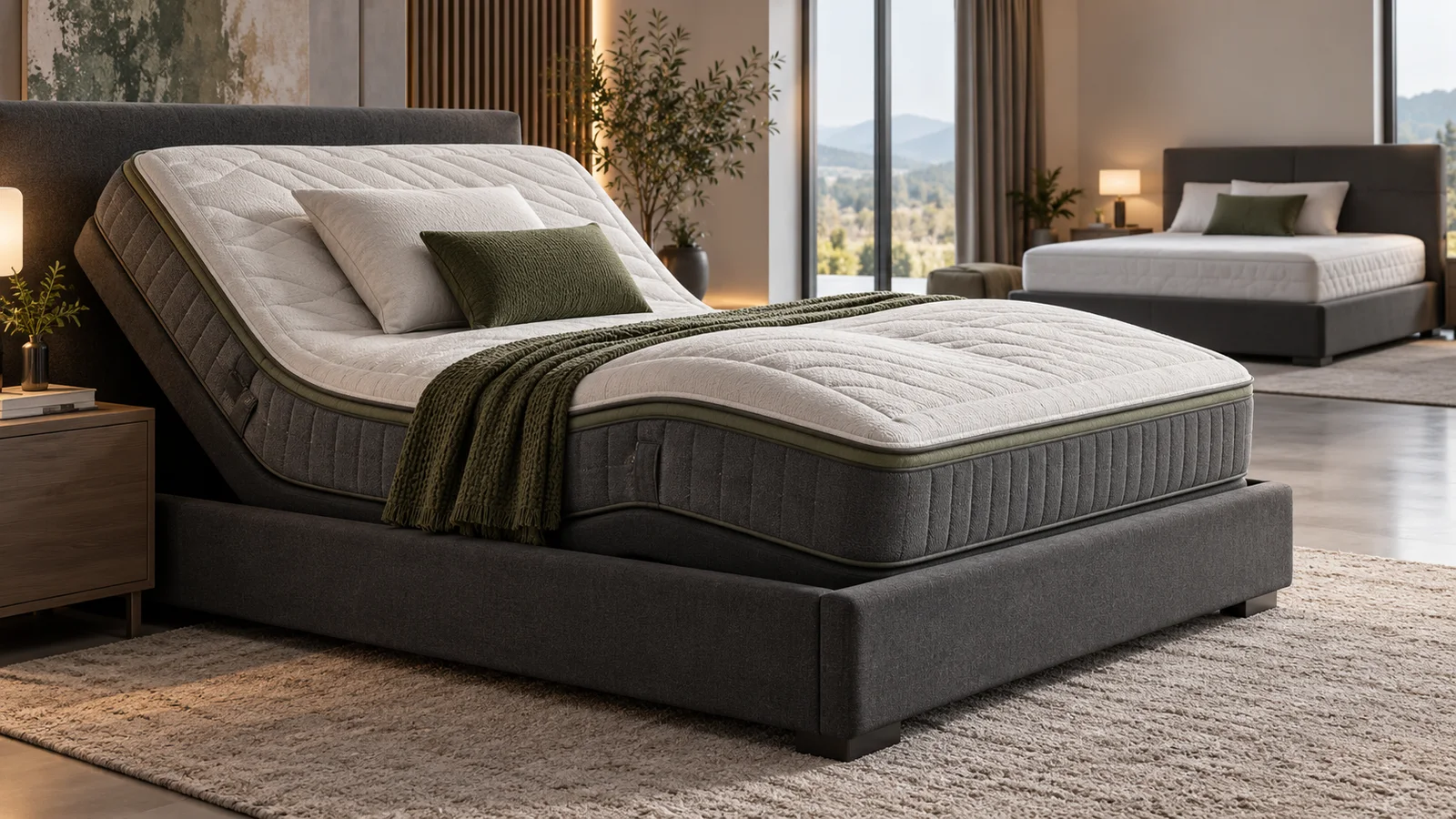
An adjustable motion mattress solves a product-format problem: it combines mattress presentation with defined powered positioning instead of treating the mattress and moving system as unrelated products. For furniture brands, that can support separate upper-body and leg positions while preserving a mattress-led silhouette. It can also simplify the commercial story for buyers who want an integrated adjustable sleep product rather than a visibly open mechanism.
The word “mattress” does not remove the need for systems engineering. The cover, comfort layers, moving sections, support platform, controls, power components and packaging must work together. Nor does movement prove a medical or therapeutic benefit.
Key takeaways
- A motion mattress can solve an assortment gap between a flat mattress and a separate adjustable-base presentation.
- Separate upper-body and leg positioning creates useful product choice, but only verified movements should be advertised.
- Flexibility, support, retention and cable routing must be approved as one system.
- Integrated appearance does not eliminate electrical service or replacement-part requirements.
- Construction and commercial details belong in the current quotation and controlled sample—not in assumptions based on an image.
Five problems the product format can address
| Product-program problem | Motion-mattress response | Buyer approval point |
|---|---|---|
| The range has only flat mattress products | Adds a defined adjustable mattress category | Positioning and channel brief |
| A visible open base does not fit the desired presentation | Integrates the moving concept into a mattress-led form | Complete silhouette and platform review |
| One geometry must serve several leisure positions | Provides separate upper-body and leg movement where verified | Function matrix and control test |
| Mattress and mechanism teams work from different assumptions | Forces layer, hinge, support and retention interfaces into one sample | Controlled construction and system sample |
| After-sales cannot identify electrical revisions | Links controls, power parts and connectors to the approved configuration | Service parts list and traceability |
Problem 1: the product range has a gap between flat and adjustable
A brand may already sell conventional mattresses and finished beds but lack a product that communicates powered positioning in a mattress-centered format. A motion mattress can fill that gap without requiring the commercial presentation to focus on an exposed metal base.
This is a range-planning solution, not proof that the format is right for every channel. Buyers should test how customers understand the product, who installs it, which support platform is required and how the system is serviced after delivery.
Problem 2: the intended appearance and the mechanism are disconnected
An adjustable mechanism can dominate the visual identity of a product if it is treated as an add-on. An integrated motion mattress starts from a coordinated silhouette. The moving zones, cover behavior and underlying support still need enough space to articulate without bunching, abrasion or interference.
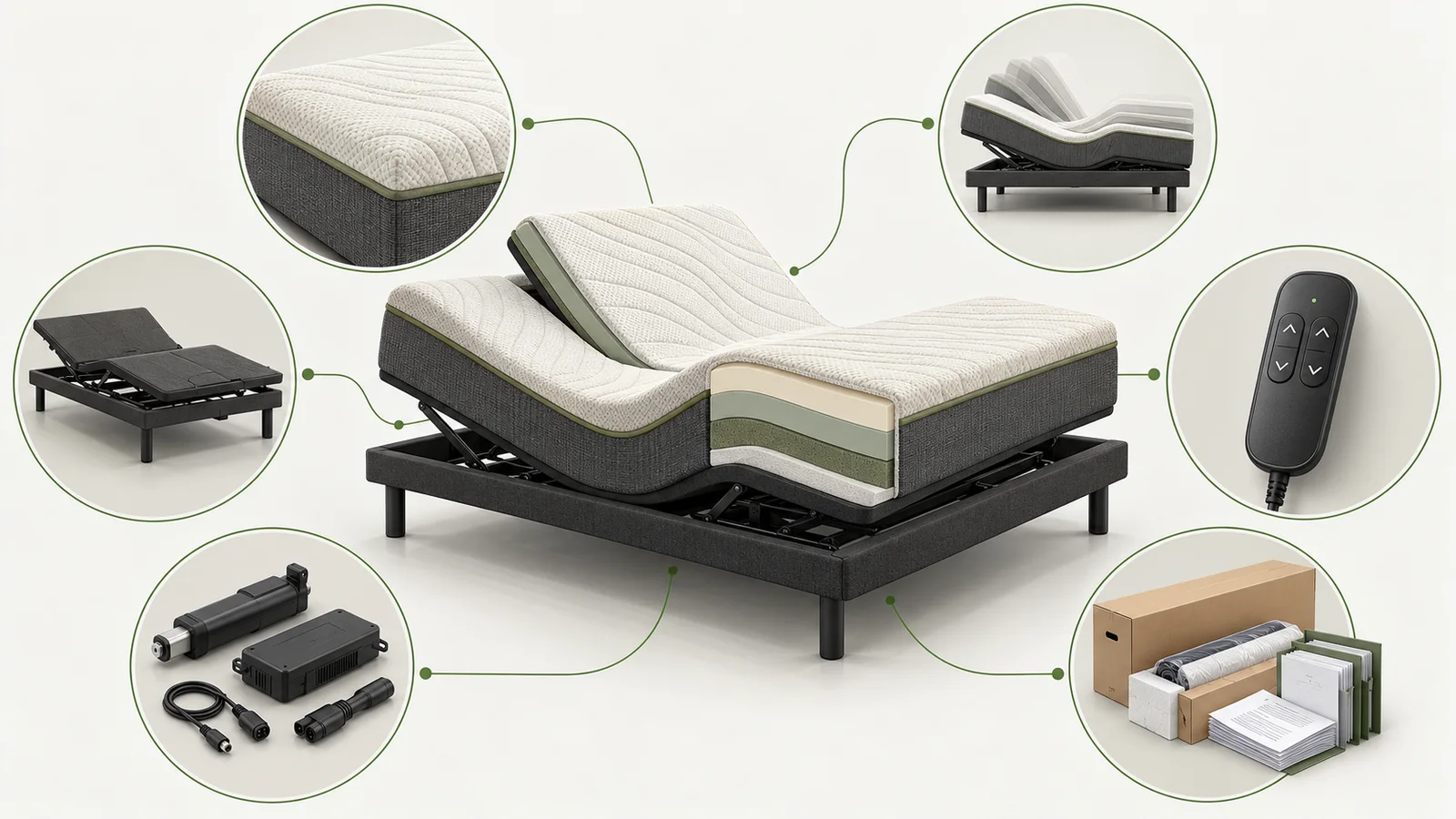
AI-generated editorial system map. Materials, layers, mechanisms and accessories are illustrative, not the exact KD004-B1 construction or a technical specification.
The integration decision should be made early. If the base, cover and mattress construction are chosen independently, the finished system can look integrated while behaving like mismatched components.
Problem 3: buyers need more than one furniture position
Separate upper-body and leg positioning can support different non-medical use preferences within one product. The commercial value comes from controllable choice, not from attaching an unsupported health outcome to a particular angle.
For every movement, define:
- Name the moving section. Use neutral functional language rather than a therapeutic claim.
- Describe the control action. Confirm which button or command starts and stops the movement.
- State the allowed combination. Record whether sections move independently or within a defined sequence.
- Check the soft materials. Inspect cover tension, fold lines and layer behavior throughout the motion.
- Check the surroundings. Confirm platform, headboard, side furniture and cable clearance.
- Record the sample result. Tie the observation to model, size, components and revision.
This turns “adjustable” into a testable product requirement.
Problem 4: the mattress and motion platform are specified by different teams
Comfort-layer decisions affect how a mattress flexes; platform geometry affects how it is supported. Retention, friction, seams and edge construction affect how the product stays aligned. These interfaces are easy to miss when one team buys the mattress and another buys the mechanism.
The mattress compatibility checklist provides a common review record. Buyers should evaluate the intended size and construction, because a successful sample in another thickness or material stack does not automatically validate the new configuration.
Where KD004-B1 fits
KCAI presents KD004-B1 as an adjustable motion mattress with an integrated format and separate upper-body and leg positioning shown in the current catalogue.
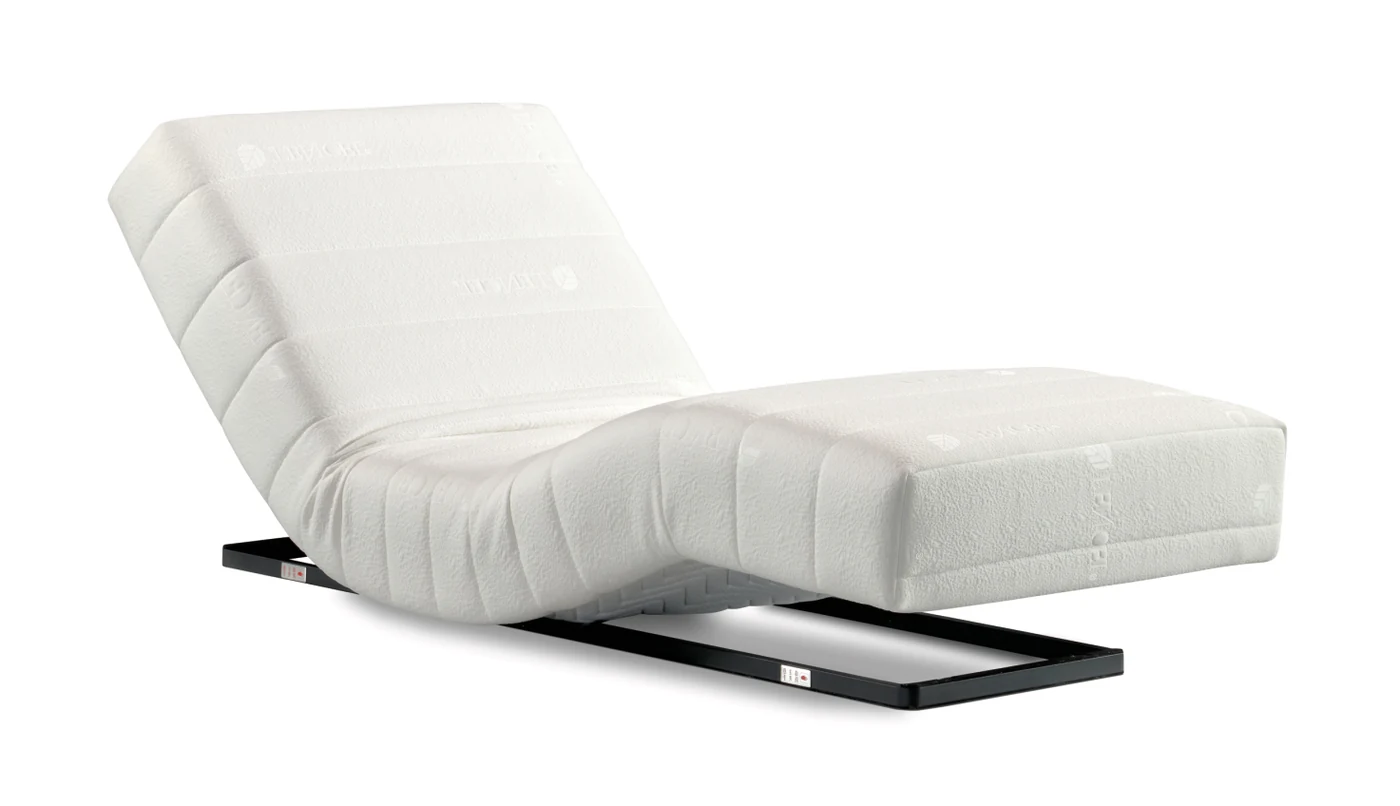
Current KD004-B1 catalogue product view. Confirm layer construction, dimensions, support platform, controls and included components for the quoted revision.
The product direction can be useful when a buyer wants the mattress itself to carry more of the finished-product identity. The KD004-B1 buyer guide explains which documents and sample checks should replace assumptions. Buyers comparing architectural approaches can also review separated versus integrated lifting systems.
Problem 5: an integrated product is sold without an integrated service plan
The appearance may be soft, but the product still includes powered components. A replacement handset, power supply, control unit, connector or actuator cannot be selected safely from appearance alone. Upholstery and cover repairs may also affect movement if seams or tension change.
Before release, define:
- the included electrical and mechanical components by revision;
- connector identification and cable routing;
- access method for inspection or authorized replacement;
- setup, operation and care instructions;
- packaging protection for both soft goods and powered parts;
- escalation steps when a field symptom is not yet diagnosed.
Do not promise universal interchangeability. Verify replacements against the approved model and configuration.
What the format does not solve automatically
An adjustable motion mattress does not automatically reduce returns, improve sleep, relieve symptoms or meet a particular certification. Those outcomes require their own definitions, evidence and market-specific review. It also does not remove the need for a suitable foundation, safe electrical installation or clear user instructions.
The safest and most useful product page describes what is actually verified: the product format, confirmed movements, intended furniture context and process for obtaining model-specific documents.
Build a solution-led enquiry
Send the target channel, desired product appearance, required positions, intended size, support platform, control preference, cover direction, packaging route, destination market and evidence checklist through the request-a-quote form. KCAI can then discuss whether KD004-B1 or another adjustable mattress direction fits the project.
The approved sample, current quotation and controlled documents must remain the source of truth for the supplied system.