In adjustable bed lifting system design, the key question is whether the lifting mechanism is separate from the mattress or built into it. A separated architecture keeps the actuator-driven lifting system and the mattress as two independent parts — a dead actuator is a simple part swap. An integrated architecture builds the lifting system into the mattress, so the whole mattress becomes the service item. KCAI's KD010-A2 is a separated split AI bed frame (2000x900mm, Twin/Full/Double/Queen/King); the KD001-B1 is an integrated one-piece electric mattress (2000x1800x500mm, 300mm side height).
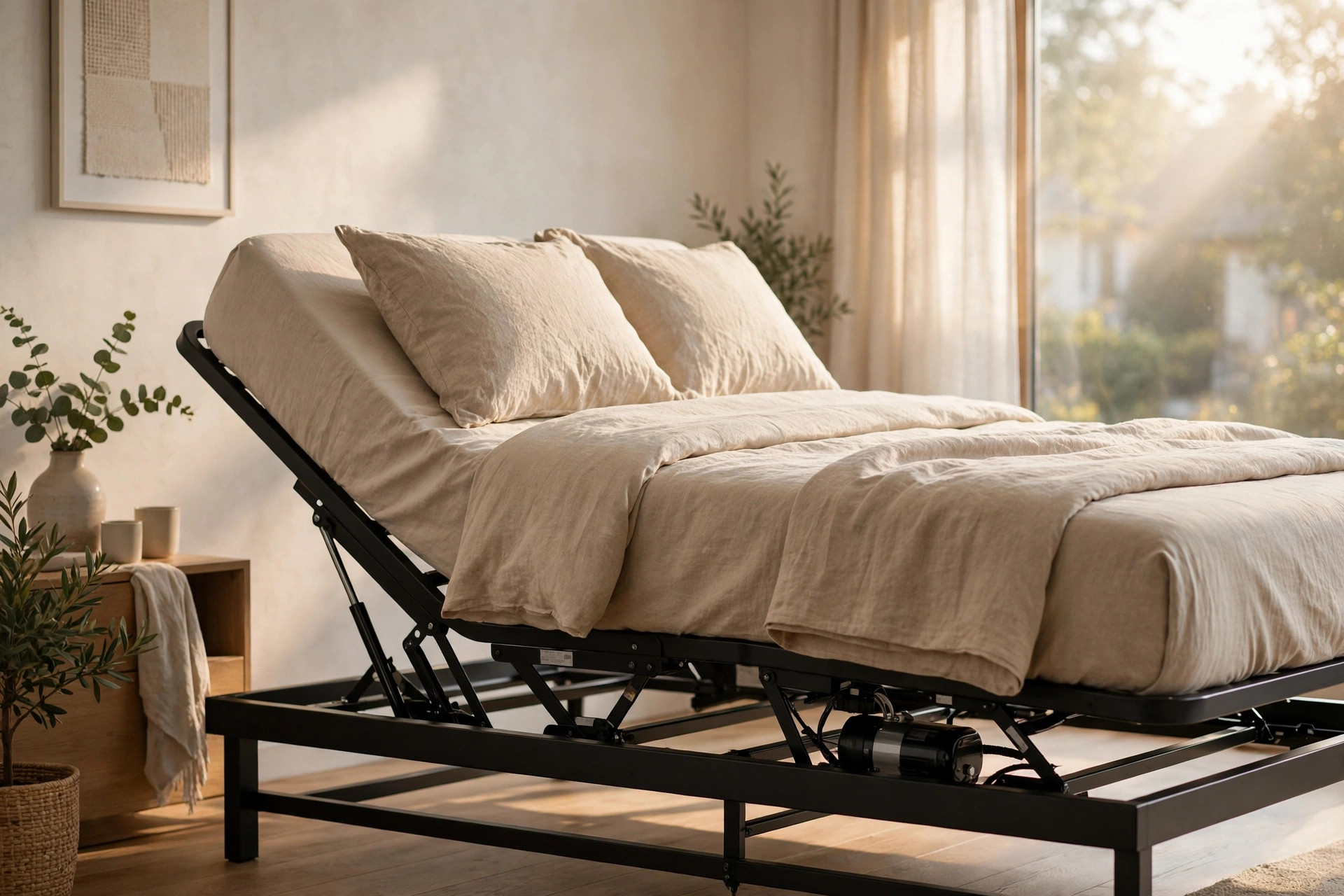
Cover image: an AI-generated scene illustration, not a photograph of a KCAI product.
Separated vs Integrated: The Core Difference
An adjustable bed has two jobs: support the sleeper and move parts of the sleep surface on demand. Where the moving parts live defines the architecture.
In a separated lifting system, the actuators, linkage arms, and control unit are mounted on the bed frame itself. The mattress simply rests on top of that moving platform. The lifting mechanism and the mattress are independent products that meet at the point of sale or in the customer's bedroom.
In an integrated lifting system, the lifting mechanism is embedded inside the mattress body. Frame, actuators, and comfort layers ship as one unit. The buyer receives a single product with a single SKU, and there is no separate base to assemble or pair.
Neither architecture is universally better. The right choice depends on your after-sales capability, your mattress strategy, and your channel. The sections below compare both, using two verified KCAI models as reference points.
Separated Architecture: Serviceability and Pairing Flexibility
The KD010-A2 is KCAI's reference example of a separated architecture: a split AI bed frame, 2000x900mm, designed with the lifting system separated from the mattress, and configurable in Twin, Full, Double, and Queen/King sizes.
Serviceability: a dead actuator is a part swap
This is the decisive operational advantage of the separated design. When an actuator fails in a separated system, the service item is the actuator — or the linkage arm, or the control box. The faulty part is replaced while the mattress stays on the bed. Spare-part inventory is small, light, and cheap to ship: a carton of actuators, not a container of mattresses.
For distributors and brands that run their own after-sales networks, this changes the economics of warranty service. Field repairs become routine, turnaround times shrink to days instead of weeks, and the failed part can be returned to the factory for root-cause analysis. If your business model depends on keeping service costs predictable across thousands of installed units, separated architecture is the structurally cheaper option.
Pairing flexibility: any mattress, your choice
Because the lifting platform and the mattress are independent, buyers can pair the separated base with any mattress they choose — their own foam line, a third-party mattress brand, or a mattress sourced locally to cut freight. KCAI's adjustable bed frames support a backrest range of 0 to 60 degrees and a leg-rest range of 0 to 40 degrees, and the lifting systems pass 10,000-plus cycle aging tests, so the platform is a known, durable quantity regardless of which mattress sits on it.
This flexibility matters most to brands that already own a mattress line, retailers that sell mattresses as a separate category, and importers in markets where shipping a mattress and a base from different suppliers is the most cost-effective routing.
See our electric adjustable bed base range for the separated product line.
Integrated Architecture: One-Piece Convenience
The KD001-B1 is KCAI's reference example of an integrated architecture: a one-piece electric mattress, 2000x1800x500mm, with a 300mm side height and the lifting system integrated with the mattress.
The one-box advantage
Integrated units compress the entire value proposition into a single product. One SKU, one box, one delivery, one assembly step — or none at all. For e-commerce channels and showroom-led retail, this simplicity is a genuine commercial asset: fewer cartons to track, fewer parts to lose, and a product that works the moment it is plugged in.
The trade-off is structural. Because the lifting system is integrated with the mattress, the whole mattress is the service item. A failed actuator cannot be swapped like a cartridge; the service case involves the complete unit. Buyers choosing this architecture should plan their after-sales policy around whole-unit service and make sure their logistics can handle it.
Mattress performance in the integrated form
KCAI's electric mattresses adjust the backrest from 0 to 55 degrees and the leg rest from 0 to 35 degrees. An inclined sleeping position may help some users feel more comfortable while reading, resting, or winding down. An adjustable bed is a comfort product, not a medical treatment substitute, and anyone with a serious health condition should consult a doctor. KCAI's KD001-B2 electric mattress (2000x1800x530mm) is verified to 15,000-plus cycle aging tests.
Head-to-Head Comparison
| Factor | Separated (e.g. KD010-A2) | Integrated (e.g. KD001-B1) |
|---|---|---|
| Architecture | Lifting system and mattress are independent components | Lifting system built into the mattress body |
| Example model | KD010-A2 split AI bed frame, 2000x900mm | KD001-B1 one-piece electric mattress, 2000x1800x500mm, 300mm side height |
| Size flexibility | Configurable Twin/Full/Double/Queen/King | Fixed one-piece dimensions per model |
| Serviceability | Faulty actuator is a part swap; small spare-part inventory | Whole mattress is the service item |
| Mattress pairing | Pair any mattress, including your own line | Mattress is fixed to the unit |
| Logistics | Two components, flexible sourcing and routing | One SKU, one box, minimal assembly |
| Buyer profile | Distributors with service networks, brands with own mattress lines | E-commerce sellers, showroom-led retailers |
| Lifting performance | Backrest 0–60°, leg rest 0–40°; 10,000+ cycle aging tests | Backrest 0–55°, leg rest 0–35° |
Separated architecture optimizes for the long tail of ownership — servicing, upgrading, and mixing components over years. Integrated architecture optimizes for the moment of sale and delivery — simplicity, speed, and a single product story.
How KCAI Engineers Both Architectures
KCAI Intelligent Sleep — Dongguan Kangcai Intelligent Sleep Technology Co., Ltd. — has manufactured adjustable sleep products since 2004, operating a 25,000 sqm factory with 100-plus staff and serving 100-plus global customers, backed by roughly 30 years of furniture R&D and multiple invention and utility model patents. Both architectures come out of the same engineering system:
- Motors: German OKIN and Haojiang motors, selected for strong power, soft start and stop, low noise, and energy saving.
- Frame materials: eco multi-layer board in 15/18mm, high-strength honeycomb aluminum panel, and quality steel; fabrics are optional and high-density foam is used in comfort layers.
- Durability testing: frame lifting systems pass 10,000-plus cycle aging tests; the KD001-B2 electric mattress is verified to 15,000-plus cycles. Testing is conducted under lab protocols associated with CNAS/SGS/TUV/UL.
- Architecture choice: because the factory builds both separated bases and integrated mattresses on the same production system, buyers can source both architectures from one supplier with consistent motor platforms and quality control.
For a deeper look at the mechanisms inside both architectures, read our adjustable bed actuator engineering buyer's guide, the pillar reference for this engineering series.
Which Architecture Fits Your Product Line?
Use this decision logic to match the architecture to your business:
- Choose separated if you run an after-sales or service network, you already sell or manufacture mattresses, you want spare-part-level service economics, or you source mattresses and bases through different supply routes. Start from the electric adjustable bed base line.
- Choose integrated if you sell primarily through e-commerce, you want a single-SKU product story, your showroom strategy depends on plug-and-play demonstration, or your logistics favor one-box delivery.
- Choose both if you serve multiple channels. Many of KCAI's global customers carry a separated base for their service-led retail channel and an integrated mattress for their online channel — one factory, two product stories.
If neither off-the-shelf architecture maps exactly to your product plan, the engineering team can develop a custom configuration. Explore OEM/ODM services for custom architecture, sizing, and motor options, available as configurable options depending on the project.
Frequently Asked Questions
What is the difference between a separated and an integrated lifting system?
A separated architecture keeps the actuator-driven lifting mechanism and the mattress as two independent components, so a faulty actuator is a simple part swap. An integrated architecture builds the lifting system into the mattress itself, so the whole mattress becomes the service item.
Which lifting system architecture is easier to service?
Separated systems are easier to service. Spare actuators or linkage parts can be shipped and replaced in the field without touching the mattress. Integrated units require servicing or replacing the whole mattress when the lifting mechanism fails, so buyers should plan whole-unit service logistics in advance.
Can I pair my own mattress with a separated lifting system?
Yes — that is the core advantage of the separated architecture. KCAI's KD010-A2 split AI bed frame is designed with the lifting system separated from the mattress and is configurable in Twin, Full, Double, Queen, and King sizes, so it can carry a mattress from your own line or a third-party supplier.
What are the lifting angle ranges of KCAI adjustable beds?
Adjustable bed frames adjust the backrest from 0 to 60 degrees and the leg rest from 0 to 40 degrees. Electric mattresses adjust the backrest from 0 to 55 degrees and the leg rest from 0 to 35 degrees. Lifting systems pass 10,000-plus cycle aging tests.
Does KCAI support custom lifting system designs?
Yes. OEM/ODM custom development is available for both separated and integrated architectures, with sizes, configurations, and motor options available as configurable options depending on the project.
Talk to Our Factory: Two Ways to Work With KCAI
Ready to add an adjustable bed lifting system to your product line? There are two ways to start:
- OEM/ODM custom development — work directly with our engineering team to develop a separated or integrated lifting system to your specification: custom dimensions, configurations, and motor options are available as configurable options depending on the project. Share your target market and channel, and we will propose an architecture that fits.
- Wholesale purchase of existing models — source proven models directly, including the KD010-A2 separated split AI bed frame and the KD001-B1 integrated one-piece electric mattress, with consistent motor platforms and factory quality control across both architectures.
Send your inquiry with your target sizes, order volume, and preferred architecture, and our team will respond with specifications and next steps.