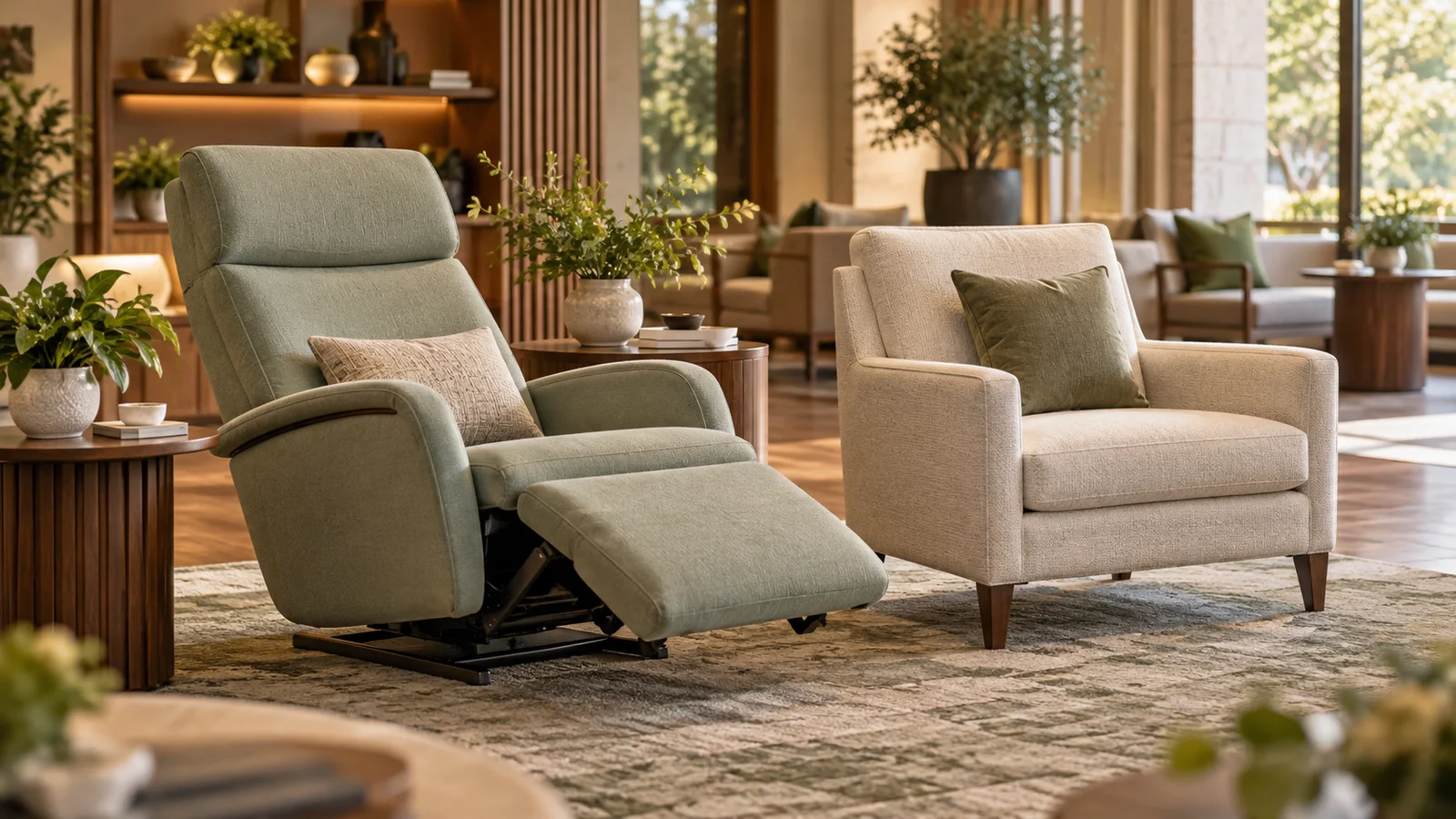
An adjustable leisure chair solves the limitation of a single fixed seating geometry by offering controlled back and leg positions within one piece of furniture. In a lounge, hospitality or wellness-oriented interior, that can support different non-medical activities—upright conversation, reading or relaxed reclining—without asking one fixed chair angle to serve every preference.
The product does not automatically solve transfer, mobility or clinical-care needs. “Adjustable,” “reclining” and “lift-assist” describe different scopes. Buyers must confirm the exact movement, control, stability, clearance and intended use instead of inferring them from the silhouette.
Key takeaways
- Adjustable back and leg sections can make one seat useful across several lounge positions.
- The moving envelope must be planned with walls, tables, walkways, power and other furniture.
- Controls should be assessed with representative users; appearance alone does not prove usability.
- Upholstery choice affects cleaning, wear, comfort presentation and movement behavior.
- A leisure chair should not be marketed as a medical or fall-prevention product without the required evidence.
Six problems adjustable leisure chairs can address
| Interior or sourcing problem | Adjustable-chair response | What the buyer must verify |
|---|---|---|
| A fixed seat angle does not suit every lounge activity | Back and leg sections provide selectable positions | Verified movement and control logic |
| Separate chair and footstool consume more floor area | Integrated leg support can consolidate the seating arrangement | Full open and closed dimensions |
| Reclining collides with walls or nearby furniture | The movement envelope can be planned before installation | Current drawing and room layout |
| Users do not understand the control | Buttons and labels can be selected and tested for the project | Representative usability review |
| Upholstery is chosen only by color | Material can be specified for the intended cleaning and wear context | Approved swatch, construction and care method |
| Powered parts are hidden after sale | Service access and component identification can be defined before release | Parts record and service instructions |
Problem 1: one fixed posture must serve every activity
A fixed lounge chair provides one relationship between the seat, back and legs. That may be appropriate for conversation but less adaptable when the same space is also used for reading or relaxed leisure. An adjustable chair can consolidate those furniture positions into one controlled seat.
The value is choice, not a promised physical outcome. The buyer should describe activities and posture preferences in neutral language, then test the chair's actual movement with the intended users and environment.
Problem 2: separate furniture pieces complicate the room plan
A chair and loose footstool can create a flexible look, but they occupy separate footprints and can move independently. An integrated adjustable leg section can reduce the number of loose pieces in a lounge concept. It does not guarantee a smaller total clearance when open.
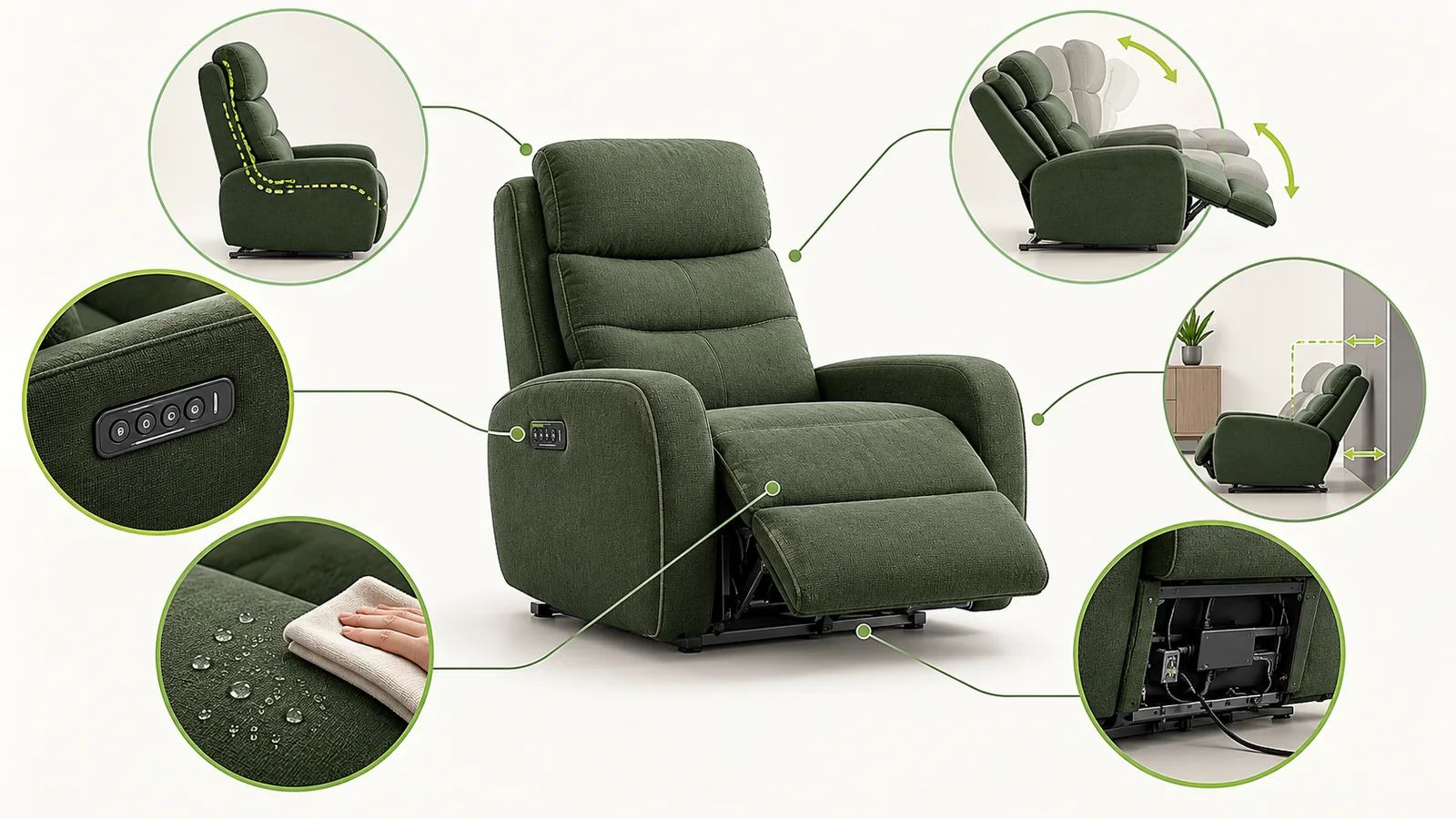
AI-generated editorial solution map. It is not the exact YJ001-1 mechanism, upholstery, control, service layout or a performance record.
Measure the chair in every required position. Include the user's approach path, side table, power outlet, cable route and adjacent seating. A room plan based only on the closed chair can fail as soon as the leg or back section moves.
Problem 3: product selection ignores the movement envelope
Buyers often compare overall style before checking what moves into the wall, aisle or neighboring furniture. The mechanism may also change the seat's relationship to a table or control point.
Use a seven-step space and function review:
- Draw the room. Record walls, doors, power outlets, walkways and fixed furniture.
- Request current chair dimensions. Obtain the controlled open, closed and intermediate envelope for the proposed revision.
- Mark the moving zones. Show the back, leg section, cables and any under-chair mechanism.
- Place the control. Confirm reach, storage and cable behavior in each position.
- Review approach space. Keep the intended circulation route clear in the real layout.
- Test the configured sample. Use the specified upholstery, control and power components.
- Recheck after changes. Repeat affected checks when dimensions, mechanism or soft materials change.
This process is more reliable than selecting a chair from a front-view image.
Problem 4: controls are treated as decoration
Button count does not measure usability. A useful control has understandable differentiation, consistent direction, appropriate feedback and a place to rest when not in use. Wired and wireless controls create different storage, pairing and service questions.
Do not describe a handset as “senior friendly” solely because it has large buttons. Test it with representative users and document what “easy to use” means for the project—for example, distinguishing functions, reaching the control and returning the chair to an agreed position.
Problem 5: upholstery is selected without an operating brief
Color and texture matter, but the material also moves across seams, cushions and articulated sections. The buyer should define the intended cleaning method, expected setting, appearance standard and documentation needs before approving a finish.
A generic AI image can suggest a mood; it cannot prove a textile specification, stain resistance or durability result. Use physical swatches, current supplier data, a configured sample and the buyer's own acceptance plan.
Where YJ001-1 fits
KCAI presents YJ001-1 as a shaped adjustable leisure chair for lounge, relaxation and wellness-oriented product ranges. Adjustable back and leg sections are shown in the current catalogue.
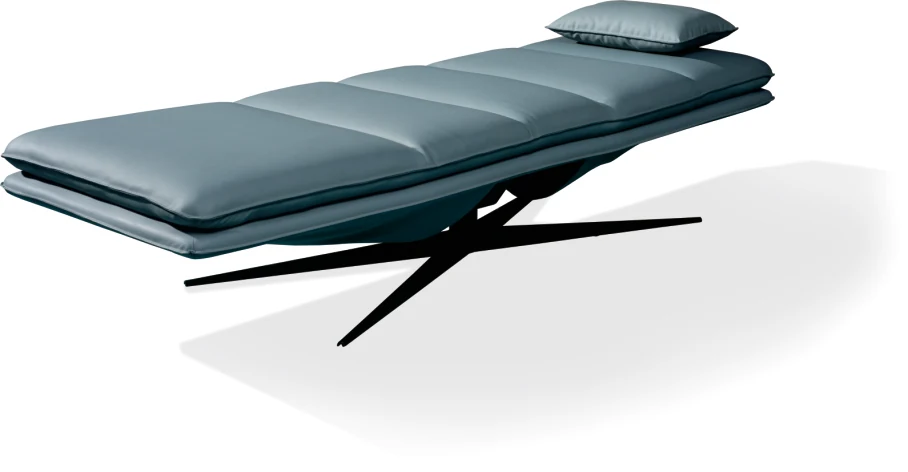
Current YJ001-1 catalogue product view. Confirm upholstery, controls, dimensions, movement, clearance and included components for the quoted revision.
The direction can help a buyer develop an adjustable seating offer without describing the product as a clinical recliner. The YJ001-1 OEM guide covers drawings, sample scope and change control. For senior-living common areas, the wellness-space procurement guide explains the boundary between leisure furniture and unsupported care claims.
Problem 6: the chair is approved visually but cannot be serviced consistently
Upholstery hides much of the powered system. That makes revision control more important, not less. Ask how the power supply, control, cables and moving components are identified and accessed. Confirm which tasks belong to the user, installer, service team or supplier.
The service plan should cover included parts, connector identification, setup instructions, fault reporting and replacement verification. It should not encourage unqualified disassembly or promise that similar-looking parts are interchangeable.
What an adjustable leisure chair does not prove
An adjustable leisure chair is not automatically a lift chair, transfer aid, fall-prevention product or medical device. It does not prove pain relief, circulation improvement, rehabilitation support or a clinical outcome. If a project genuinely requires those functions or claims, create a separate intended-use and evidence pathway with qualified input.
For a furniture program, the strongest value proposition is clear: selectable non-medical lounge positions, coordinated room planning and a controlled product-and-service specification.
Request a project-specific review
Send the intended environment, room plan, target users, required positions, upholstery direction, cleaning method, control preference, power location, packaging route, evidence list and service expectations through the request-a-quote form. KCAI can then discuss whether YJ001-1 or another adjustable leisure-chair direction fits the brief.
The current quotation, controlled drawing, approved sample and project documents—not a generic image or category label—must define the supplied chair.