
An adjustable bed solves the problem of fixed or improvised positioning by giving a compatible mattress a controlled, repeatable moving platform. In a residential furniture context, that can make reading, resting or watching media easier to configure than stacking pillows or repeatedly rearranging cushions. For B2B buyers, it can also create a differentiated bed category—but only when the mattress, controls, furniture surround, packaging and service plan are specified as one system.
It does not automatically solve a medical problem. A powered movement should not be converted into promises about treating pain, improving circulation, preventing falls or supporting rehabilitation without product-specific evidence and the applicable authorization.
Key takeaways
- Adjustable motion replaces unstable positioning workarounds with repeatable furniture positions.
- The complete solution includes the base, mattress, control, room clearance and service parts.
- More functions are useful only when each function has a defined user need and acceptance method.
- A catalogue image identifies a product direction; drawings, samples and current documents define the order.
- Buyers should compare solutions against the same requirements, not compare feature counts alone.
Six practical problems an adjustable bed can address
| Buyer or user problem | Adjustable-bed response | Evidence to approve |
|---|---|---|
| Pillows move or compress during an activity | A powered platform provides a repeatable upper-body position | Motion demonstration and sample review |
| One flat position must serve every activity | Defined head and leg positions expand non-medical comfort choices | Function matrix and control check |
| The base conflicts with the mattress | System-level selection aligns platform movement and mattress flexibility | Compatibility record and complete sample |
| Moving parts collide with surrounding furniture | Clearance is designed around the articulated envelope | Current drawing and room mock-up |
| Controls are confusing or inconsistent | Button logic, labels and presets can be specified for the target channel | Approved handset and user instructions |
| Service teams cannot identify replacement parts | Electrical and mechanical parts are tied to a controlled revision | Parts list, connector record and service plan |
The table describes sourcing problems, not guaranteed performance. The final answer depends on the exact configuration and the buyer's acceptance criteria.
Problem 1: unstable pillow stacking
Pillows are soft, movable components. When they are used to create an elevated reading or resting position, the angle can change as the pillows compress or slide. A powered adjustable platform offers a more repeatable furniture position and leaves pillows to perform their normal cushioning role.
That does not mean one preset is correct for every person. The useful outcome is controlled adjustability: the user can change the position within the verified range of the product instead of rebuilding a stack of cushions.
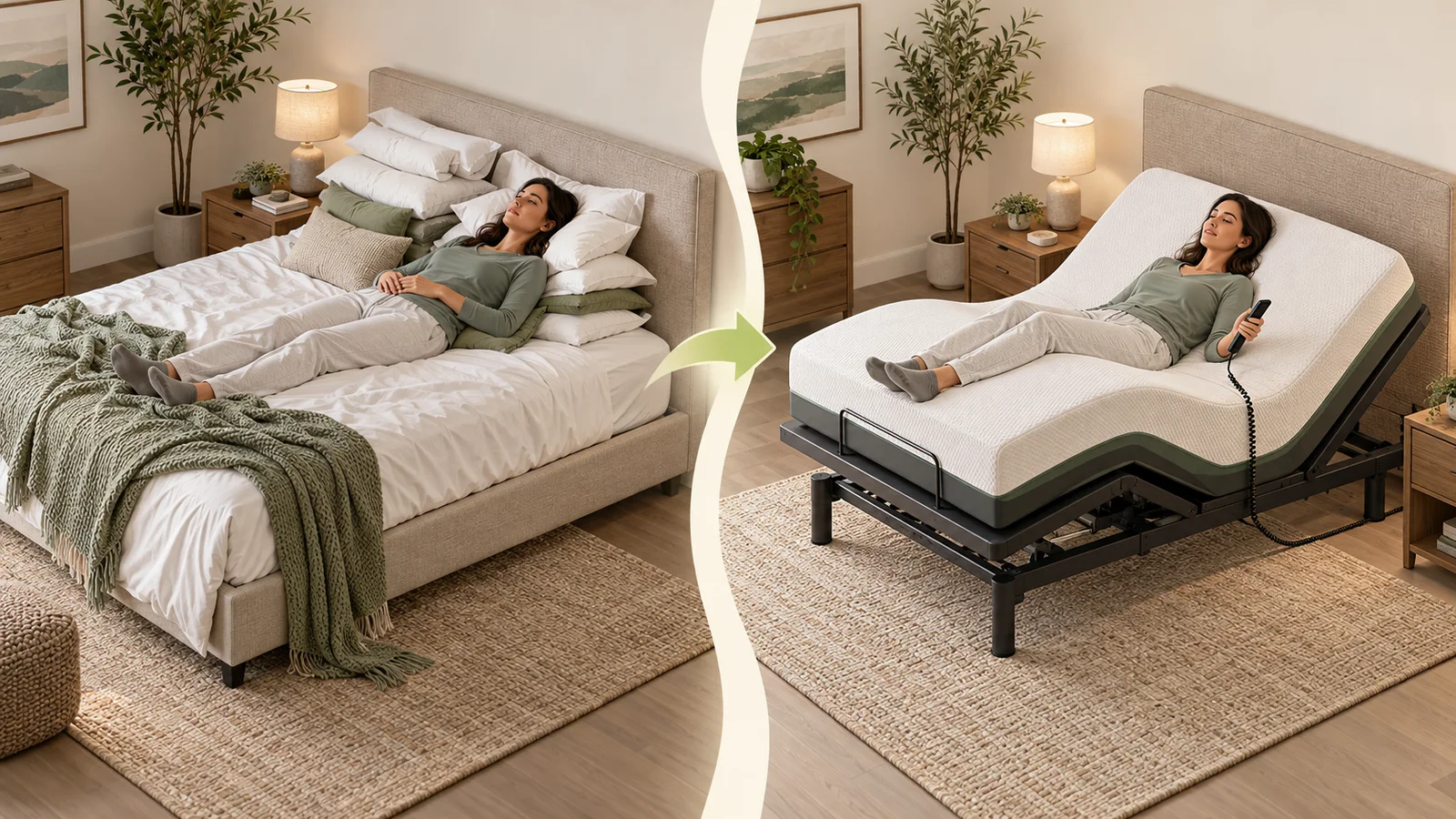
AI-generated editorial comparison. It is not an exact KCAI product, medical recommendation, engineering drawing or proof of performance.
Problem 2: a flat-only product cannot support multiple furniture uses
A conventional flat bed is optimized around one geometry. An adjustable bed can add non-medical positions for activities such as reading, viewing a screen or relaxing before sleep. This lets a furniture brand develop a broader use story without adding loose wedges or separate lounge products.
The buyer still needs to define the intended use. Terms such as “zero gravity,” “anti-snore” or “wellness mode” should not be copied into marketing solely because a handset contains a named button. Each public claim needs a clear meaning and evidence for the exact model.
Problem 3: product components are sourced separately but must work together
The moving base, mattress, retainer, upholstered surround and bedside furniture occupy the same space. If each is approved independently, the assembled system may bunch fabric, shift the mattress, trap cables or collide with the frame.
Use the adjustable-bed mattress compatibility checklist to review the full motion envelope. Test the actual mattress construction and target size on the quoted base revision rather than assuming that every flexible-looking mattress is compatible.
Problem 4: a brand needs a differentiated adjustable-bed direction
An adjustable product can give a private-label or OEM range a clear functional category beyond a fixed bed frame. The KD008-A1 multifunction electric bed frame is one requirements-led direction in KCAI's public range.
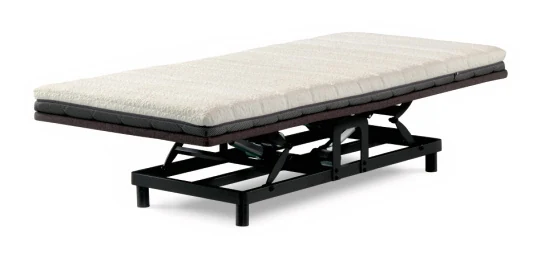
Current KD008-A1 catalogue product view. Confirm functions, dimensions, controls, compatible mattress and included parts in the current quotation.
The public catalogue direction shows an elevating frame structure. It does not authorize a buyer or writer to invent a motion sequence, lifting range, load rating or certification. The KD008-A1 OEM review guide explains how to turn the concept into a controlled specification.
Problem 5: feature-heavy quotations are difficult to compare
Suppliers may use similar terms for different mechanisms. “Dual motor,” “multifunction” or “smart control” can hide different included parts, movement logic and service obligations. A solution-based RFQ converts those labels into questions.
- Define the channel. State whether the product is for retail, ecommerce, hospitality, senior-living furniture or another non-clinical route.
- Describe the problem. Explain the required activities and room constraints without prescribing unsupported benefits.
- List required movements. Mark each movement or preset as required, optional or excluded.
- Name the mattress plan. Provide the intended construction, size and any buyer-supplied components.
- Map the interfaces. Include furniture clearance, power location, controls, accessories and cable route.
- Set the evidence gate. Request the current drawing, parts list, sample plan, packaging information and applicable documents.
- Control the revision. Approve one complete sample and reopen affected checks after a change.
The adjustable-bed OEM RFQ checklist can be attached to the enquiry so every supplier quotes the same scope.
Problem 6: after-sales teams receive an assembly, not a service system
A powered bed contains interfaces that may need identification later: handset, power supply, control box, actuators, cables, fasteners and mechanical assemblies. If the buyer approves only the finished appearance, a future replacement can become a compatibility guess.
Ask for a revision-linked included-parts list, connector identification, setup instructions and escalation route. Confirm whether a proposed replacement is interchangeable with the approved configuration before shipment. This is especially important when a program runs across multiple orders or markets.
What an adjustable bed does not solve by itself
An adjustable bed does not replace clinical assessment, accessible room planning, a suitable mattress, safe installation or accurate product instructions. It also does not prove that a product is a medical bed, a transfer aid or a fall-prevention device.
For a sourcing project, the strongest language is specific and modest: describe the verified movement, interface and use context. Leave medical outcomes, unsupported superlatives and unverified test values out of the product page.
Turn the problem into an RFQ
Send KCAI the target market, intended non-medical use, required positions, room drawing, mattress direction, furniture surround, control preference, packaging route, evidence list and expected service model. Use the request-a-quote form to ask whether KD008-A1 or another electric adjustable-bed direction fits the brief.
The quotation, controlled drawing, approved sample and project documents—not an AI image or a generic benefit list—must define the supplied product.