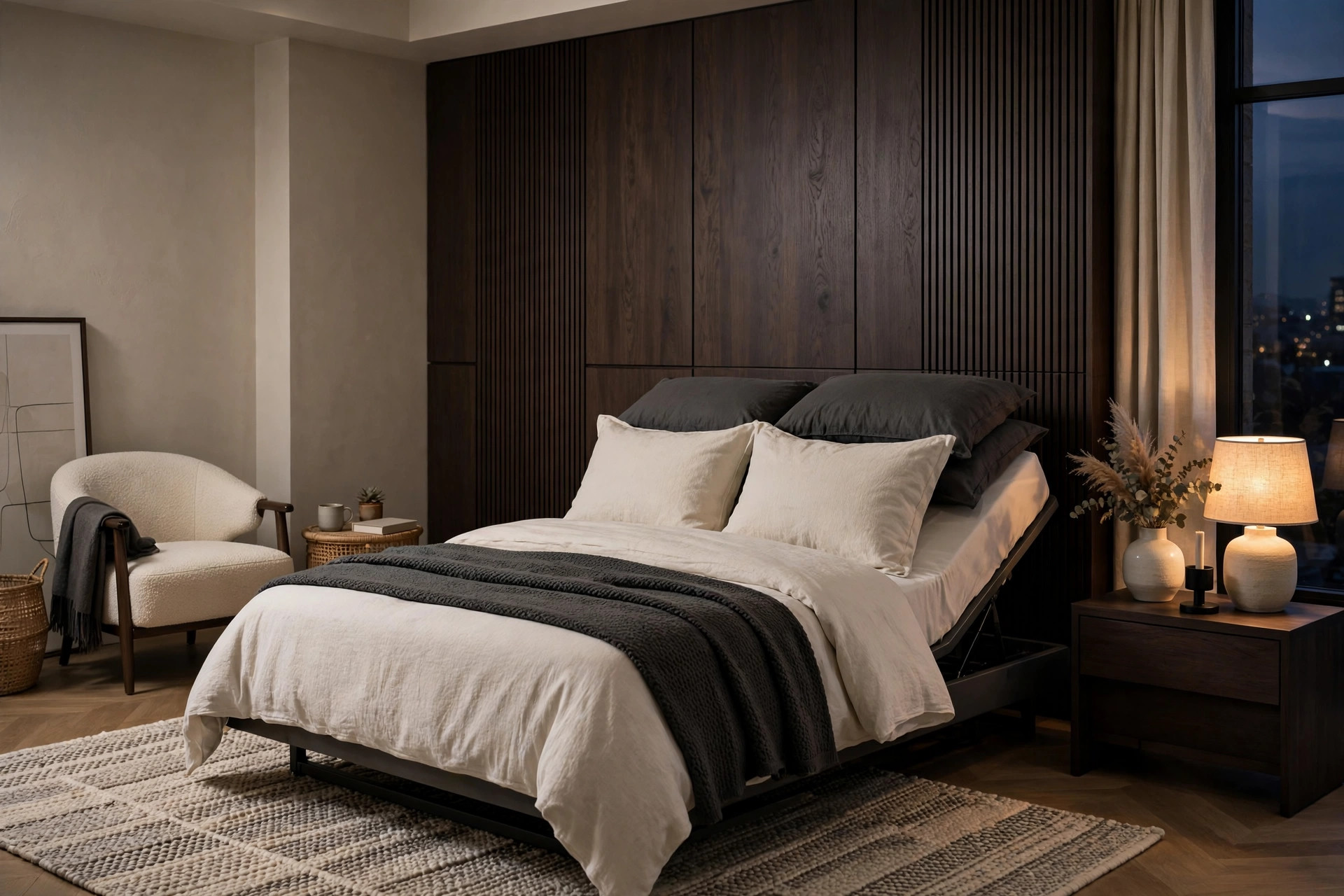
Note: the lifestyle image above is a scenario illustration, not a photograph of the KD004-A3. Actual product photos are available on request.
The headboard gap: the mechanism mistake that shows up after delivery
Here is a failure mode that rarely appears in a showroom and almost always appears in a customer's bedroom. The dealer demos a standard adjustable bed on the open floor. The customer buys it, places it against their headboard at home, raises the backrest — and a gap opens between their back and the headboard. Pillows slide into it. The reading position feels wrong. The customer calls the dealer, the dealer calls the distributor, and everyone discovers that the mechanism geometry was never matched to how the bed would actually be used.
This is a product-definition problem, not a quality problem. Different lifting geometries behave differently against a headboard, and choosing the wrong one for the target room layout creates exactly this kind of post-delivery complaint. KCAI's KD004-A3 addresses it with a slide-back mechanism: as the backrest rises, the back section shifts rearward, keeping the sleeper's torso position stable relative to the bed. This deep dive covers the confirmed specifications, how slide-back geometry works, how it compares with wall-hugger and fixed mechanisms, which room layouts it suits, and how B2B buyers can source it wholesale or as an OEM/ODM platform.
How the slide-back mechanism works
Every adjustable bed faces the same geometric problem: rotating a backrest upward around a fixed point moves the surface the sleeper lies on. On a basic fixed-hinge frame, raising the backrest pushes the sleeper's torso toward the foot end of the bed and opens a gap at the head end. The higher the recline, the worse it gets.
The slide-back mechanism solves this by adding a controlled rearward translation to the rotation. As the backrest rises from 0 to 60 degrees, the linkage slides the back section backward — toward the head end — by a calibrated amount. The two motions cancel out the drift: the sleeper's torso stays roughly where it was when the bed was flat, and the headboard gap stays small through the full range.
In practical terms:
- Torso position stays put. The user's shoulders and head remain aligned with their pillows instead of migrating toward the foot of the bed.
- The headboard gap stays minimal. Because the back section moves rearward as it rises, the space between sleeper and headboard does not open up the way it does on a fixed hinge.
- Recline feels natural. Without the sensation of being pushed downhill toward the foot end, the reclined position feels stable — important for reading, viewing, and extended rest.
- Pillows stay where they belong. Anyone who has fished a pillow out of a headboard gap knows why this matters to end users.
Buyers evaluating the sample should place a marker at the sleeper's shoulder position with the bed flat, raise the backrest to 60°, and check how far the marker has moved toward the foot end. On a genuine slide-back, the displacement is small; on a fixed hinge marketed with slide-back language, it is not.
The buyer's evaluation checklist for slide-back geometry
- Torso-drift test. Mark the shoulder position with the bed flat, raise the backrest to 60°, and measure displacement toward the foot end. A genuine slide-back keeps it small; a relabeled fixed hinge does not.
- Headboard-gap check. Place the sample against a wall or mock headboard and run the full range. The gap between the raised backrest and the wall should stay visibly smaller than on a fixed-hinge reference.
- Slide-track inspection. Look under the deck for the sliding hardware — guided tracks or sliding pivot blocks are expected on a real slide-back. Absence of sliding hardware with a slide-back label is a red flag.
- Motion smoothness. The combined rotation-and-slide is mechanically demanding. The motion should be continuous and quiet across the range; hesitation or noise at the slide points suggests tolerance or actuator-matching problems.
- Cycle-test documentation. KCAI's lifting systems pass 10,000+ cycle aging tests through CNAS, SGS, TUV, and UL recognized processes. For a slide-back, where the linkage works harder per cycle than a fixed hinge, ask for the test report behind the number.
- Motor behavior under load. OKIN and Haojiang actuators are specified for gentle rise and lower movement, low noise, and energy saving. Test at full recline with realistic weight to confirm the slide motion does not strain or slow.
For the actuator-level engineering picture, see the pillar guide: Adjustable Bed Actuator Engineering: A Buyer's Guide.
KD004-A3: full specifications
| Item | Specification |
|---|---|
| Model | KD004-A3 |
| Type | Slide-back adjustable bed frame |
| Dimensions | 2000 × 1800 / 2000 × 1500 / 2000 × 900 mm |
| Backrest adjustment | 0–60° |
| Leg rest adjustment | 0–40° |
| Mechanism | Slide-back linkage (back section shifts rearward as backrest rises) |
| Motors | OKIN and Haojiang (gentle rise/lower, low-noise, energy-saving) |
| Cycle testing | 10,000+ lifting aging tests passed |
| Frame materials | High-density foam, 15/18mm eco multi-layer board, high-strength honeycomb aluminum panel, quality steel |
| Fabric | Configurable options |
| Controls | Wired / wireless remote, app / mini-program, voice control, Siri (remote series SK.29.11 / SK.34.09 / SK.50.17 / SK.27.11 / SK.27.19 / SK.51.11 / SK.51.19 / SK.67.09) |
| Comfort features | Vibration massage, USB ports, LED light (configurable) |
| Sleep features | Sleep monitoring, anti-snore head incline, zero-gravity preset (configurable) |
| Smart home integration | Huawei, Xiaomi, Alibaba, Tuya, Amazon IoT (configurable) |
| Manufacturer | KCAI Intelligent Sleep, Dongguan, China |
| Factory | 25,000 sqm, in operation since 2004 |
| Testing & certification | CNAS / SGS / TUV / UL |
| Customer base | 100+ global customers |
For parameters not listed here — exact carton dimensions, container loading quantities, thrust ratings — request the official spec sheet rather than working from assumptions.
Slide-back vs wall-hugger vs fixed: the geometry decision
Buyers often treat these three mechanisms as interchangeable "premium features." They are not — they solve different geometric problems, and the right choice depends on the room layout and user habits:
| Fixed hinge | Wall-hugger (e.g. KD001-A7) | Slide-back (KD004-A3) | |
|---|---|---|---|
| What moves | Backrest rotates around one pivot | Sleeper shifts toward headboard | Back section slides rearward as it rises |
| Body drift | Toward foot end | Minimal — stays near nightstand | Minimal — torso position stable |
| Headboard gap | Opens with recline | Stays small | Stays small |
| Nightstand reach | Degrades with recline | Preserved | Largely preserved |
| Mechanism complexity | Lowest | Higher (rotation + shift linkage) | Higher (rotation + slide linkage) |
| Best for | Price-driven volume SKUs | Users who live at the nightstand | Headboard-against-wall layouts |
The decision logic for a buyer:
- Choose fixed (e.g. KCAI's KD001-A3) when the priority is dependable volume at an accessible price point and the end user mainly needs basic backrest and leg adjustment.
- Choose wall-hugger when the selling story centers on the nightstand — the customer who reads with glasses, phone, and water all within arm's reach. The wall-hugger keeps the sleeper close to the head end.
- Choose slide-back when the bed will sit against a headboard or wall and the priority is keeping torso position and pillow alignment stable through the recline range. The slide-back keeps the sleeper from migrating toward the foot end.
Many assortments carry two of the three: a fixed model for volume and either a wall-hugger or slide-back as the step-up story. The full head-to-head is covered in Wall-Hugger vs Slide-Back Mechanism Guide.
Room layouts and dealer assortments: where the KD004-A3 wins
The KD004-A3's slide-back geometry earns its place in specific, common scenarios:
- Headboard-against-wall bedrooms. The most common real-world layout. The slide-back keeps the headboard gap small, which is exactly the complaint that fixed-hinge frames generate in this layout.
- Upholstered bed frames and panel beds. When the adjustable base sits inside a decorative bed frame, torso migration looks and feels wrong. The slide-back keeps the sleeper centered in the frame's opening through the full range.
- Couples' double layouts. The 2000x1800mm size covers double bedrooms where two sleepers recline independently in habit if not in mechanism — stable torso position means neither partner ends up fighting for pillow space at the head end.
- Hospitality and rental projects. Guests do not read manuals. A mechanism that keeps body position intuitive through recline reduces confusion-driven service calls — a real cost line in hotel and serviced-apartment operations.
- Showroom pairing. Demo the KD004-A3 next to a fixed-hinge frame, both against a mock headboard wall. Raise both backrests and let the customer see the gap difference. Like the wall-hugger's nightstand demo, it is a thirty-second sale.
With three sizes — 2000x1800, 2000x1500, and 2000x900mm — dealers can carry the slide-back story across single, queen, and double floor positions on one platform, simplifying spare-parts stocking and staff training.
Users who recline for reading, viewing, or rest will notice the stable torso position immediately. The anti-snore head incline may help users who snore rest more comfortably — this is lifestyle ergonomics support, not a medical treatment, and anyone with a serious condition should consult a physician.
Inside the frame: materials, motors, and manufacturing depth
The KD004-A3 uses KCAI's confirmed material platform: high-density foam, 15mm or 18mm eco multi-layer board, high-strength honeycomb aluminum panel, and quality steel, with fabrics as configurable options. The steel frame carries the slide-back linkage, where the sliding hardware demands precise tolerances — play in the tracks translates directly into uneven motion that customers feel.
The motor platform pairs OKIN and Haojiang actuators specified for gentle rise and lower movement, low noise, and energy saving. On a slide-back, the actuators manage rotation and rearward translation simultaneously, so matched, quality actuators matter more here than on a simple frame. KCAI's 10,000+ cycle aging tests validate the lifting system over repeated full-range actuations; request the test documentation during qualification.
Control options include wired and wireless remotes across the SK series, app and mini-program control, voice control, and Siri integration. Depending on configuration: vibration massage, USB ports, LED lighting, sleep monitoring, anti-snore head incline, and zero-gravity presets, plus smart home integration with Huawei, Xiaomi, Alibaba, Tuya, and Amazon IoT. These are configurable options — confirm the exact configuration on your spec sheet.
Sourcing the KD004-A3: wholesale or OEM/ODM
KCAI Intelligent Sleep — 25,000 sqm in Dongguan, operating since 2004, 100+ customers worldwide — offers the KD004-A3 through two paths:
Wholesale of the existing model. Buy the proven slide-back platform as-is in 2000x1800, 2000x1500, or 2000x900mm. Fastest route to a differentiated SKU with documented cycle testing behind it — and a mechanism story that demos itself against a headboard.
OEM/ODM customization. Build on the KD004-A3 platform with your own fabrics, finishes, control configurations, feature sets, and branding through KCAI's OEM/ODM program. Factory-direct development — KCAI manufactures what it designs — for brand owners and large retailers building proprietary lines.
Lead magnets such as the RFQ template, carton CBM calculation sheet, factory audit checklist, and CAD drawings are available on a contact-to-request basis: contact us to request the current versions. Nothing is promised as an instant download.
Next step: request a quote with your target sizes, configuration, quantities, and destination market, and KCAI's team will respond with the official spec sheet and commercial terms.
Frequently Asked Questions
What is a slide-back mechanism on an adjustable bed? A slide-back mechanism shifts the back section rearward as the backrest rises, so the sleeper's torso keeps its position relative to the bed rather than being pushed toward the foot end. It reduces the gap that opens between the sleeper and the headboard during recline.
What are the confirmed specifications of the KD004-A3? The KD004-A3 is a slide-back adjustable bed available in 2000x1800mm, 2000x1500mm, and 2000x900mm. Backrest adjustment is 0-60° and leg rest adjustment is 0-40°. It uses OKIN and Haojiang motors, and the lifting system has passed 10,000+ cycle aging tests.
How does slide-back differ from wall-hugger and fixed mechanisms? A fixed hinge rotates the backrest around one pivot and lets the body drift toward the foot end. A wall-hugger shifts the sleeper toward the headboard to preserve nightstand reach. A slide-back shifts the back section rearward as it rises, keeping torso position stable. Each geometry suits different room layouts and user habits.
Which room layouts suit the KD004-A3 best? The slide-back geometry works well where the bed sits against a headboard or wall and the buyer wants minimal gap opening at the head end during recline. With three sizes from 2000x900 to 2000x1800mm, it fits single, queen, and double bedroom layouts, plus hospitality and rental projects.
Can I source the KD004-A3 as OEM/ODM or wholesale? Both. KCAI offers the KD004-A3 as a wholesale purchase of the proven existing model, and as an OEM/ODM platform with configurable fabrics, finishes, control options, and branding. Contact us to request the official spec sheet and discuss which path fits your project.