Wall-hugger vs slide-back vs fixed: a wall-hugger slides the backrest toward the headboard as it rises, keeping the sleeper within arm's reach of the nightstand; a slide-back keeps the head section close to the wall without sliding, trimming the gap while avoiding headboard contact; a fixed mechanism pivots in place, so the sleeper drifts away and the gap widens. The choice is about bedroom UX and product positioning. This guide compares the three mechanisms, uses verified examples from KCAI Intelligent Sleep — KD001-A7 (wall-hugger type) and KD004-A3 (slide-back) — and helps you match a mechanism to your market.
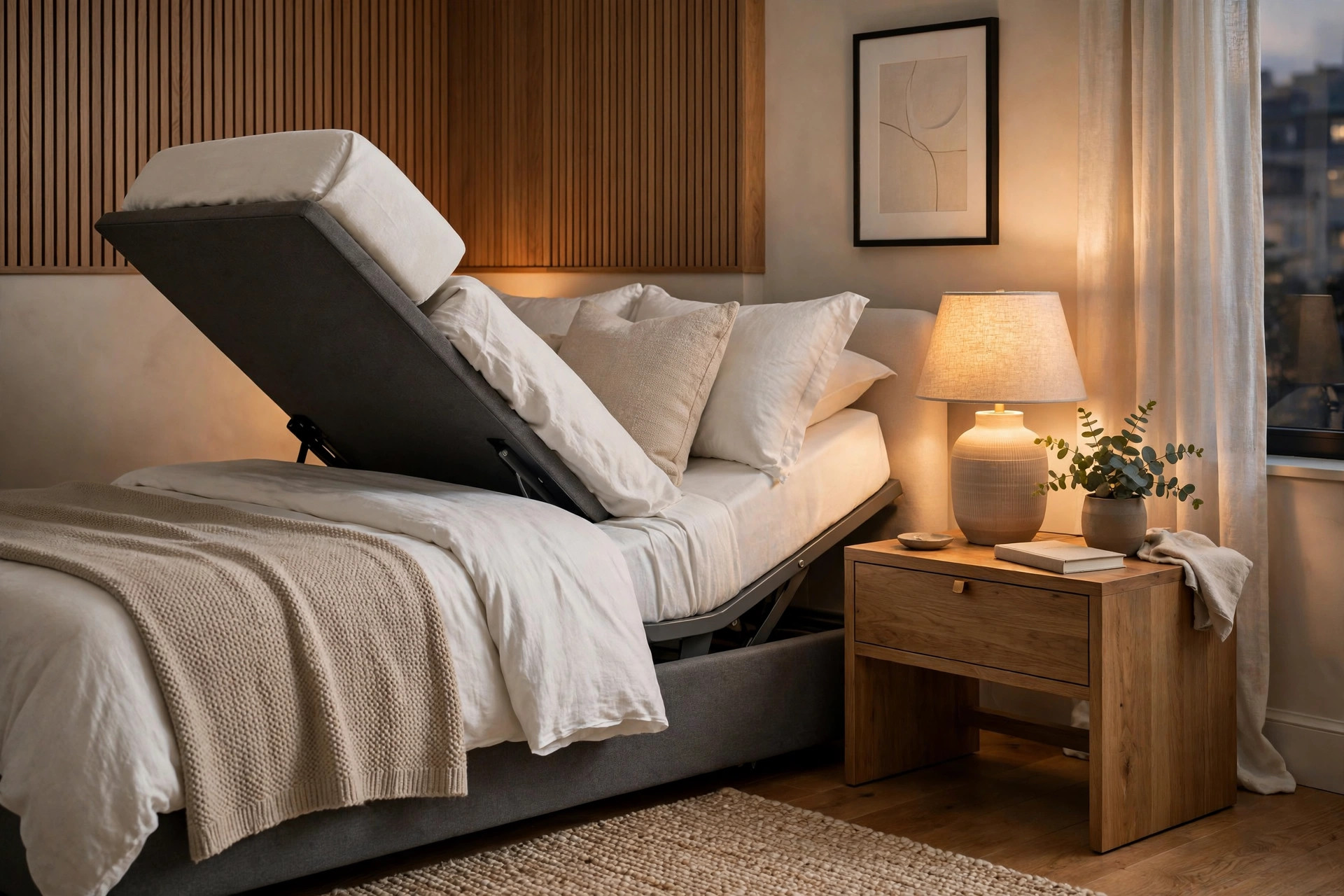
Cover image: an AI-generated scene illustration, not a photograph of a KCAI product.
The Short Answer: How the Three Mechanisms Differ
All three mechanisms raise the backrest and leg rest of an adjustable bed base — in KCAI's adjustable bed frames, the verified motion envelope is backrest 0–60° and leg rest 0–40° — but they move the sleeper along different paths:
- Wall-hugger translates the backrest platform toward the headboard during lift. The sleeper's head stays near the wall, so the phone, lamp, or glass of water on the nightstand stays within reach.
- Slide-back keeps the head section close to the wall without forward sliding, reducing the gap without pushing the frame into the headboard.
- Fixed pivots the backrest on a stationary axis. Simple and robust, but the pivot geometry moves the sleeper's head away from the wall as the angle increases, widening the nightstand gap.
For importers, distributors, and brand owners, the mechanism is a positioning decision: it shapes the unboxing and daily-use experience of your end customer, the linkage complexity on the factory floor, and the story your marketing can tell.
How a Wall-Hugger Mechanism Moves
A wall-hugger linkage combines a pivoting joint with a translation stage. When the motor drives the backrest upward, the whole backrest section also glides toward the headboard along guide rails or a parallelogram linkage. The net effect: the sleeper's head and shoulders remain close to the wall through the full 0–60° travel instead of arcing away from it.
This is the mechanism behind KCAI's KD001-A7, a wall-hugger-type frame with a surround frame design, verified in size options of 2000 × 1800 / 1500 / 900 mm. The surround frame gives the base a complete, furniture-like perimeter — a detail buyers targeting premium bedroom retail often request — while the wall-hugger linkage delivers the signature benefit: nightstand access at any recline angle.
The trade-offs buyers should weigh are engineering ones: the translation linkage adds moving parts versus a fixed hinge, so assembly and inspection take more care, and the mechanism's travel envelope is defined by configuration. If you need a different translation profile, frame height, or upholstery, that is handled at the OEM/ODM stage rather than guessed at in marketing copy.
How a Slide-Back Mechanism Moves
The slide-back approach solves the same nightstand problem from a different direction. Instead of translating the platform toward the wall, the linkage geometry is designed so the head section stays close to the wall throughout the lift — the backrest rises without pushing the frame backward into the headboard.
KCAI's KD004-A3 is a verified slide-back example, available in 2000 × 1800 / 1500 / 900 mm size options. It suits installations where the bed sits against a headboard or wall-mounted panel: because the mechanism does not slide the platform toward the headboard, there is no risk of the frame pressing into it during adjustment.
In practice, slide-back is the middle ground. It keeps the nightstand gap tighter than a fixed mechanism while using a linkage layout that some buyers find simpler to explain and service than a full wall-hugger translation stage. As with every KCAI frame, the core motion envelope — backrest 0–60°, leg rest 0–40° — is the same; what differs is the path the sleeper travels to get there.
How a Fixed Mechanism Moves
A fixed mechanism is the baseline: the backrest pivots on a stationary hinge axis, and nothing translates. The geometry is the simplest of the three, which means fewer moving parts, the most straightforward assembly and inspection, and the most compact flat-pack shipping envelope — real advantages for value-positioned lines and high-volume container loads.
The cost of that simplicity is bedroom UX. Because the pivot is fixed, the sleeper's head arcs away from the wall as the backrest rises: at a full 60° backrest angle, the distance between the sleeper's head and the nightstand is at its widest. End users who read or watch content in bed will notice it; end users who mostly use the bed flat may never care.
Fixed mechanisms remain a legitimate line choice when packaging efficiency and SKU simplicity matter more than in-bed reach. The key is positioning the product honestly — which is exactly what the comparison table below is for.
Side-by-Side Comparison: Movement Path, Nightstand Gap, Buyer Fit
| Mechanism | Movement path | Nightstand-gap behavior | Best-fit buyer | Example models |
|---|---|---|---|---|
| Wall-hugger | Backrest pivots and translates toward the headboard during lift | Gap stays smallest; nightstand stays within reach through full travel | Premium brands and bedroom retailers where in-bed UX is the selling point | KD001-A7 (wall-hugger type, surround frame; 2000 × 1800/1500/900 mm) |
| Slide-back | Head section stays close to the wall without forward sliding | Gap stays moderate; no frame-to-headboard contact | Buyers with headboard-mounted installations or tight wall clearances | KD004-A3 (slide-back; 2000 × 1800/1500/900 mm) |
| Fixed | Backrest pivots on a stationary axis; no translation | Gap widens as backrest rises; largest at full recline | Value-positioned lines prioritizing simple assembly and compact packaging | Available as configurable options / depending on configuration |
All three mechanisms share the same verified performance baseline in KCAI frames: backrest 0–60°, leg rest 0–40°, and lifting systems that pass 10,000+ cycle aging tests.
Factory Solution: How KCAI Engineers These Mechanisms
A mechanism is only as good as its drive system, structure, and testing. Here is how KCAI Intelligent Sleep — Dongguan Kangcai Intelligent Sleep Technology Co., Ltd., manufacturing adjustable beds since 2004 from a 25,000 sqm facility with 100+ staff serving 100+ global customers — engineers the mechanisms above, using only verified facts:
- Proven drive systems. Frames are powered by German OKIN and Haojiang motors, selected for strong power output, soft start/stop motion, low operating noise, and energy-saving operation. Smooth, quiet motion matters more in a wall-hugger or slide-back linkage than in a fixed hinge, because the translation stage amplifies any judder.
- Verified structural materials. Frame construction uses eco multi-layer board (15/18 mm), high-strength honeycomb aluminum panels, and quality steel, with optional fabrics and high-density foam for upholstered variants. The honeycomb aluminum panel keeps the moving sections rigid without excess weight — important when a wall-hugger platform must glide smoothly under load.
- Cycle-tested lifting systems. Every mechanism's lifting system passes 10,000+ cycle aging tests, so the linkage motion you specify in the catalog is the motion the end customer gets after years of daily adjustment.
- Lab-tested, honestly stated. Products are tested under lab protocols associated with CNAS/SGS/TUV/UL. KCAI makes no claim to hold specific certificates — the claim is testing, not certification.
- Patented mechanical design. The factory holds multiple invention and utility model patents covering its mechanical designs, reflecting ~30 years of furniture R&D behind the linkage geometry.
For the engineering detail behind the motors, actuators, and load paths in these mechanisms, see our adjustable bed actuator engineering buyer's guide.
One note on comfort language: an adjustable base may help users find a more comfortable resting or reading posture, depending on configuration. It is not a medical treatment substitute, and users with serious conditions should consult a doctor.
Frequently Asked Questions
What is a wall-hugger adjustable bed mechanism?
A wall-hugger mechanism slides the backrest section toward the headboard as it rises, so the sleeper stays close to the wall and the nightstand remains within arm's reach. KCAI's KD001-A7 is a verified wall-hugger-type frame with a surround frame design, available in 2000 × 1800/1500/900 mm sizes.
How is a slide-back mechanism different from a wall-hugger?
A slide-back mechanism keeps the head section close to the wall without sliding forward, trimming the nightstand gap while avoiding contact with the headboard. A wall-hugger actively translates the platform toward the wall during lift. KCAI's KD004-A3 is a verified slide-back example, also available in 2000 × 1800/1500/900 mm.
What is a fixed adjustable bed mechanism?
A fixed mechanism pivots the backrest in place on a fixed hinge axis, with no lateral translation. It is the simplest construction and packs the most compactly, but the sleeper drifts away from the wall as the backrest rises, so the nightstand gap widens the most.
Which mechanism is best for B2B product-line planning?
Wall-hugger suits premium positioning where nightstand access matters, slide-back suits headboard-mounted installations that need wall clearance, and fixed suits price-sensitive or compact-packaging lines. All three share KCAI's core performance envelope: backrest 0–60°, leg rest 0–40°, and lifting systems passing 10,000+ cycle aging tests.
Can KCAI customize the mechanism, sizes, or appearance for my brand?
Yes. KCAI supports OEM/ODM development — mechanism layout, frame structure, fabrics, and configurable sizes can be adapted to your brand. For faster launches, existing models such as KD001-A7 and KD004-A3 are available for wholesale purchase. Contact the factory through the OEM/ODM service page or the electric adjustable bed base lineup below.
Talk to the Factory: OEM Development or Wholesale Purchase
Ready to add a wall-hugger, slide-back, or fixed mechanism to your lineup? KCAI offers two cooperation paths:
- OEM/ODM custom development — adapt the mechanism layout, frame structure, sizes, and upholstery to your brand and market. Start at our OEM/ODM service page.
- Wholesale purchase of existing models — source verified frames like KD001-A7 (wall-hugger type) or KD004-A3 (slide-back) directly. Browse the electric adjustable bed base lineup and send your RFQ.
Tell us your target market, order volume, and configuration needs, and our engineering team will respond with a manufacturable proposal.