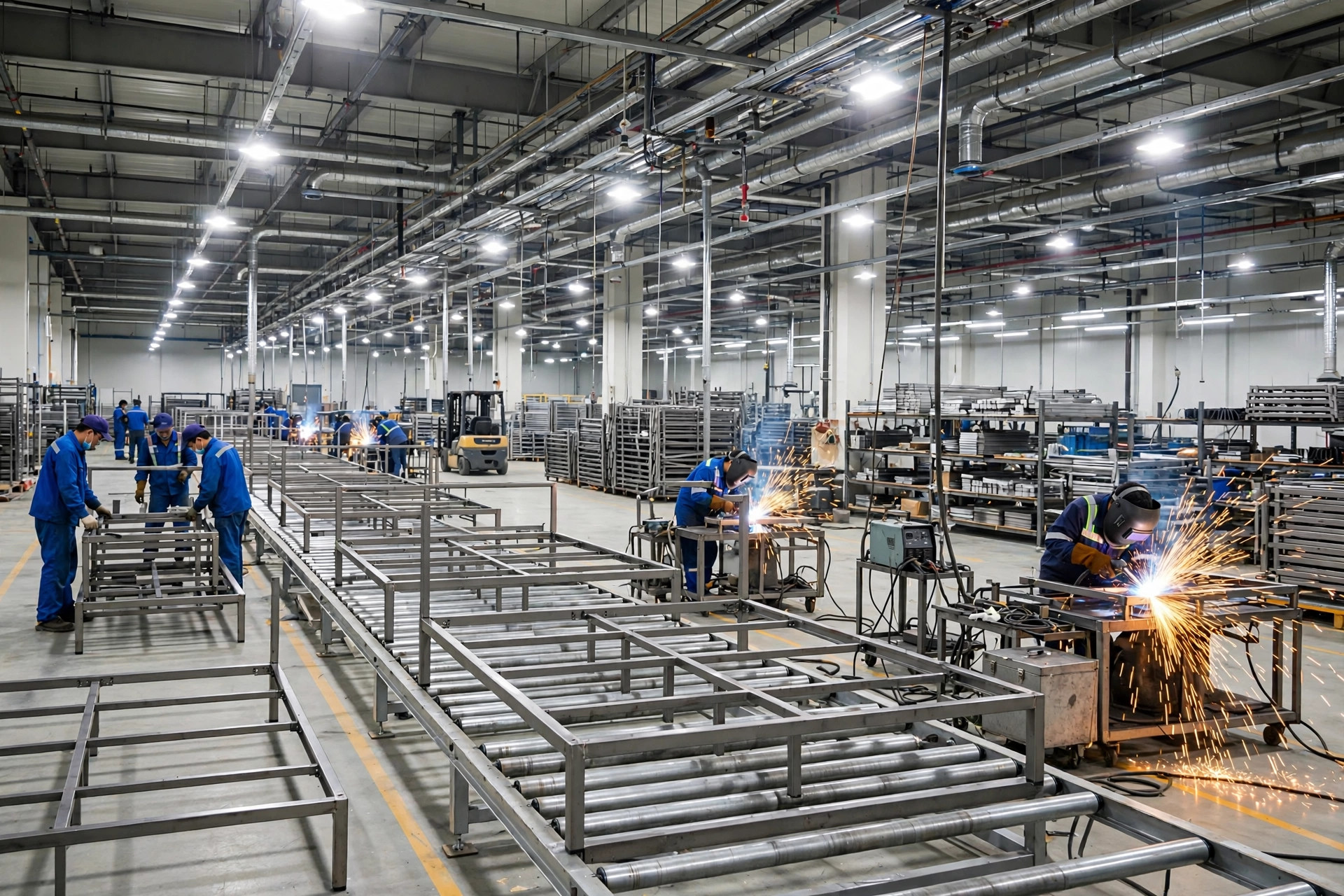
The fastest way to source adjustable beds from China is to work directly with a vertically integrated factory: one that builds frames, assembles motors, and runs its own testing laboratory under one roof. Verify it with a live video audit covering four zones — production lines, the testing lab, QC records, and the warehouse. Genuine factories hold multiple invention and utility model patents, run lift-system aging tests beyond 10,000 cycles, and have products tested in CNAS, SGS, TUV or UL laboratories. Then match your route to your volume: wholesale proven existing models for speed and low risk, or OEM/ODM custom manufacturing when your design and projected volume justify the tooling investment.
The Short Answer: What a Genuine Factory Looks Like
A real adjustable bed factory does three things a trader cannot: it engineers, it manufactures, and it tests. Look for in-house engineering with CAD capability, a metal workshop and assembly lines on the same campus, and a testing laboratory with aging-test rigs and calibration certificates. KCAI, based in Dongguan's Qisha Industrial Park since 2004, operates on this model: a 25,000 sqm facility, 100+ staff, nearly 30 years of furniture R&D and production experience, and more than 100 global customers. Its adjustable bed frames offer backrest adjustment from 0–60° and leg adjustment from 0–40°, powered by German OKIN and Haojiang motors known for smooth, low-noise, energy-saving operation. Lift systems undergo 10,000+ aging tests, and the KD001-B2 mattress has passed 15,000+ aging cycles. Products are CNAS, SGS, TUV and UL lab-tested, and the company holds multiple invention and utility model patents. If a supplier cannot show you these capabilities on a live video call, treat it as a trader regardless of what its website claims.
Why Your Source Decision Matters
Adjustable beds are mechatronic products — steel frames, motors, controllers, and wiring must work together for years under load. When something fails, the supplier who designed and assembled the product can diagnose and fix it; a trader can only forward your complaint up the chain. That difference determines warranty costs, return rates, and your brand's reputation.
Three routes exist, each with trade-offs:
- Direct factory (OEM/ODM): Engineering support, customization, and factory-direct QC. Requires enough volume to justify engineering time and, for fully custom designs, tooling investment. Best for brands building a differentiated line.
- Wholesale of existing models: Proven models such as the KD010-A2 split AI bed frame or the multifunctional KD008-A1, often with your branding. Lower risk and faster to market, but less differentiation.
- Trading company or agent: Convenience, consolidated shipments, and language support — at a margin, and without direct access to engineering or QC data. Fine for small mixed orders; risky as a core supply.
A mid-program supplier switch means re-testing, re-certification, and potentially stranded inventory. Decide on evidence, not brochures.
How to Audit a Factory on Video: The 4-Zone Checklist
A live video audit, guided by you in real time, reveals what polished photos cannot. Ask for these four zones in one continuous call.
Zone 1: Production lines
Ask the guide to walk the actual lines, not just the showroom: metal workshop (cutting, welding, forming), assembly lines with frames at different stages, and motor installation stations. A factory with 100+ staff shows a busy floor; a trader shows an office with samples.
Zone 2: The testing laboratory
This is where real factories separate from traders. Ask to see aging-test rigs running lift systems through repeated cycles — KCAI tests its lift systems beyond 10,000 cycles and its KD001-B2 mattress past 15,000 cycles. Ask for the test standards, pass criteria, and calibration certificates, and request a close-up of a recent dated test report.
Zone 3: QC records
Ask the QC manager — not the salesperson — to walk you through one recent production lot's records: incoming material inspection, in-process checkpoints, and final QC before packing. Ask how defects are recorded and what corrective action follows. Red flag: "our partner factory handles quality" — that sentence means you are talking to a middleman.
Zone 4: The warehouse
End with the warehouse and loading area: finished-goods storage, export packaging standards, and whether the models you care about are actually stocked.
Red Flags and Factory-vs-Trader Signals
| Signal | Real factory | Trading company |
|---|---|---|
| Production site | Shows metal workshop, assembly lines, live workers | Shows showroom samples, avoids the "factory floor" |
| Testing lab | Aging-test rigs running, calibration certificates | No lab; talks about "partner factory's lab" |
| QC documentation | Lot-level inspection records, corrective actions | Verbal assurances, no records shown |
| Engineering | In-house CAD, prototyping, patents held | "We can ask the factory" for technical questions |
| Motor integration | Assembles and tests OKIN/Haojiang motors on site | Sources complete units, cannot explain motor specs |
| Certifications | Products tested in CNAS/SGS/TUV/UL labs, reports on file | Claims certificates that belong to someone else |
| Customization | OEM/ODM with configurable dimensions, materials, functions | Only logo printing on stock models |
| Patents | Multiple invention and utility model patents | No patents, or vague "patent pending" claims |
Beyond the table, watch for these disqualifiers: a supplier that refuses or delays a live video audit; one whose team cannot answer technical questions directly (ask how the 0–60° backrest and 0–40° leg ranges are calibrated, or what happens at cycle 10,001 of an aging test); certificates issued in another company's name; same-day quotes for "fully custom" designs — real OEM work requires engineering review, CAD, and prototyping, so instant custom quotes mean someone is copying an existing mold; and a business license address that does not match the location shown on video.
The OEM/ODM Process: From CAD Drawing to Mass Production
Here is how a disciplined program runs, phase by phase.
1. Technical review
Share target specs — dimensions, materials, functions, target market. Engineers review feasibility: can the backrest reach 0–60° within your height constraint? Are OKIN or Haojiang motors compatible with your control requirements (remote, app, voice, smart-home integration with Huawei, Xiaomi, Alibaba, Tuya, or Amazon IoT)? A serious factory answers with engineering questions, not just a price. Clarify what is configurable versus what requires new development — only parameters confirmed against factory documentation belong in your spec.
2. Engineering and CAD development
For OEM projects, the factory produces CAD drawings and engineering specifications for your approval. For ODM projects, you start from an existing platform — for example the split-design KD010-A2, the five-zone KD005-A1, the multifunctional KD008-A1, the wall-hugger-style KD001-A7, or the framed split KD011-A3 — and define your modifications: upholstery fabric, foam density, slat materials (eco-friendly 15/18mm multilayer board, high-strength honeycomb aluminum panels, quality steel), remote control models, and optional features such as vibration massage, USB ports, LED lighting, sleep monitoring, or smart anti-snore modes. See our OEM/ODM services for the full customization scope.
3. Prototyping and the golden sample
The factory builds prototype units for your evaluation. Test them the way your customers will: full adjustment ranges, remote and app control, noise levels, and stability under load. The approved prototype becomes the "golden sample" — the reference standard every production lot is judged against. Keep one unit yourself and document its measurements.
4. Pre-production and testing
Pre-production units go through the testing laboratory: aging cycles on lift systems, electrical safety checks, and function tests on every specified feature. This is when lab testing to CNAS, SGS, TUV or UL standards is arranged for your market. Learn more about our manufacturing capabilities.
5. Mass production and shipment
Production runs with incoming inspection, in-process checkpoints, and final QC against the golden sample. Get the QC plan in writing and the right to third-party inspection. Confirm export packaging, spare-parts support (motors, SK-series remotes, power supplies), and how warranty claims are handled.
Ask for a project-specific schedule with milestones per phase. Avoid suppliers promising fixed timelines before seeing your specifications — credible schedules depend on design complexity, testing, and volume.
MOQ vs Tooling Cost: The Trade-Off Startups Must Get Right
The most common mistake new brands make is treating tooling as a one-time fee and MOQ as the only real cost. Think of it as a single equation: the true cost of customization is the tooling and development investment amortized over your realistic first-year volume, plus the MOQ you must fund and store.
When wholesale of existing models wins. If your projected volume is modest, buying proven models is the rational choice. The KD010-A2 split AI bed frame, KD008-A1 multifunctional frame, and KD011-A3 framed split model are production-ready with tested lift systems, established QC records, and configurable fabrics, materials, and remote options. You skip tooling investment, reach market faster, and learn what your customers actually buy before committing to custom development.
When custom tooling is justified. Custom tooling makes sense when your design is meaningfully different and your projected volume amortizes the investment to a negligible per-unit cost: divide total tooling and development cost by your realistic (not optimistic) first-year units. If the per-unit adder destroys your margin, wait.
Questions to ask: Who owns the tooling and design IP — get it in writing. What is configurable without new tooling versus what requires it? Can the factory show aging-test and QC records for the wholesale model? What spare-parts support exists for motors and controllers? A factory with genuine engineering depth gives honest answers — including telling you when wholesale is the smarter choice for your stage. That honesty is itself a vetting signal.
Certifications and Testing: What Documentation Actually Proves
Paperwork only matters if it describes your product, from your supplier, tested in an accredited lab. KCAI's products are tested in CNAS, SGS, TUV and UL laboratories — ask for the actual test reports and check that the product model, factory name, and test date match what you are buying; see our certifications overview. For durability, ask for the test records behind the headline numbers: lift systems tested beyond 10,000 aging cycles, and the KD001-B2 mattress past 15,000 cycles with 3D breathable materials. A dated report with pass criteria is evidence; a brochure claim is marketing. Patents matter too — multiple invention and utility model patents indicate real engineering capability and reduce your IP exposure in your home market. Finally, verify business facts against the license and export history: founded 2004, 25,000 sqm, 100+ staff, 100+ global customers, nearly 30 years of furniture R&D and production experience, and named brand partnerships such as MANWAH, DeRUCCI, Sweet Night, TOHO, AIRLAND, and MENDALE.
One caution on health-related features: modes such as zero gravity, vibration massage, and smart anti-snore may support comfort-oriented sleep routines, but they are not medical treatments and cannot cure, treat, or eliminate medical conditions. Advise customers with sleep disorders to consult a physician.
Frequently Asked Questions
How can I verify a real adjustable bed factory in China without traveling there?
Request a live video audit of four zones: production lines, the testing lab, QC records, and the warehouse. Ask to see motor assembly, lift-system aging tests, and calibration certificates in real time — a genuine factory shows these without hesitation.
What is the difference between OEM and ODM for adjustable beds?
OEM means the factory builds to your design and specifications. ODM means you adapt existing platforms — such as the KD008-A1 multifunctional frame or KD011-A3 framed split model — with your branding and selected modifications. ODM reaches production faster with lower risk; OEM gives you a fully differentiated product.
Should a startup choose custom tooling or wholesale existing models?
If your projected volume cannot comfortably amortize custom tooling, wholesale proven models like the KD010-A2 or KD008-A1: no tooling investment, faster market entry, tested quality from day one. Choose custom tooling when your design is meaningfully different and realistic first-year volume brings the per-unit cost down to a negligible level.
What testing should I ask an adjustable bed factory about?
Ask for lift-system aging test records — KCAI tests lift systems beyond 10,000 cycles and the KD001-B2 mattress past 15,000 cycles — plus CNAS, SGS, TUV or UL lab reports on the specific models you plan to buy. Check that factory name and model numbers match your supplier and order.
Do I need patents to work with an adjustable bed factory in China?
No, but check that the factory holds its own — multiple invention and utility model patents signal genuine engineering rather than copy-and-paste trading. Confirm in writing who owns any tooling and design IP created for your project.
Two Ways to Work With KCAI
Path 1 — OEM/ODM custom manufacturing. Bring your design, or adapt one of our proven platforms, and our team takes it from CAD drawing to golden sample to mass production — in-house motor assembly, 10,000+ cycle lift-system testing, CNAS/SGS/TUV/UL lab verification. Explore our OEM/ODM services, then request a quote.
Path 2 — Wholesale proven models. Skip tooling and development: source production-ready models like the KD010-A2 split AI frame, the KD008-A1, or the KD011-A3 with your branding and choice of fabrics, materials, and remotes. Request a quote for wholesale pricing — the fastest route from decision to container.