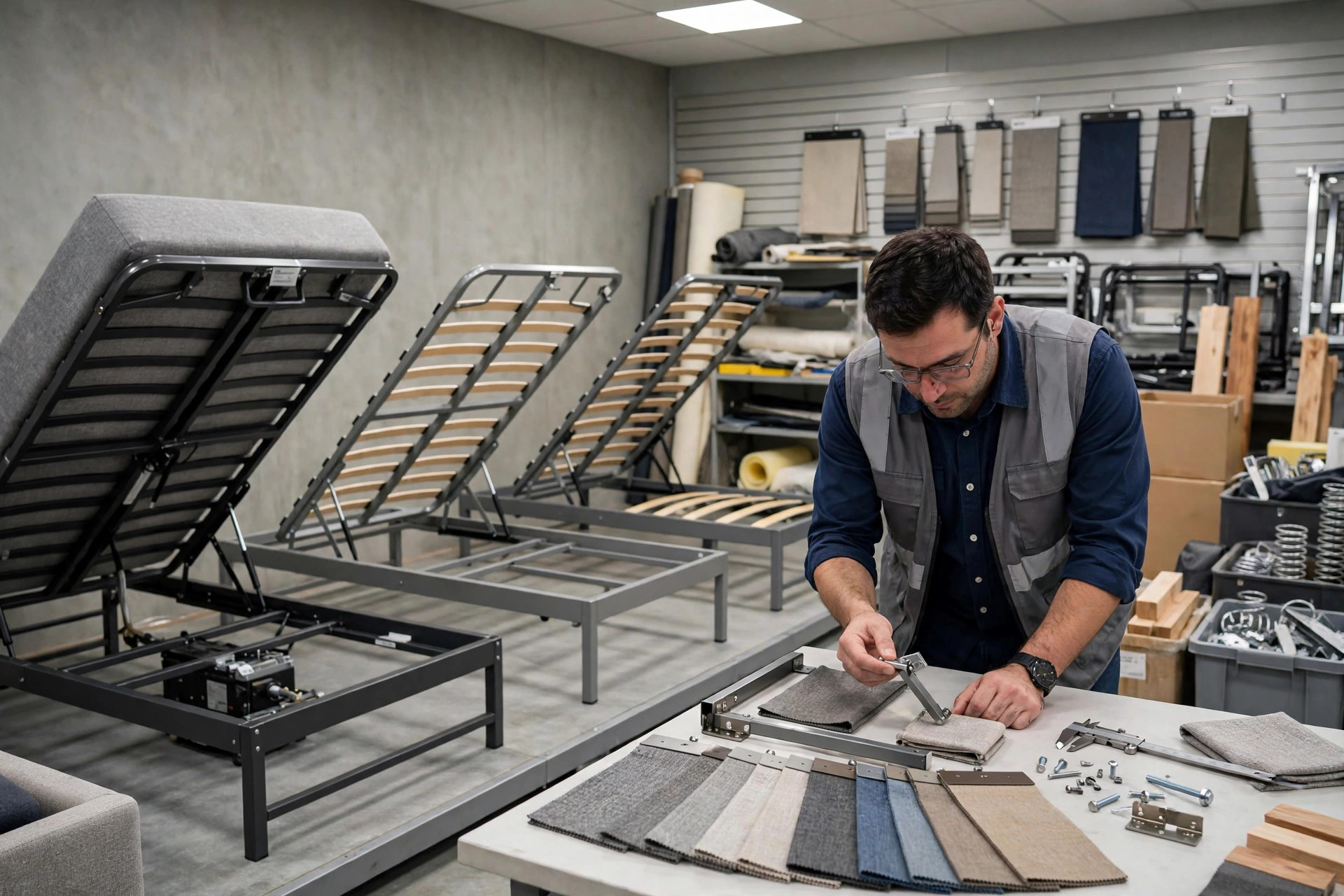
Cover image: an AI-generated illustration of a golden reference sample in a factory sample room (shown for reference, not an actual product photo).
The golden sample is the most important quality document in furniture OEM — except it is not a document, it is a physical object. The direct answer: a golden sample is the mutually approved reference unit that locks in materials, dimensions, finishes, and functions before mass production, and every shipped unit is judged against it. It de-risks OEM production by converting subjective expectations into an inspectable, measurable object that both sides have signed. Buyers who treat the golden sample as a formality discover its value in the worst way — when a container arrives with substituted materials or unapproved finishes and there is no agreed reference to reject it against. This guide explains what the golden sample locks, how to inspect one like an engineer, and how change control protects both sides afterward. For the wider supplier-evaluation context, see our complete guide to sourcing adjustable beds from a China factory.
The Direct Answer: What a Golden Sample Does
Most OEM disputes are not about malice; they are about ambiguity. "High-quality fabric," "smooth mechanism," "sturdy frame" mean different things to a buyer in one market and a factory in another. The golden sample eliminates that ambiguity: it is the one physical unit both sides have inspected, measured, operated, and signed. From approval onward, quality has a definition — the sample. Factory QC compares production units against it, third-party inspectors compare shipments against it, and any dispute is settled by placing the contested unit next to the sample. Everything else in OEM quality management — AQL inspection, incoming material checks, lab testing — orbits this single reference point.
Prototype vs Golden Sample: Why the Distinction Matters
Buyers sometimes use the two terms interchangeably, which creates exactly the risk the golden sample exists to prevent. A prototype is an exploration tool: built to verify that a design works, and freely revised. Nobody signs a prototype as final because revision is its purpose. A golden sample is a commitment tool: built after the design is frozen, inspected exhaustively, and then signed by both sides as the production reference. The practical difference:
| Aspect | Prototype | Golden sample |
|---|---|---|
| Purpose | Verify the design works | Freeze the production reference |
| Revisions | Expected and free | Formal engineering change only |
| Inspection depth | Functional check | Exhaustive: dimensions, materials, finishes, functions |
| Legal weight | None | Signed acceptance standard |
| Copies | Usually one | Buyer counter-sample plus factory master |
If your factory cannot articulate this distinction, its change-control process is informal — and informal change control is where silent specification drift begins.
What the Golden Sample Locks: Seven Elements
A proper golden sample approval form lists exactly what was approved. Use this table as the minimum lock-down scope for an adjustable bed program, comparing confirmed reference parameters against the low-tier market hazards the sample process is designed to prevent:
| Element | Confirmed reference (example: KCAI program) | Low-tier market hazard it prevents |
|---|---|---|
| Adjustment geometry | Head 0–60°, foot 0–40° on bed frames; head 0–55°, foot 0–35° on bed mattresses | Shortened travel or uneven angles between shipments |
| Dimensions | Frame footprint 2000×900mm, with Twin/Full/Double/Queen/King configurable | Dimensional drift that breaks bedding compatibility |
| Structural materials | High-density foam, 15/18mm eco multi-layer board, high-strength honeycomb aluminum panel, quality steel | Substituted thinner boards or weaker steel in mass production |
| Drive system | OKIN or Haojiang motors with soft start/stop, low-noise, energy-saving behavior | Silent motor-brand substitution between sample and shipment |
| Durability validation | Lifting system evaluated through 10,000+ aging cycles (15,000+ on KD001-B2) | Mechanisms that pass a demo but fail within a selling season |
| Control & functions | Documented remote model code (e.g., SK.29.11, SK.34.09), vibration massage, USB, LED per agreed spec | Feature drift: functions present on the sample, missing in production |
| Packaging | Agreed carton configuration and labeling | Export cartons that fail in real handling |
Any parameter not confirmed in the factory's documentation should be listed on the approval form as "request the official spec sheet" rather than left blank — a blank field is an unwritten permission to improvise. Parameters such as exact carton outer dimensions and per-container quantities belong in this category until the factory confirms them in writing.
Buyer-Side Inspection: How to Sign Off Like an Engineer
The golden sample only protects you if your inspection was thorough. Treat the sample review as a technical acceptance test, not a showroom visit:
- Operate every function repeatedly. Run the head and foot lift through the full confirmed range multiple times. Feel for smoothness, listen for abnormal noise, and confirm the mechanism holds position under load without creep.
- Measure, don't eyeball. Verify the frame footprint, section lengths, and travel angles against the specification with actual instruments. Confirm the 2000×900mm footprint and the 0–60°/0–40° ranges match what was agreed.
- Examine structure and finish. Inspect welds and fasteners, check coating uniformity, and compare upholstery fit and finishes under proper lighting — color and texture drift are common silent changes.
- Verify the control chain. Confirm the remote model code on the handset matches the specification, test pairing, and check the motor brand on the control box label against the agreed drive system.
- Document everything. Photograph the sample from fixed angles, record measurements, and note every approved detail on the sign-off form: model name, revision, materials, finishes, functions, motor brand, remote code.
- Keep a counter-sample. Retain one signed sample at your office and leave the master at the factory. Both sides then compare production against the same physical standard — this single practice resolves most "that's not what we approved" disputes before they start.
Rushed approval is the most expensive shortcut in OEM. A week of thorough inspection costs nothing next to a container of unrejectable goods.
How the Golden Sample Protects Both Sides
Buyers see the golden sample as their shield, but disciplined factories value it equally. For the buyer, it creates an objective acceptance standard: inspections have a reference, rejections have evidence, and specification drift has a remedy. For the factory, it creates a signed, unambiguous build target: production plans against a fixed definition, and the factory is protected against shifting buyer expectations, unrecorded verbal requests, and retroactive "we meant something else" claims. This mutuality is why serious factories insist on formal sign-off rather than a nod over video call — the golden sample is the contract's physical appendix. When both sides treat it that way, the commercial relationship gets measurably calmer: fewer disputes, faster inspections, and change requests handled as engineering rather than arguments.
Change Control: When Something Must Change After Approval
Markets change, regulations change, and sometimes the sample reveals a genuine improvement. The golden sample process does not forbid change — it disciplines it. Any post-approval change affecting materials, dimensions, finishes, or functions follows formal engineering change control:
- Document the request in writing with the reason, the affected elements, and the proposed alternative.
- Assess impact — cost delta, schedule delta, and whether lab validation must be repeated.
- Build and approve a revised sample reflecting the change, with both sides signing the revision.
- Update all records: the master sample, the buyer's counter-sample, QC checklists, and packaging specifications.
A factory that implements changes "because the buyer asked on a call" without updating the sample is running two specifications at once — and you will discover which one shipped when the container opens. Ask prospective suppliers to describe their change-control process before you approve anything; the answer predicts how your program will be managed.
How a Real Factory Runs the Golden Sample Process
A capable OEM partner organizes sampling as a managed workflow, not a favor. KCAI Intelligent Sleep (Dongguan Kangcai Intelligent Sleep Technology Co., Ltd.) has operated as a furniture manufacturer since 2004, with a 25,000-square-meter facility, more than 100 staff, and over 100 global customers served. Its OEM/ODM programs cover smart adjustable beds, slat frames, leisure chairs, mattresses, and upholstered beds for home, elderly care, institutional, hospitality, and project applications — supported by roughly 30 years of furniture R&D experience and multiple invention and utility model patents.
In practice, that means an in-house engineering team handling CAD review and prototyping, a formal golden sample sign-off that locks materials, dimensions, finishes, and functions, and products evaluated under lab protocols associated with CNAS, SGS, TUV, and UL — with lifting systems validated through 10,000+ aging cycles (15,000+ on KD001-B2). Confirmed program parameters — 0–60° head and 0–40° foot adjustment on bed frames, 2000×900mm footprints with multi-size configurability, OKIN and Haojiang drive platforms, and documented remote model codes — give buyers a precise, checkable specification to lock into their own approval forms. Explore the process through our OEM/ODM services and the electric adjustable bed base line it supports.
Frequently Asked Questions
What is a golden sample in furniture OEM? The golden sample is the mutually approved physical reference sample that locks in materials, dimensions, finishes, and functions before mass production. Every shipped unit is measured against it in factory QC and third-party inspection, which is why thorough buyer-side inspection before sign-off is essential.
What is the difference between a prototype and a golden sample? A prototype verifies that a design works and can be revised freely. A golden sample is the frozen reference for production: after both sides sign it, changes require a formal engineering change request. The prototype explores; the golden sample commits.
What should a buyer inspect before approving a golden sample? Operate every function repeatedly through the full range, verify dimensions against the specification, examine welds and seams, compare finishes under proper lighting, check remote pairing and motor labels, and confirm packaging details. Keep a signed counter-sample at your office for comparison.
What happens if a change is needed after golden sample approval? Post-approval changes go through formal engineering change control: document the change, assess cost and schedule impact, build and approve a revised sample, and update all records and the counter-sample. Any change affecting materials, dimensions, finishes, or functions restarts part of the validation.
How does a golden sample protect the factory as well as the buyer? It gives the factory a signed, unambiguous build target — protecting it against shifting buyer expectations and unrecorded verbal requests — while giving the buyer an objective acceptance standard for inspections and quality discussions. Both sides reference the same physical object.
Lock the reference before you lock the order
The golden sample is the cheapest insurance in furniture OEM: one thoroughly inspected, mutually signed reference unit that defines quality for the entire production run — and the standard every shipment is judged against.
Path 1 — OEM/ODM custom development: Bring your design brief to our engineering team and we will walk it through CAD review, prototyping, and formal golden sample sign-off. Start through our OEM/ODM services, or send your specifications directly via request-a-quote and reference the approval criteria in this guide.
Path 2 — Wholesale purchase of existing models: Prefer to start from a proven, sample-locked design? Source from our existing adjustable bed lineup — including the electric adjustable bed base series — with factory-direct wholesale terms. Share your target volumes through request-a-quote and we will confirm availability against a project-specific production schedule.