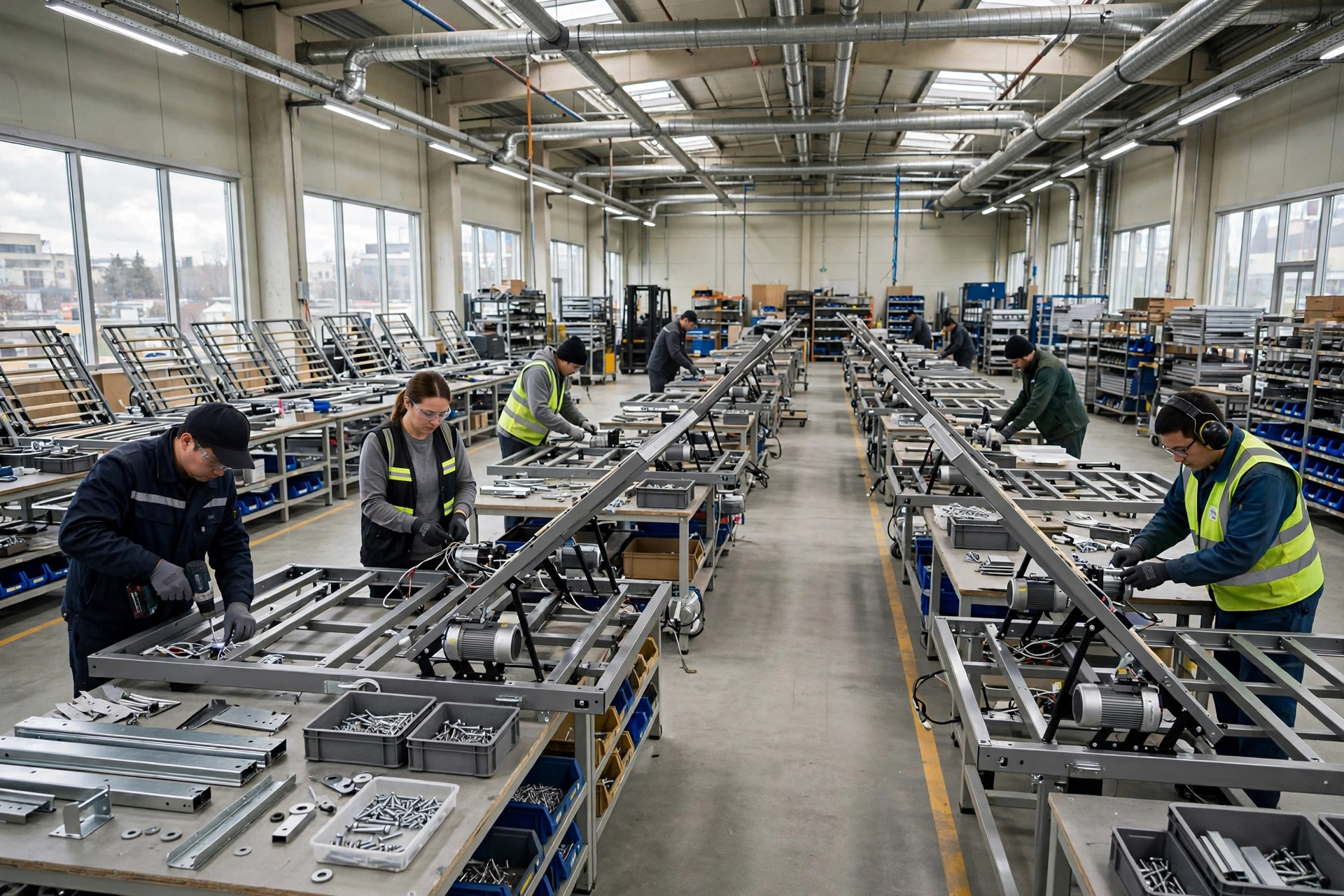
Cover image: an AI-generated illustration of a remote video factory audit over an adjustable-bed production line (shown for reference, not an actual product photo).
A video factory audit is a live, guided walkthrough of a supplier's facility conducted over video call — and it is the fastest way to separate real factories from traders. The direct answer: ask the supplier to show the production line, the testing laboratory, QC records, and the warehouse in one continuous, unedited call; verify staffing, floor area, and engineering claims against their catalog; and treat any refusal to go live on the factory floor as a failed audit. Sourcing teams that skip this step discover the truth at the worst possible moment — when field returns spike, a customs inspection raises questions about the declared manufacturer, or promised spare parts never materialize. This checklist gives you the questions to ask, the red flags that expose middlemen, and the technical spot checks that prove a factory's engineering claims. For the full supplier-evaluation framework, see our complete guide to sourcing adjustable beds from a China factory.
Why Video Audits Became the Standard First Gate
The pain point is not the cost of a plane ticket. It is the cost of signing with the wrong partner: a trader who outsources your adjustable bed frames to an unknown workshop, changes actuator brands between shipments without notice, and has no engineering team when your returns spike. By the time the pattern is visible, you have committed tooling, inventory, and a selling season.
A video audit costs one hour and filters out most bad fits before you spend anything else. It also protects good factories: a genuine manufacturer welcomes the call because the floor, the lab, and the records speak for themselves. Treat the video audit as a qualification gate, not a formality — pass it, and you earn the right to spend money on samples and on-site visits; fail it, and you move to the next candidate on your list.
Before the Call: Documents to Request
A serious supplier prepares documentation before the camera turns on. Request these items in advance so the live call can verify them rather than discover them:
- Business license showing the Unified Social Credit Code and registered address — confirm the address matches where the call will take place.
- Product catalog with model codes — specific models such as KD010-A2 or KD001-A3, with dimensions and functions stated, not generic lifestyle photography.
- Lab test summaries — cycle-test counts, testing protocols referenced, and the testing bodies involved (redacted reports are acceptable at this stage).
- QC documentation samples — an incoming-material checklist, an in-line inspection record, and a final inspection report from a recent shipment.
- Export and customer references — the number of markets served and customer types, without requiring confidential customer names.
If a supplier cannot produce these basics before the call, that is itself audit data. Reschedule rather than audit blind.
The Walkthrough: What to Verify on Camera
Insist on a continuous walkthrough: office, production line, testing lab, warehouse, in one unedited sequence. Staged, pre-recorded segments defeat the purpose. Use this table as your scoring sheet:
| Area | What to see | What it proves |
|---|---|---|
| Production line | Adjustable bed frames actually on the line: welding stations, upholstery work, motorized assembly | In-house manufacturing capability, not subcontracting |
| Testing laboratory | Cycle-test rigs running or recently run; recorded test counts (e.g., 10,000+ mechanism cycles, 15,000+ on KD001-B2) | Engineering validation exists and is measured |
| QC records | Incoming material checks, in-line records, final inspection reports on recent shipments | Quality is a documented system, not a promise |
| Warehouse | Raw materials stocked, finished goods staged, carton markings and labels readable | Real inventory and export-ready packing |
| Sample room | Golden samples of shipped models, revision history | Design control and change management |
At the warehouse, ask the guide to open one packed export carton on camera and read the carton dimensions aloud. Then run the basic container math yourself: carton CBM equals length times width times height in meters. A 40HQ container offers roughly 76 cubic meters of internal volume (industry reference — confirm carrier specifics). Divide usable volume by carton CBM for a theoretical unit count, then derate for stacking limits and handling gaps. If the supplier's quoted per-container quantity cannot survive this arithmetic, their logistics numbers are aspirational, not engineered. Request exact carton specs for your model rather than relying on catalog estimates.
The Trader Test: Red Flags That Rule Out Middlemen
Traders can rent showrooms; they cannot fake a factory floor. Watch for these signals during the call:
- Office-only video. The guide stays in a meeting room and "the factory is in another city." Real factories start the tour at the line.
- Catalog-to-line mismatch. The catalog shows adjustable beds, slat frames, mattresses, and sofas, but the line only assembles one product type. Ask which catalog items are made in-house and which are sourced.
- No testing equipment. No cycle-test rigs, no measurement instruments, no test records. A manufacturer of motorized beds without a testing area is not engineering anything.
- No QC records. "Our quality is very good" with no incoming, in-line, or final records is a claim, not a system.
- Refusal of unannounced areas. A genuine factory may have one restricted zone; a trader restricts the entire floor.
- Vague technical answers. The guide cannot name the motor brand, the mechanism cycle count, or the remote model codes. Compare this against suppliers whose engineers answer precisely.
One red flag is a data point; two is a pattern. Three ends the evaluation.
Technical Spot Checks That Prove Engineering Claims
General impressions are useful; engineering proof is better. During the call, request these live demonstrations:
- Full-range actuator test. Ask the guide to run a frame's head section from flat to its full confirmed angle (0–60° on adjustable bed frames) and the foot section through its range (0–40°), then back down. Watch for smooth, even motion and listen for abnormal noise — this is the缓升缓降 (soft start/stop) behavior a quality mechanism shows.
- Motor identification. Ask to see the control box or actuator label on camera and read the motor brand — for example OKIN or Haojiang — and confirm the same brand appears in the written specification for your model. Motor-brand substitution between sample and shipment is one of the most common silent downgrades in this category.
- Remote pairing. Ask which remote model code ships with the bed — real programs use specific codes such as SK.29.11, SK.34.09, or SK.50.17 — and have the guide demonstrate pairing and basic functions live.
- Golden sample reference. Ask to see the golden sample for a current production model and how mass-production units are compared against it. This single question reveals whether the factory runs a documented change-control process.
These checks take ten minutes and tell you more than a hundred brochure pages.
Scoring the Audit and Planning the Next Step
Score each area green, amber, or red. Green across production, testing, and QC earns the supplier a golden sample request or an on-site visit. Amber — for example, records exist but are thin — earns a written improvement plan with a deadline before you proceed. Red on any trader-test item ends the evaluation; do not let an attractive unit price override a failed audit.
After a successful video audit, the sequence is: request the golden sample, agree on the lab-test scope for your model, and put quality terms in writing before any purchase order. The video audit is the gate, not the destination. When you are ready to compare verified partners, our OEM/ODM services page outlines how factory-direct programs are structured, and the electric adjustable bed base line shows the product range these processes support.
How a Real Factory Handles a Video Audit
A capable OEM partner treats a video audit as routine. KCAI Intelligent Sleep (Dongguan Kangcai Intelligent Sleep Technology Co., Ltd.) has operated as a furniture manufacturer since 2004, running a 25,000-square-meter facility with more than 100 staff and serving over 100 global customers. Its OEM/ODM programs cover smart adjustable beds, slat frames, leisure chairs, mattresses, and upholstered beds for home, elderly care, institutional, hospitality, and project applications — backed by roughly 30 years of furniture R&D experience and multiple invention and utility model patents.
In a video audit, that profile translates into verifiable stops on the tour: adjustable bed frames on the production line, a testing area where lifting systems are evaluated through 10,000+ cycle durability tests (15,000+ on KD001-B2), QC records across incoming, in-line, and final stages, and a warehouse with export-ready packed cartons. Engineering questions get precise answers — confirmed adjustment ranges of 0–60° head and 0–40° foot on bed frames, OKIN and Haojiang motor platforms, and documented remote model codes — because the answers come from the factory's own specifications, not a trading desk. Products are evaluated under lab protocols associated with CNAS, SGS, TUV, and UL. When comparing candidates, use this audit checklist against every supplier and keep the one whose floor matches its claims.
Frequently Asked Questions
What is a video factory audit? A video factory audit is a live, guided walkthrough of a supplier's facility over video call. It lets buyers verify the production line, testing laboratory, QC records, and warehouse remotely before committing to an on-site visit or an order. Treat refusals to go live on the factory floor as a failed audit.
What should a furniture video factory audit cover? Cover five areas: production line (in-house welding, upholstery, assembly), testing laboratory (cycle test rigs and recorded test counts), QC records (incoming, in-line, and final inspection), warehouse (materials and packed cartons), and technical spot checks such as a live actuator demonstration through the full adjustment range.
How can a video audit expose a trader posing as a factory? Red flags include office-only video with no floor access, claims that the factory is in another city, catalogs showing product ranges absent from the line, no testing equipment, no QC records, and refusal to show unannounced areas. A real factory walks you to the floor without hesitation.
What technical spot checks should I request during a video audit? Ask for a live demonstration of the head and foot lift through the full confirmed range, the motor brand on the control box label, the remote model code paired to the bed, and the factory's golden sample with an explanation of how mass production is compared against it.
What comes after a successful video factory audit? A successful video audit earns the supplier an on-site visit or a golden sample request — it does not replace either. Use the audit to shortlist two or three verified factories, then proceed to sample evaluation, lab testing, and written quality agreements before any purchase order.
Verify before you commit
A one-hour video audit filters out traders, validates engineering claims, and gives you documented evidence of who you are really buying from — before samples, before visits, before purchase orders.
Path 1 — OEM/ODM custom development: If your audit shortlist includes a verified factory, bring your design brief and compliance requirements to our engineering team through our OEM/ODM services. To start a formal inquiry, send your specifications via our request-a-quote page and reference the audit criteria that matter most to your program.
Path 2 — Wholesale purchase of existing models: Prefer proven designs from an audited source? Source from our existing adjustable bed lineup — including the electric adjustable bed base series — with factory-direct wholesale terms. Share your target volumes and delivery window through request-a-quote, and we will confirm availability with a project-specific production schedule.