Every startup furniture brand hits the same wall in its first factory conversation: MOQ vs tooling cost. The minimum order quantity decides how much stock you must commit to; tooling cost decides how much you must spend before a single unit ships. Understand the trade-off and you can choose the right path — custom development or wholesale of existing models — without burning your launch budget. This guide explains both concepts, compares the two paths side by side, and gives you the questions to ask any bed factory before you sign.
What MOQ Actually Means in Bed Frame Sourcing
MOQ — minimum order quantity — is the smallest batch a factory will produce in one run. It is not arbitrary. For an adjustable bed frame, an MOQ reflects real production constraints: line setup time, material procurement batches, and the economics of running a factory floor. Even a factory with a 25,000 sqm facility and 100+ staff must schedule each run against other customers, and very small runs disrupt that schedule.
The key insight for startups: the headline MOQ number matters less than whether you can sell through it. A low MOQ on a product your market does not want is still expensive. Pressure-test your demand forecast before negotiating MOQ — the real risk is unsold inventory, not the number itself.
Also ask what drives the MOQ. Some factories set it by production line; others by material purchasing minimums, such as a steel batch or a fabric dye lot. If materials are the driver, you may find room to negotiate by accepting the factory's standard materials rather than custom specs.
What Tooling Cost Actually Covers
Tooling cost is the one-time engineering expense that turns a drawing into a producible product: new frame structures, production jigs and fixtures, and first-article validation — the samples and checks that prove a design can be built repeatedly at quality.
Material choices are where tooling cost diverges. An eco multi-layer board frame at 15mm or 18mm, a high-strength honeycomb aluminum panel, quality steel, optional fabrics, high-density foam — these are real engineering variables. Moving from an existing validated platform to a new combination of these materials is exactly what triggers new tooling: new fixtures, new validation runs, new quality checkpoints.
The critical distinction is between platform variants and ground-up redesigns. Platform variants — new fabric, minor dimensional changes, finish updates on an existing frame — typically require limited or no new tooling. A ground-up redesign with a different load path or hinge geometry requires substantial tooling. When a factory quotes you, ask explicitly which of the two your design falls into. That answer determines whether tooling cost is a footnote or a budget line.
Your Two Paths: Wholesale or Custom Development
Path A — Wholesale existing models. You buy the factory's production-validated models under your own brand, usually with your logo and packaging. Advantages: no tooling cost, faster market entry since lines are already tooled and validated, and proven reliability from real-world feedback. The trade-off is differentiation — you compete on brand, marketing, and service rather than a unique product. For most startups, that is the right sequence: prove you can sell first, then invest in custom product. Wholesale also gives you customer feedback that makes your eventual custom design far better informed.
Verified models buyers can wholesale include the KD010-A2 (split AI frame, 2000x900mm), the KD001-A3 (fixed, 2000x900mm), the KD008-A1 (multi-function, 2000x900mm), and the KD001-B1 (integrated electric mattress, 2000x1800x500mm). These are models already in production, tested under lab protocols associated with CNAS/SGS/TUV/UL, and sold to 100+ global customers. If you need a launch-ready electric adjustable bed base, these platforms are the fastest route to market.
Path B — OEM/ODM custom development. The factory builds to your specification, from light platform customization to a fully new frame from your brief. This is the path to differentiation, but it requires two commitments: tooling cost up front and MOQ discipline through the product's life. Custom development makes sense when your volume can absorb the MOQ, your design solves a real problem existing models do not, and you have an iteration plan — because the first run of a custom design almost always reveals improvements.
A practical middle path exists: platform-based customization. Many factories can adjust finishes, fabrics, dimensions, and branding on top of a validated frame platform, giving you differentiation without the full tooling bill. Ask where the boundary lies between "platform variant" and "custom tooling" — that boundary is the most useful piece of information in your first RFQ.
Decision Table: Which Path Wins for Your Situation
Be honest about which profile you actually match — the most expensive mistake in sourcing is picking the custom path with a wholesale-sized budget.
| Approach | When it wins | Trade-offs | Buyer profile |
|---|---|---|---|
| Wholesale existing models | Launch budget is tight; speed to market matters; demand not yet proven | Less differentiation; compete on brand and service | First-time founders, lean teams, brands testing a new channel |
| Platform-based customization | Need differentiation but cannot fund full tooling; modest volume | Design freedom bounded by the platform; unit cost sits in the middle | Brands with initial sales data and a clear positioning gap |
| Full custom tooling (OEM/ODM) | Proven demand, clear design advantage, volume to amortize tooling, iteration plan | Highest upfront cost; longest timeline; locks design before market feedback | Funded brands, established sellers expanding a winning category |
A common successful sequence is wholesale first, then platform customization, then full custom — each step funded by the revenue and market learning of the previous one.
The Questions to Ask Any Factory
Ask these before you ask for a quote:
- What drives your MOQ — line setup or material procurement? The answer tells you where negotiation room exists.
- What counts as a platform variant versus custom tooling on your floor? Get the boundary in writing, not just in conversation.
- How does a design change affect unit price? Understand the cost curve before you iterate the design.
- What validation applies to each path? Ask whether lab protocols associated with CNAS/SGS/TUV/UL testing cover existing models, platform variants, and custom designs equally.
- What does your sample process include? Samples are where design misunderstandings surface cheapest — before tooling, not after.
Factories with long R&D histories — around 30 years of furniture R&D and multiple invention and utility model patents, for example — can usually answer these precisely. Vague answers are a signal, not a detail.
How a Real Factory Accommodates Both Paths
A mature factory does not choose between wholesale buyers and custom-development buyers; it serves both, because both feed its production schedule. At Dongguan Kangcai Intelligent Sleep Technology Co., Ltd. (KCAI Intelligent Sleep) — operating since 2004, 25,000 sqm factory, 100+ staff, 100+ global customers — that dual capability works like this.
For wholesale buyers, the factory runs existing models — the KD010-A2, KD001-A3, KD008-A1, KD001-B1 platforms — on established lines with validated quality checkpoints. The buyer's path is short: confirm the model, agree on branding and finishes, and enter the production schedule.
For OEM/ODM buyers, the same factory applies roughly 30 years of furniture R&D and multiple invention and utility model patents to custom briefs, working from the same validated material palette — eco multi-layer board in 15mm or 18mm, high-strength honeycomb aluminum panel, quality steel, optional fabrics, high-density foam. All designs are tested under lab protocols associated with CNAS/SGS/TUV/UL before entering production.
Both paths run on real production lines, not a workshop corner. For the full sourcing picture, read our pillar guide on how to source adjustable beds from a China factory.
Frequently Asked Questions
What is MOQ when sourcing adjustable beds from a furniture factory? MOQ (minimum order quantity) is the smallest number of units a factory will produce for one order or one SKU. For startup brands, the decisive factor is not the headline number but whether the MOQ matches your sales forecast — a low MOQ you can sell through beats a low unit price tied to volume you cannot move.
What does tooling cost mean for a custom bed frame? Tooling cost covers the one-time engineering work before production starts: new frames, jigs, molds, fixture setup, and first-article validation. Changing finishes or fabrics on an existing platform keeps tooling limited; a ground-up frame redesign raises it substantially.
Should a startup brand choose custom tooling or wholesale existing models? Startups usually benefit from wholesaling proven existing models first. Verified platforms such as the KD010-A2, KD001-A3, KD008-A1, or KD001-B1 have already been through lab protocols and production validation, so you carry no tooling cost and launch faster. Move to custom tooling once sales volume and feedback justify the investment.
Can a startup get a low MOQ and a custom design at the same time? Partly. Many factories offer light customization on existing platforms — fabric options or minor dimensional adjustments — at manageable order quantities. Full custom tooling with a low MOQ is harder to combine, because one-time engineering must be amortized over fewer units, which usually shows up in the unit price.
What questions should I ask a factory about MOQ and tooling? Ask what drives their MOQ (line setup, material procurement, or packaging), what counts as custom tooling versus a platform variant, how design changes affect unit price, and what validation steps — such as lab protocols associated with CNAS/SGS/TUV/UL — apply to each path.
Start Your Inquiry: Custom Development or Wholesale
If you are a startup brand weighing MOQ against tooling cost, you do not have to decide alone. KCAI Intelligent Sleep works with brands on both paths — and the honest answer for your situation depends on your budget, timeline, and sales forecast.
Path A — OEM/ODM custom development: Send us your design brief, drawings, or reference samples. Our engineering team will review it, tell you honestly whether it falls into platform customization or full custom tooling, and outline the development process. Start with our OEM/ODM services page.
Path B — Wholesale existing models: If speed and proven reliability matter more than a unique design, wholesale one of our production-validated platforms — the KD010-A2, KD001-A3, KD008-A1, or KD001-B1 — under your own brand with your logo and packaging. Browse the electric adjustable bed base options to see what is ready today.
Tell us your target market and expected volume, and we will recommend the approach that protects your budget. For the full sourcing picture, start with our pillar guide on how to source adjustable beds from a China factory.
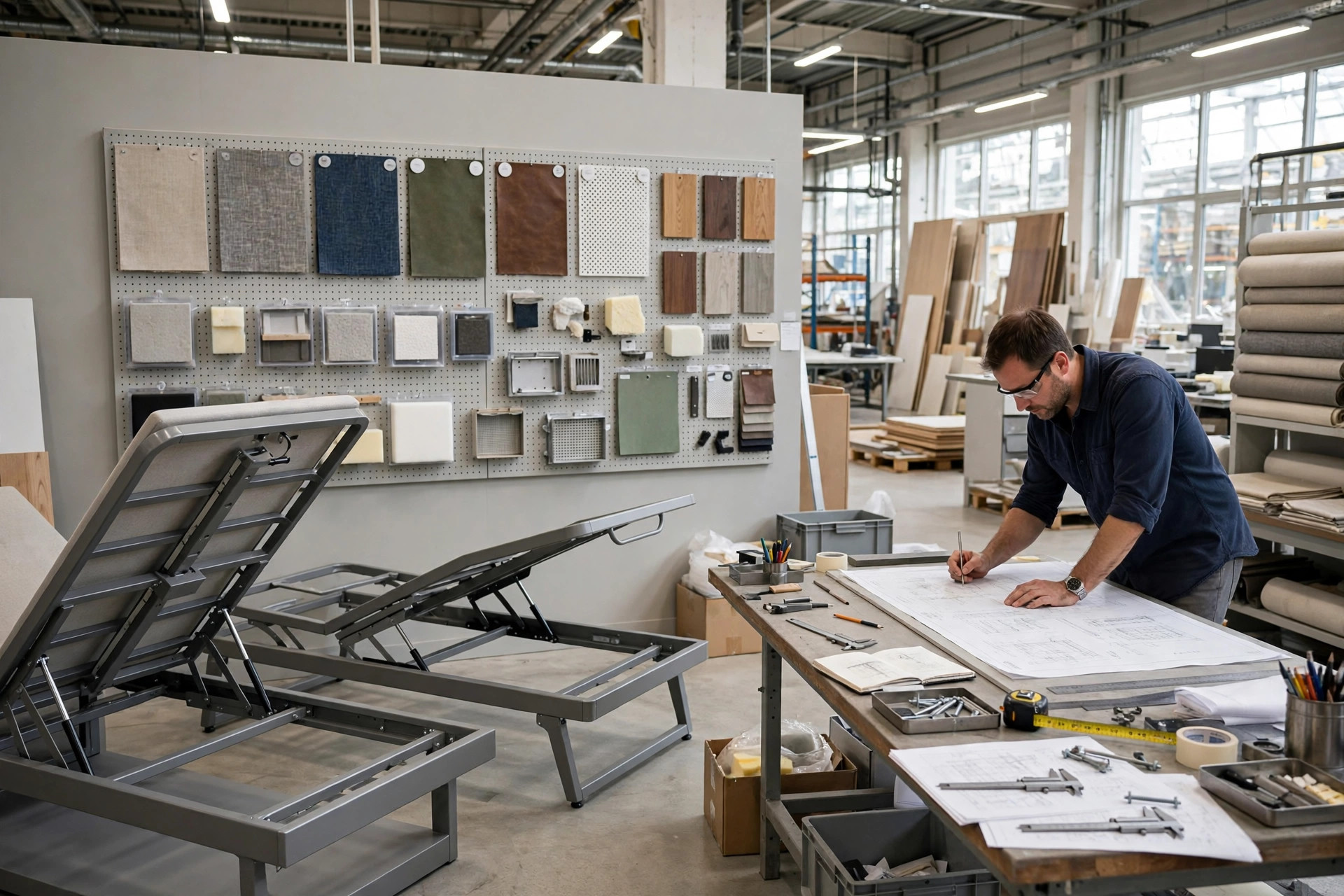
Cover image: an AI-generated illustration of a furniture factory sample room.