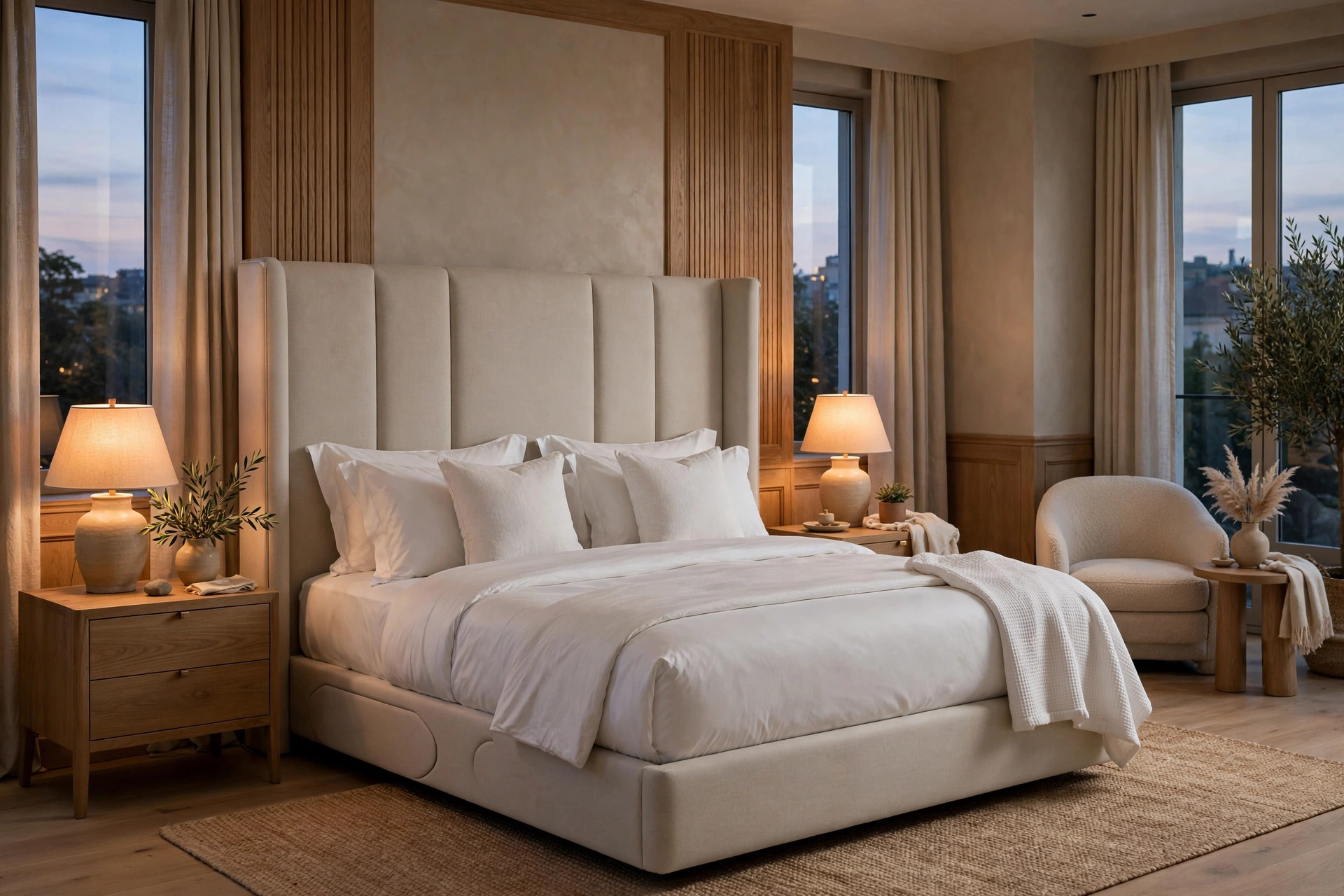
Cover image: an AI-generated lifestyle scene for illustration (not an actual product photo).
KR001 Upholstered Smart Bed (King Format): A Buyer's Deep Dive
Design-led furniture retailers are losing the premium bedroom customer to a structural problem: every adjustable bed on their floor looks like equipment. The mechanism-first open-frame base — grey steel, exposed actuators — cannot sit next to a tailored headboard without breaking the room's story. Hospitality procurement faces the mirror image: guest rooms need adjustable comfort to differentiate the sleep experience, but nothing in the adjustable category meets interior-design standards.
This article gives procurement teams a furniture-first evaluation framework for the KR001 upholstered smart bed from KCAI Intelligent Sleep — a 2000x1800mm king-format adjustable platform where upholstery design leads and the smart mechanism hides inside. You get a transparent spec table (confirmed parameters only), a king-versus-queen format strategy, upholstery spec discipline for container buying, a method for evaluating a concealed mechanism, hospitality checkpoints, the logistics math behind landed cost, and two sourcing paths: OEM/ODM customization or wholesale. Every number here is verified KCAI data; anything unconfirmed is flagged "request the official spec sheet."
Furniture-First vs. Mechanism-First: Two Products, Two Buyers
The adjustable bed market splits into two design philosophies, and confusing them is the most expensive mistake a buyer can make.
Mechanism-first products — open-frame adjustable bases — optimize for the mechanism: visible actuators, foldable steel frames, spec-sheet wins on angles and lift. They sell through mattress retailers and direct channels where the customer already decided they want an adjustable base. Their buyer evaluates motors, hinges, and remotes.
Furniture-first products like the KR001 optimize for the room. The adjustable platform is concealed inside an upholstered bed — tailored headboard, finished side rails, upholstery wrapping the structure. The customer sees bedroom furniture first and discovers adjustment second. The buyer is a different person: a furniture retailer's category manager, a hospitality procurement director, a distributor selling into design-driven channels. Their criteria differ too: headboard aesthetics, upholstery tailoring, how the piece photographs in a styled room, whether it passes the showroom "spouse test."
This distinction drives everything downstream: a mechanism-first base is evaluated like an appliance; a furniture-first upholstered smart bed like furniture containing an appliance. For a broader view of structuring adjustable-bed sourcing from Chinese factories, see our sourcing pillar guide.
The KR001 is the larger-format sibling of the KR004 (2000x1500mm) in KCAI's upholstered smart-bed series — king versus queen, segmented by room size and regional format preference.
Format Strategy: King (2000x1800mm) vs. Queen (2000x1500mm)
Format choice is a market-entry decision, not a quality decision. The KR001's 2000x1800mm king footprint and the KR004's 2000x1500mm queen footprint address structurally different demand.
King format dominates where bedrooms are large and the bed is a statement piece: North American master bedrooms, Middle Eastern villas, and the premium European segment where the bed anchors the room. The upholstered king photographs as the hero of the bedroom set, and the retailer's average order value justifies the floor space.
Queen format (2000x1500mm) fits smaller urban bedrooms and more price-sensitive tiers: dense Asian metros, European city apartments, mid-range hospitality where room dimensions cap bed size. The KR004 serves this buyer.
For distributors, the question is portfolio coverage; for retailers, floor-space economics: one king-format hero (KR001) plus one queen-format volume piece (KR004) covers the showroom's adjustable story. Match each to your market's room sizes — not "which is better." For per-model geometry beyond the footprints here, request the official spec sheet; angles confirmed for KCAI's bed-frame series do not automatically apply to the KR series.
Structured Spec Table: Confirmed KR001 Parameters vs. Market Risks
Procurement authority comes from transparency: state what is confirmed, and name the risks unconfirmed alternatives carry.
| Evaluation dimension | KR001 (confirmed) | Common market risk in this category |
|---|---|---|
| Product series | Upholstered smart bed series (KR series) | "Smart bed" label on a standard bed with a bolted-on vibrator — no integrated platform |
| Footprint | 2000x1800mm, king format | Footprint stated without upholstery; rails add undeclared width |
| Design philosophy | Furniture-first: upholstery leads, mechanism concealed | Mechanism-first base with an upholstered slipcover added as an afterthought |
| Sibling format | KR004 at 2000x1500mm for queen-format markets | Single-format supplier forces one SKU across markets |
| Motor brands | German OKIN and Haojiang motors | Unspecified "OEM motor" — no brand, no traceability, no service path |
| Motor characteristics | Soft start/stop, low noise, energy saving | Harsh start/stop shaking the headboard; audible in a quiet bedroom |
| Control options | Wired/wireless remote, Sleepace system, APP/mini-program, voice control, Siri (configurable options) | Single IR remote only; no smart-home path |
| Remote models (factory range) | SK.29.11 / SK.34.09 / SK.50.17 / SK.27.11 / SK.27.19 / SK.51.11 / SK.51.19 / SK.67.09 | Remote model unlisted — no replacements in year three |
| Construction materials (factory capability) | High-density foam, 15/18mm eco multi-layer board, high-strength honeycomb aluminum panel, quality steel | Unspecified board and foam — sagging rails, delamination within two seasons |
| Fabric | Fabric options available as configurable options | Single stock fabric, no colorway program, no lot control |
| Company backing | KCAI Intelligent Sleep, since 2004, 25,000 sqm, 100+ staff, 100+ global customers, ~30 years furniture R&D, multiple invention and utility model patents | Trading-company seller: no factory, no R&D record, no patents |
| Testing association | Lab testing associated with CNAS, SGS, TUV, UL | No third-party testing reference at all |
| Adjustment geometry | Adjustable smart-bed platform; request the official spec sheet for per-model geometry | Angles borrowed from a different product line applied to the upholstered model |
Two discipline notes. First, angles: confirmed angle ranges belong to the bed-frame series, not the KR upholstered series — never transfer them across. Second, teardown-style benchmark values circulating in the market (thrust ratings, decibel claims, wall thicknesses, coating microns, load ratings, container counts, standard numbers) are industry references, not KCAI specifications. Never accept them as KCAI's; verify against KCAI's official documentation.
Upholstery Spec Discipline at Container Scale
On a furniture-first product, upholstery is not trim — it is the product the customer sees. And upholstery is where container-quantity buying most often fails, because the golden sample that won the order is not the production that ships six months later. Lock four variables on the golden sample before production, with tolerances in the QC agreement:
1. Fabric identity and lot control. Fabric options are configurable on the KR001 — but "available" is not a specification. Lock the exact fabric: supplier, article number, composition, weight, colorway. Then lock lot-to-lot color tolerance (a ΔE value or physical swatch range). Two production lots with visibly different dye lots become two visibly different products on a retailer's floor. Request the official spec sheet for the current fabric program; never accept a fabric name invented by a sales rep.
2. Foam feel versus golden sample. High-density foam is confirmed in KCAI's construction capability — but that describes a material class, not a feel. Headboard hand-feel, rail firmness under pressure, edge recovery: specify these comparatively ("matches golden sample dated X"), and require the factory to retain the golden sample under controlled conditions for the run's duration.
3. Stitching consistency. Stitch pattern, density, seam tension, and piping alignment are what a design retailer's customer inspects at arm's length. Across a container of upholstered beds, stitching drift is the most common visible defect. Define the stitch specification from the golden sample and require in-line inspection, not just end-of-line sampling.
4. Colorway program. If you develop exclusive colorways through the OEM/ODM path, the colorway becomes IP worth protecting: exclusivity terms, MOQs per colorway, and ownership of the developed article belong in the agreement.
The principle: the mechanism is concealed, so upholstery carries the entire perceived-quality burden. Spec it with the rigor you apply to the motor — the customer judges it first.
Evaluating the Concealed Mechanism: Trust, Then Verify
The central tension of furniture-first adjustable beds: the mechanism you pay for is the part you cannot see. The KR001 conceals its platform inside upholstery — exactly what the design customer wants, and exactly what makes procurement harder. Four ways to evaluate it:
Brand traceability first. KCAI confirms German OKIN and Haojiang motors — named brands with service networks and parts channels. This is the single most important mechanism data point on an upholstered bed. An unnamed "OEM motor" inside upholstery is a warranty time bomb: when it fails in year two, there is no brand to call. Get the motor brand in writing on the quotation and confirm it matches the spec sheet.
Characteristics, not just presence. Confirmed characteristics — soft start/stop, low noise, energy saving — matter more in an upholstered bed than in an open-frame base, because upholstery couples vibration to the headboard. A harsh-start actuator that is merely annoying on steel becomes a headboard-shaking defect on an upholstered bed. Soft start/stop is a furniture-quality feature here, not just a comfort feature.
Service access by design. Upholstery must conceal the mechanism, not entomb it: how does a technician reach the actuator and control box without destroying the upholstery? Are there access panels? A bed with no service access turns every motor failure into an upholstery replacement — put this on your RFQ.
Match controls to your market. The confirmed range — wired/wireless remote (factory models include SK.29.11, SK.34.09, SK.50.17, SK.27.11, SK.27.19, SK.51.11, SK.51.19, SK.67.09), Sleepace system, APP/mini-program, voice control, Siri — is configurable. Hospitality buyers may want lockable, simplified controls; retail buyers may want the full smart-home story. Do not pay for a control BOM your market will not use.
Respect the positioning boundary. The KR001 supports lifestyle ergonomics — posture alignment, home-care elevation support, an anti-snore head incline. These may help everyday comfort, but the product is not a medical device and not a substitute for medical treatment; for serious conditions, consult a doctor. Never position it as a medical or hospital bed — the regulatory exposure is not worth any short-term gain.
The Hospitality Procurement Lens
Boutique hospitality is the KR001's natural second market, but hotel procurement runs on criteria retail buyers never consider:
Housekeeping-grade durability. A hotel bed is adjusted and cleaned around daily — by staff, not owners. Confirm fabric cleanability under commercial protocols and get the factory's recommended maintenance procedure in writing. Commercial-grade upholstery execution is a factory-capability question: KCAI's 25,000 sqm base and ~30 years of furniture R&D are the relevant evidence.
Standardized controls. Fifty rooms need fifty identical control experiences — lock one configuration for the whole property order.
Service logistics. Hotels cannot ship a bed back to China for a motor issue. Confirm the service procedure and spare-parts availability for the named motor brands (OKIN, Haojiang) — contact us to request the factory-audit checklist.
Aesthetic longevity. Every guest photographs the room. Tailored upholstery sharp in year one and tired in year three destroys review photos. Evaluate foam recovery and fabric wear against the property's replacement cycle.
Logistics Math and Pre-Shipment QC
The KR001's 2000x1800mm footprint makes it volume-heavy, and volume — not weight — drives ocean freight. Upholstered beds do not flat-pack like open-frame bases; the headboard and rails create large, mostly-air cartons. Plan containers on cubic meters, not unit count.
The CBM method. Per carton: CBM = length (m) × width (m) × height (m); sum the shipment. A 40HQ offers roughly 76 m³ of usable volume as an industry reference — divide total CBM by per-carton CBM for the theoretical unit count.
Request exact carton specs. No carton dimensions or units-per-40HQ figures appear in this article deliberately — carton engineering (knock-down vs. assembled headboard, nesting, protective packaging) determines the real number and varies by configuration. The correct RFQ line: "request exact carton specs (dimensions, weight, packing method) before container planning."
The king-format multiplier. 2.000 × 1.800 m (KR001) versus 2.000 × 1.500 m (KR004): 20% more footprint area before packaging, and upholstered packaging scales worse than linearly because the headboard is the bulkiest carton. When freight rates spike, the per-unit freight delta between king and queen widens — price margins against volume-based freight and re-run the math every season. Raise packaging optimization during OEM/ODM scoping; a headboard carton 10 cm thinner can add multiple units per 40HQ.
Pre-shipment QC — six checkpoints. For a concealed-mechanism product, inspect what the customer sees and what they cannot: (1) upholstery vs. golden sample — fabric article, colorway, stitch density, seam tension, foam feel, sampled across production lots; (2) mechanism function — full articulation cycle per inspected unit, soft start/stop, noise in a quiet room, remote pairing; (3) structural integrity — rail joints, headboard mounting, leg attachment, with confirmed materials (high-density foam, 15/18mm eco multi-layer board, honeycomb aluminum panel, quality steel) traceable in the BOM; (4) control verification — shipped remote model matches the order; (5) packaging audit — protective packaging on upholstery corners and headboard faces.
Two Sourcing Paths: OEM/ODM Customization or Wholesale
Path 1 — OEM/ODM customization. Choose this when the KR001's furniture-first concept is right but the execution must be yours: exclusive upholstery colorways, headboard profile modifications, a locked control configuration for a hotel property, container-optimized packaging, or private-label branding. KCAI's OEM/ODM operation — ~30 years of furniture R&D, 25,000 sqm of manufacturing, 100+ global customers — develops the product against your golden sample. Start with the OEM/ODM program, then submit requirements through request a quote. Contact us to request the RFQ Excel template, factory-audit checklist, and CAD drawing support — provided on request, never promised as downloads.
Path 2 — Wholesale of the existing model. Choose this when speed beats exclusivity: the KR001 as specified — 2000x1800mm king-format upholstered smart bed, concealed adjustable platform, named-brand motors, configurable controls — ordered in container quantities for cost-effective bulk supply. Factory-direct sourcing of a finished, tested product: faster to market, lower development overhead. Submit volume requirements through request a quote, and request the official spec sheet to confirm the exact configuration — fabric program, control set, carton specs — before committing container space.
Either path starts with the discipline this article argues for: confirmed specifications in writing, a golden sample governing production, and logistics math done before the purchase order. The KR001 rewards buyers who evaluate it as what it is — bedroom furniture that happens to adjust, built by a factory with the R&D depth and scale to stand behind both the furniture and the mechanism inside it.