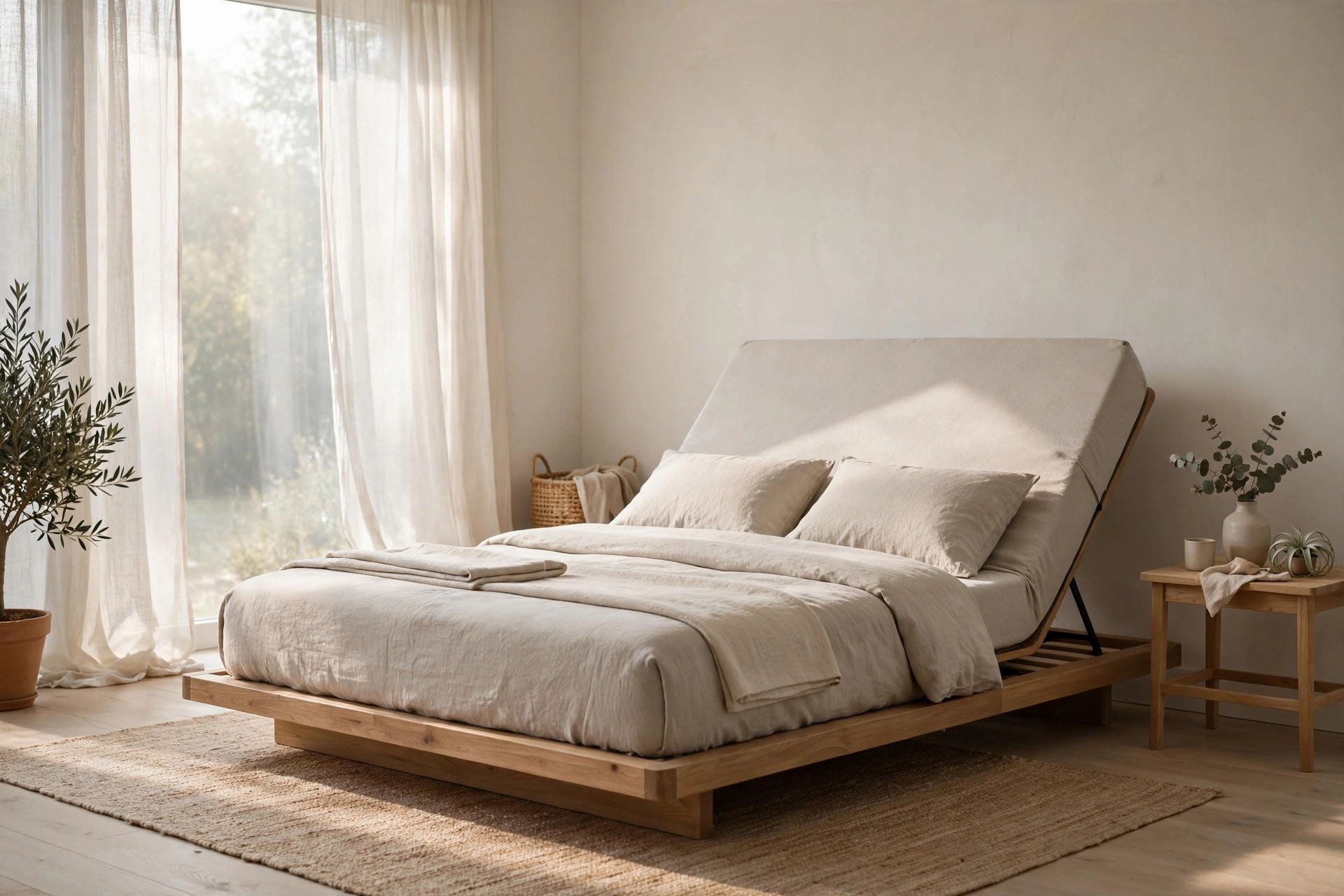
Cover image: an AI-generated lifestyle scene for illustration (not an actual product photo).
Dealers want adjustable-sleep revenue without the freight and warehouse pain of full-size bases. End users want an elevated, anti-snore head incline, but they balk at throwing out a perfectly good bed. That mismatch — a channel that can only sell what ships economically, and a consumer who will not replace their whole bedroom — is where most adjustable-bed programs stall. The KD004-B1 from KCAI Intelligent Sleep answers it with an enclosed split-head electric mattress: a self-contained adjustable surface, 2000 × 900 × 280 mm, that sits directly on the customer's existing flat bed board.
This article is the engineering deep-dive on that architecture: the drop-in use case, what "fully-enclosed split-head" means mechanically, confirmed specifications against common low-spec market risks, the motor and control platform, configurable layer options, a worked CBM method for container planning, and the QC checkpoints a procurement team should apply. A companion buyer-guide article on the KD004-B1 already exists on this site; this piece goes one level deeper into the engineering.
1. The Drop-In Use Case: Adjustable Revenue Without a New Base
The drop-in story is simple to state and difficult to engineer: the customer keeps their bed, and the mattress does the moving. The KD004-B1's 2000 × 900 mm footprint lands in twin-size territory, matching single-bed frames and platforms across Western markets. With the mechanism fully enclosed inside the mattress body, there is no separate base to position or level — the unit drops onto a flat bed board or solid platform and is ready.
For dealers and e-commerce sellers, three consequences follow. First, the ticket is lower than a base-plus-mattress bundle, which shortens the decision cycle and opens a mid-price adjustable SKU. Second, freight and warehousing behave like mattress freight — one SKU, one carton family, no steel legs or headboard brackets to track as accessories. Third, the objection curve flattens: the buyer is upgrading their sleep surface, not remodeling their bedroom.
Home-care and lifestyle-ergonomics channels gain a parallel benefit: programs selling home-care elevation support or anti-snore head incline can position a product that requires no installation visit — with health expression kept to the lifestyle register, never as medical treatment. Serious conditions should always be discussed with a doctor.
The boundary condition matters: the drop-in case assumes a flat, rigid support — a solid platform, closely spaced slats, or a flat bed board. Sellers should state the support requirement explicitly to keep return rates down.
2. Anatomy of the Fully-Enclosed Split-Head Architecture
"Split-head" means the head section articulates independently. In the KD004-B1, the backrest travels 0–55° and the leg rest 0–35°, driven by the enclosed mechanism, while the center and foot zones stay put.
"Fully-enclosed" describes how that mechanism is packaged: the articulation hardware lives entirely inside the mattress body, sealed behind the side panels — with a side height of 250 mm — rather than sitting exposed beneath a frame. Three engineering effects follow:
- Mechanism protection. The enclosure keeps the drive train and hinge points away from dust, bedding ingress, and casual contact. In warehouse and showroom environments with repeated handling, the sealed silhouette meaningfully reduces the cosmetic and mechanical damage exposed linkages collect.
- Pinch-point discipline. Split-head mechanisms have a known failure mode in low-spec builds: the articulating head section traps or pinches the surrounding fabric at the hinge line. A properly engineered enclosure manages fabric travel at the fold, keeping clearances consistent across the full 0–55° sweep.
- Aesthetics. The unit reads as a mattress, not as machinery with a mattress on top. For lifestyle and home-care positioning, that visual simplicity shortens the explanation the sales channel has to give.
The 2000 × 900 × 280 mm dimensions are the datum every downstream calculation starts from: the footprint determines which bed boards it fits, the 280 mm height determines guard-rail and fitted-sheet clearance, and the footprint volume feeds the container math in section 6.
3. Confirmed Specifications vs. Common Low-Spec Market Risks
The table below contrasts what KCAI confirms for the KD004-B1 platform against the risks in low-spec market alternatives. Anything not confirmed here is, by policy, "available as configurable options" or "request the official spec sheet" — this article does not fill gaps with guesses.
| Parameter | KD004-B1 confirmed | Low-spec market risk |
|---|---|---|
| Overall dimensions | 2000 × 900 × 280 mm | Non-standard footprints that fit no common bed board |
| Side height | 250 mm | Thin sidewalls that expose the mechanism |
| Backrest articulation | 0–55° | Unbranded actuators, undocumented ranges |
| Leg rest articulation | 0–35° | Leg sections that bind or drift under load |
| Motors | German OKIN and Haojiang | Unspecified motor brand, no service history |
| Motion character | Soft start/stop, low noise, energy saving | Jerky starts, audible gear noise at night |
| Controls | Wired/wireless remote, Sleepace, APP/mini-program, voice control, Siri | Single basic remote, no ecosystem integration |
| Preset modes | Deep sleep, zero-gravity, memory (one-key reset), anti-snore, vibration massage, reading, movie | Manual positions only |
| Remotes | SK.29.11 / SK.34.09 / SK.50.17 / SK.27.11 / SK.27.19 / SK.51.11 / SK.51.19 / SK.67.09 | Non-replaceable proprietary controllers |
| Enclosure | Fully-enclosed split-head design | Open mechanisms; fabric pinching at the hinge |
| Company backbone | Since 2004, 25,000 sqm, 100+ staff, 100+ global customers, ~30 years furniture R&D, invention + utility model patents, lab testing associated with CNAS, SGS, TUV, UL | No factory traceability, no test-lab association |
Two rows deserve explicit attention. The motor brand is the fastest filter against anonymous-drive-train builds that drive warranty claims. The enclosure is where low-spec split-head designs fail first — seam stitching strength and hinge-line fabric management belong on the physical sample checklist in section 7.
Parameters deliberately not stated here — motor thrust, acoustic output, steel wall thickness, coating thickness, maximum rated load, exact carton dimensions, units per container — are unconfirmed. Benchmark-style figures sometimes quoted in teardown discussions (for example 6000N thrust or 45dB noise claims) are industry references, not KCAI specifications, and must never be written into a purchase order as factory data. Request KCAI's official spec sheet and treat it as the binding document.
4. Motor and Control Platform Engineering
The drive platform is the engineering core of any articulating sleep product. Motors come from German OKIN and Haojiang, with three confirmed motion characteristics: soft start/stop, low noise, and energy saving. Soft start/stop matters more in a mattress format, where the sleeper is in direct contact with the moving surface — a hard start becomes a perceptible jolt through 280 mm of mattress. Low-noise operation matters because the bedroom is the quietest room in the house; energy saving keeps standby draw compatible with always-plugged bedroom installations.
The control layer spans wired and wireless remote options, the Sleepace sleep system, APP and mini-program control, voice control, and Siri integration. That range is a segmentation tool: e-commerce programs can lead with APP and voice control; home-care channels with the large-button remote families (SK.29.11 through SK.67.09); contract programs can standardize on one remote family for spares commonality. Confirm exactly which control options ship with your configuration — remote family, language firmware, pairing behavior — on the official spec sheet before writing the listing.
The preset-mode set — deep sleep, zero-gravity, memory with one-key reset, anti-snore, vibration massage, reading, and movie — converts the 0–55° / 0–35° mechanical ranges into sellable positions. Zero-gravity and anti-snore carry the lifestyle-ergonomics positioning: an elevated-torso position that may help nighttime comfort for some users, presented honestly, never as a cure or treatment.
5. Mattress Layer Build Options
An enclosed split-head mattress is only as good as the layers the mechanism moves. KCAI's platform offers a configurable stack: knitted fabric three-in-one quilting for the ticking, natural latex, high-density foam, independent pocket springs, 3D breathable material, and — on some models — graphene elastic cotton.
Knitted three-in-one quilting gives the ticking its hand feel and seam strength at the enclosure panels. Natural latex and high-density foam are the pressure-relief pair: latex for responsive contour, foam for the support core that must hold its shape across the hinge line without developing a permanent crease at the fold. Independent pocket springs, where configured, add ventilation and point-elastic response — requiring disciplined pocket construction where the split-head seam crosses the spring unit. 3D breathable material targets heat and moisture management; graphene elastic cotton is the specialty-fabric option.
Spec the layer stack against the channel, not a wish list. Confirm your exact stack, and its effect on compressed height and weight, on the official spec sheet before costing freight.
6. Packaging and Container Math: A Worked CBM Method
Container economics decide whether a drop-in mattress program survives its first reorder, so this section works the method openly. Start with the footprint volume — the confirmed unit dimensions, not the carton, as a first-pass bound:
2.000 m × 0.900 m × 0.280 m = 0.504 m³ per unit.
That 0.504 m³ is the theoretical minimum space the product occupies. Real planning then layers on the carton envelope, the stacking pattern and height limit, and palletization. A 40HQ container offers approximately 76 m³ of internal volume — an industry reference figure, not a KCAI specification — giving a hard ceiling of 76 / 0.504 ≈ 150 units before packaging, stacking, or pallet losses. Real load counts come in below that ceiling; the gap is exactly what the carton's engineering determines.
That gap is where procurement should focus. A well-engineered carton protects the hinge line and enclosure seams in transit while keeping the dimensional penalty tight. Ask for the exact carton dimensions, the stacking orientation and its tested limit, whether the unit ships palletized or floor-loaded, and the validated units-per-40HQ figure. Do not accept a load count derived from footprint volume alone; it bounds the problem, it is not a freight quote. For anything not yet published, the correct language is "request exact carton specs" — KCAI's team can supply the CBM calculation for your target container on request (lead-magnet assets such as the CBM calculator are provided through the RFQ process, not as downloads).
Two downstream effects of the mattress format are worth naming. First, the damage profile is a mattress damage profile — corner crush, seam abrasion, puncture — which freight forwarders and insurers already price as a known category, unlike the bent-linkage and scratched-coating claims that follow adjustable bases. Second, returns logistics are mattress returns logistics: compressible, re-baggable, storable in standard racking, which keeps reverse-logistics cost inside the channel's existing playbook.
7. QC Checkpoints for Procurement
Run the same inspection sequence on every candidate sample — these checkpoints target the architecture's known failure modes:
- Hinge-line fabric management. Cycle the backrest through its full 0–55° range and watch the ticking at the split-head seam. Fabric must travel cleanly with no pinching, puckering, or crease memory after repeated cycles — the number-one sample test for this architecture.
- Enclosure seam strength. Inspect the 250 mm side panels and stitching at corners and the hinge crossover. Weak enclosure stitching shows up in month three, not day one.
- Motor identity and motion character. Verify the specified OKIN or Haojiang drive units. Run start/stop transitions under load — the confirmed character is soft start/stop and low noise. Any grinding, hesitation, or side-to-side asymmetry fails the sample.
- Control pairing and presets. Pair every control option in your configuration and exercise each preset mode, including one-key reset. Confirm remote model numbers match the SK-series families on your order.
- Dimensional truth. Measure the unit: 2000 × 900 × 280 mm, side height 250 mm. Confirm the footprint against target bed boards and the 280 mm height against guard-rail and fitted-sheet clearances.
- Layer stack verification. Open the inspection sample and confirm the configured layers match the bill of materials. Photograph the cross-section for the file.
- Carton and transit test. Request the exact carton specs, then insist on a drop-and-vibration transit test of a packed unit, with the hinge line and enclosure corners photographed before and after.
Run the same sequence on the golden sample and on first-article production. Enclosed mechanisms hide their defects well — that is the point of the enclosure — so inspection discipline has to be proportionally stricter. For actuator-evaluation background behind several of these checkpoints, see our adjustable bed actuator engineering buyer's guide.
8. Start Sourcing: Two Paths
If the drop-in use case fits your channel — dealers wanting a lower-ticket adjustable SKU, e-commerce sellers who need mattress-simple logistics, or home-care and lifestyle-ergonomics programs selling elevation support without an installation visit — there are two ways to work with KCAI Intelligent Sleep.
Path 1 — OEM/ODM customization. Configure the KD004-B1 platform to your program: layer stack, ticking and enclosure finish, control ecosystem (remote family, Sleepace, APP/mini-program, voice, Siri), preset modes, and private-label packaging. Start from the OEM/ODM program overview, then request a quote with your target volumes and configuration — the factory will return the official spec sheet, the exact carton specs and CBM calculation for your container, plus the RFQ template, factory-audit checklist, and CAD drawings on request through the RFQ process.
Path 2 — Wholesale of existing models. Buy the KD004-B1 as a finished, factory-configured SKU for container-optimized bulk supply. Request a quote with your destination port and target quantities, and the sales team will confirm availability, lead time, and the validated units-per-container figure for your freight plan.
KCAI Intelligent Sleep — Dongguan Kangcai Intelligent Sleep Technology Co., Ltd. — has built adjustable sleep products since 2004 from a 25,000 sqm facility, serving 100+ global customers with ~30 years of furniture R&D, multiple invention and utility model patents, and lab testing associated with CNAS, SGS, TUV, and UL. The KD004-B1 enclosed split-head mattress is that factory platform expressed as a drop-in: the customer's bed stays, the sleep surface starts moving.